
SEO for menopause treatment clinics means ranking when women search for perimenopause symptoms or hormone therapy (HRT or MHT). It also means showing up for “menopause doctor near me” and for online menopause visits in their state. The best first move is a set of symptom and treatment pages written to match the new FDA hormone therapy labels. After that, put certified menopause practitioner (MSCP) proof on every clinician page. Those two jobs shape most rankings, so we built this guide around them.
We researched menopause program pages from health systems and telehealth clinics. We also read the FDA’s labeling notices, The Menopause Society’s credential rules and long-term study data on hot flashes. Every fact here comes from a public page we opened, and the keyword sets and plans are our own.
Map the Years-Long Search Path From First Hot Flash to Treatment
Hot flashes and night sweats lasted a median of 7.4 years in the Study of Women’s Health Across the Nation (SWAN). That study followed 1,449 women with frequent symptoms and was published in JAMA Internal Medicine in 2015. Women whose symptoms began before or early in perimenopause had them for more than 11.8 years. So a menopause patient may search for answers for close to a decade.
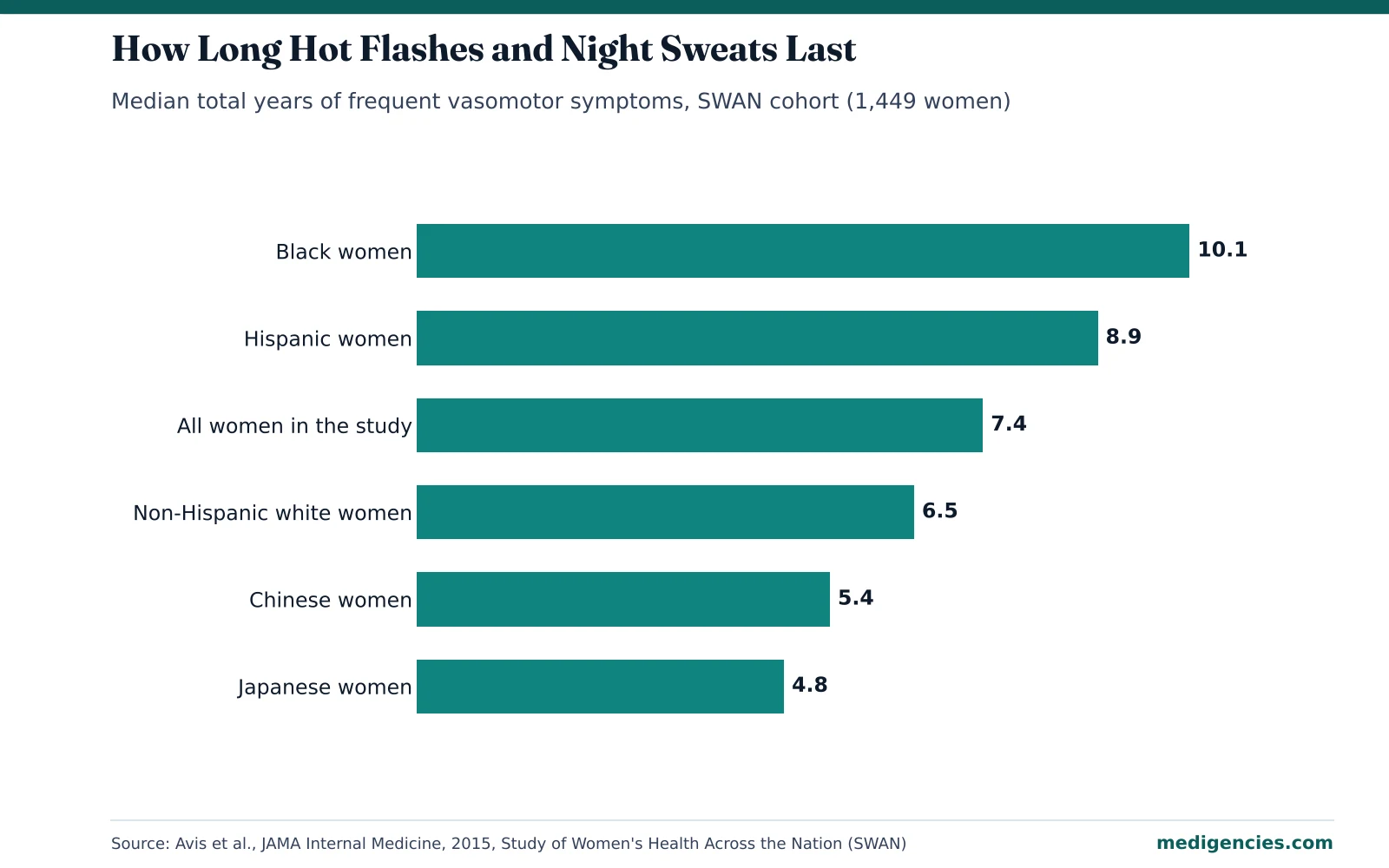
The same study found wide gaps between groups. For instance, Black women reported a median of 10.1 years of symptoms, and Hispanic women 8.9 years. By contrast, the median was 6.5 years for non-Hispanic white women. We ran the numbers on it. Black women’s median runs about 55% longer than white women’s, and about twice as long as Japanese women’s (4.8 years).
What does that mean for a clinic? First, symptom pages keep earning visits for years, so they deserve the most care. Second, content and photos should reflect the women who live with symptoms longest. Also, a Spanish version of your top symptom pages reaches a group with long symptom spans.
Sort Menopause Searches by Stage and Question
Menopause searches follow the body’s timeline. A woman of 43 types “irregular periods and anxiety.” A few years later, she types “night sweats treatment.” Then she compares “estrogen patch vs pill” and looks for a doctor. We compiled this keyword set from those stages. Each row maps to one page type.
| Stage | Example searches | Page type | Example title tag |
|---|---|---|---|
| Early signs | perimenopause symptoms at 42; irregular periods in 40s; can perimenopause cause anxiety | Perimenopause page | Perimenopause Symptoms and Care in [City] |
| Hot flashes | how to stop hot flashes; night sweats treatment; non-hormonal hot flash medicine | Hot flash and night sweat page | Hot Flash and Night Sweat Treatment in [City] |
| Sleep, mood and focus | menopause insomnia; menopause brain fog; menopause anxiety help | One page per symptom | Menopause Sleep Problems: Causes and Treatment |
| Vaginal and urinary | vaginal estrogen cream; painful sex after menopause; GSM treatment | Genitourinary syndrome page | Vaginal Dryness and GSM Treatment at [Practice] |
| Hormone therapy choice | is HRT safe; HRT black box warning removed; estrogen patch vs pill; HRT after 60 | HRT/MHT page and FDA update article | Hormone Therapy for Menopause: Options and Label Facts |
| Bone and heart | bone density test after menopause; menopause heart health | Long-term health page | Bone and Heart Care After Menopause |
| Finding a clinician | menopause doctor near me; menopause specialist [city]; certified menopause practitioner near me | Location and clinician pages | Menopause Specialist in [City], MSCP Certified |
| Telehealth | online menopause doctor; menopause telehealth [state]; HRT prescription online | State pages | Online Menopause Care in [State] |
| Cost and coverage | does insurance cover menopause visits; HRT cost without insurance; menopause clinic Medicare | Pricing and insurance page | Menopause Visit Costs and Insurance at [Practice] |
| Special cases | early menopause at 38; surgical menopause after hysterectomy; menopause after breast cancer | Special-situation pages | Early and Surgical Menopause Care in [City] |
Next, open Google Keyword Planner and choose “Discover new keywords.” Paste five seed terms from one row. Then set the location to your office counties, or to the states where your clinicians hold licenses. Small accounts see volume as ranges. Still, ranges show whether “HRT” or “hormone therapy” gets more searches in your area. Our roundup of healthcare SEO tools covers other free Google tools for this step.
Match the Names Patients Use for Hormone Therapy
Patients use several names for the same treatment. Some type “HRT,” some type “hormone replacement therapy” and clinicians write “MHT.” FDA uses both terms and treats menopausal hormone therapy (MHT) and hormone replacement therapy (HRT) as the same thing. So use the patient term in the title tag, then define MHT in the first paragraph.
Then check Search Console. In the Performance report, filter queries that contain “hrt,” “hormone” or “estrogen.” Sort by impressions. If “bioidentical” shows up often, write a page that explains the term plainly. However, keep that page factual, because compounded drugs are not FDA-approved.
Rewrite Hormone Therapy Pages Around the New FDA Labels
FDA asked makers of menopausal hormone therapy to change their labels in November of last year. Then, on February 12, 2026, FDA approved the first six updated labels. Those six covered all four product types, including vaginal estrogen. More label approvals may follow, so labels will differ by product for a while.
The changes are specific, so copy them exactly. We read FDA’s notice line by line and turned each change into page guidance.
| Label item | FDA’s requested change | What your page can say |
|---|---|---|
| Boxed warning on heart disease, breast cancer and probable dementia | Remove this language from the boxed warning | FDA asked makers to remove these risks from the boxed warning, and updated labels are rolling out product by product. |
| Boxed warning on endometrial cancer | Keep it for systemic estrogen-alone products; remove it elsewhere | Systemic estrogen-alone products still carry a boxed warning about endometrial cancer. |
| Heart disease and breast cancer warnings | Keep them in the labeling | Labels still list heart disease and breast cancer risks in the warnings section. |
| “Lowest effective dose for the shortest time” | Remove this line from the boxed warning | Your clinician will choose a dose and length of treatment with you. |
| Probable dementia | Remove it from the labeling as a whole | Drop old dementia warnings from your FAQ once your products’ labels change. |
| Starting age and timing | Add the option of starting treatment for moderate to severe hot flashes in women under 60 or within 10 years of menopause | Labels now discuss age and time since menopause when starting treatment. |
| Vaginal estrogen | Condense safety information to what matters for local use | Vaginal estrogen labels now focus on risks that apply to local use. |
Retire Old Black Box Copy Across the Site
Many clinic sites still say “HRT carries a black box warning for breast cancer.” That line is now out of date for updated products. So search your own site for “black box,” “boxed warning,” “WHI” and “lowest dose.” Then fix each hit in one pass, and add a “last reviewed” date and a reviewer name.
Also publish one short article on the label change. Use FDA’s wording, link FDA’s pages and add what your clinic does differently, if anything. Patients search “HRT black box warning removed,” so this page can rank quickly. In fact, it gives local reporters a clinic to call.
Be careful in the other direction too. FDA did not call hormone therapy risk-free. For example, avoid lines such as “HRT is now proven safe” or “FDA says HRT prevents dementia.” Instead, describe the label change and invite the reader to a visit.
Write Symptom Pages That Lead to a Booking
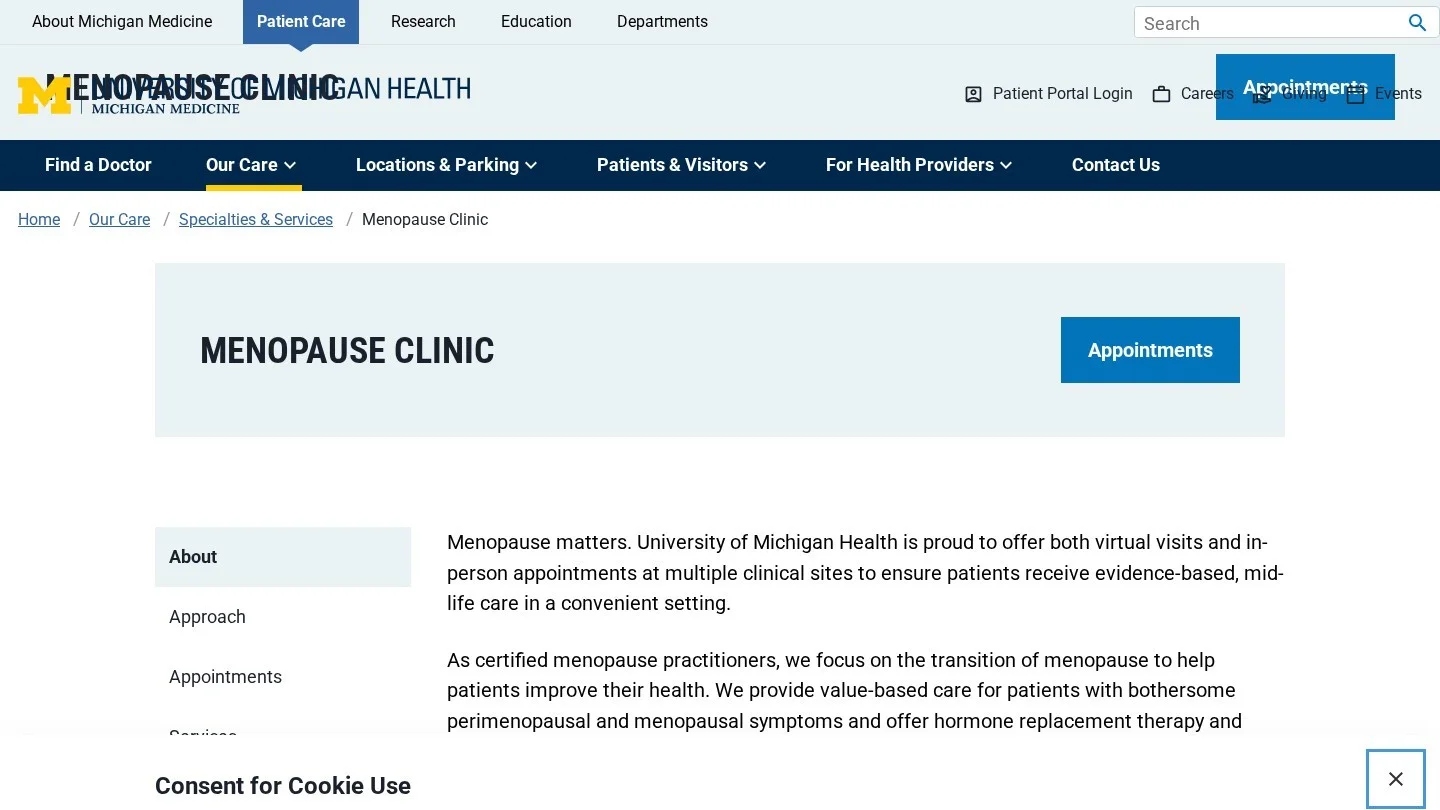
Symptom pages bring in early searchers who are not ready to book. So each page needs a plain answer first, then the treatment options and a booking link. University of Michigan Health lists the symptoms its menopause clinic treats, including hot flashes, sleep problems and urinary symptoms. It also names the specialties it works with, such as cardiology and pelvic physical therapy.
Build one page for each symptom cluster in the keyword table. Then add a short “when to see a menopause specialist” block on each. After that, link each symptom page to the HRT page and the non-hormonal treatment page. Patients want both options, and FDA-approved non-hormonal choices exist for hot flashes.
Link Conditions, Tests and Services in One Hub
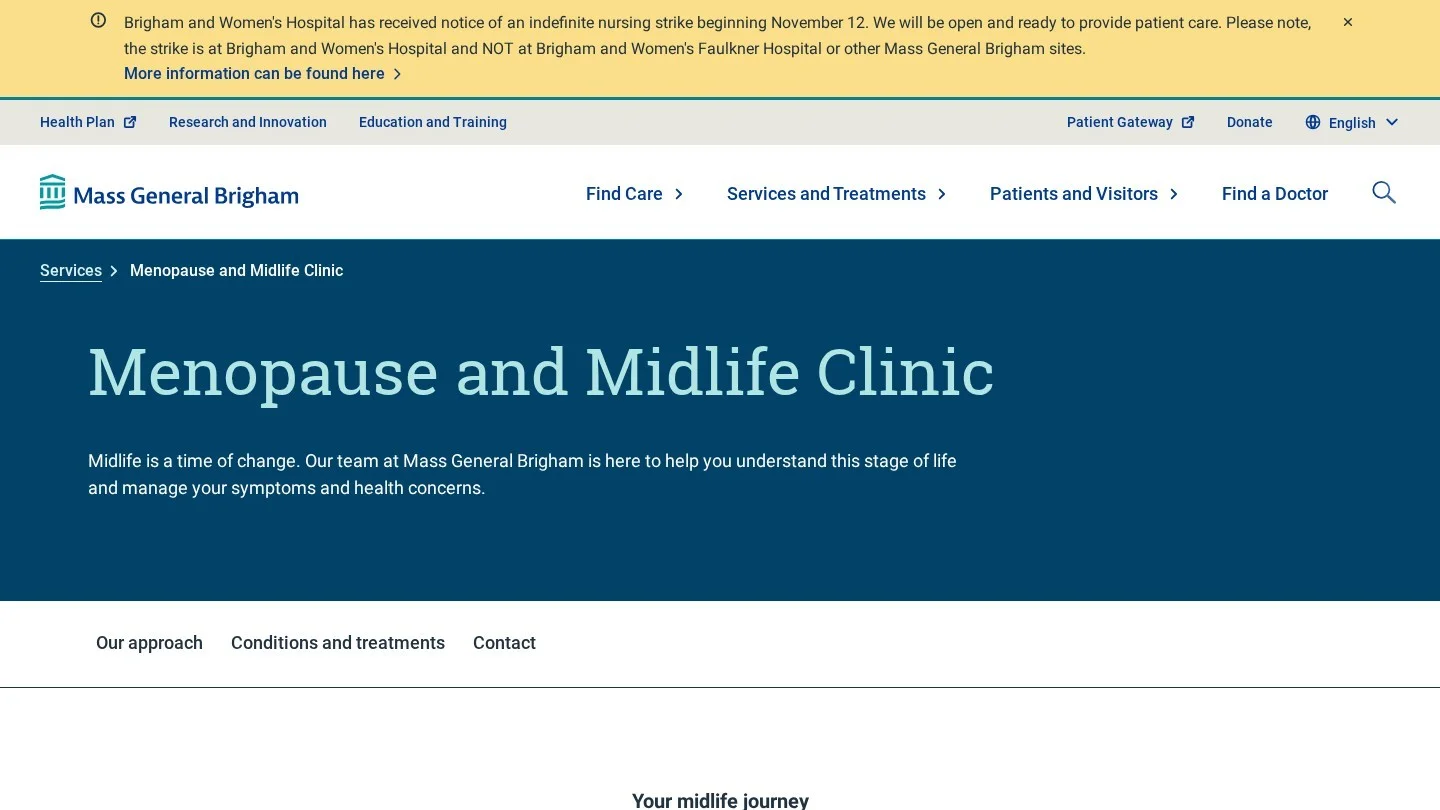
Mass General Brigham runs one menopause and midlife page that covers perimenopause, early, premature and surgical menopause. Lower on the page, it lists nine related conditions and nine related tests and treatments, such as bone density tests and endometrial biopsy. As a result, each related page gets a link from a page that ranks.
Copy that structure on a smaller scale. A five-clinician practice might link the hub to eight pages: perimenopause, hot flashes, sleep, GSM, HRT, non-hormonal care, bone health and early menopause. Then each child page links back to the hub with plain anchor text.

Prove Menopause Expertise With MSCP Credentials
The Menopause Society Certified Practitioner (MSCP) credential is open to any licensed healthcare professional who passes the society’s exam. The exam runs online in one-month windows in March, June, September and November. It costs $400 for members and $725 for nonmembers. The credential lasts three years, then the holder renews by exam or continuing education.
Google cannot read a credential from a logo. So write it out on each clinician page: full name, license type, MSCP, board certification and the year each was earned. The society lets credential holders use “MSCP” after their name. It also offers a downloadable MSCP logo on request for websites.
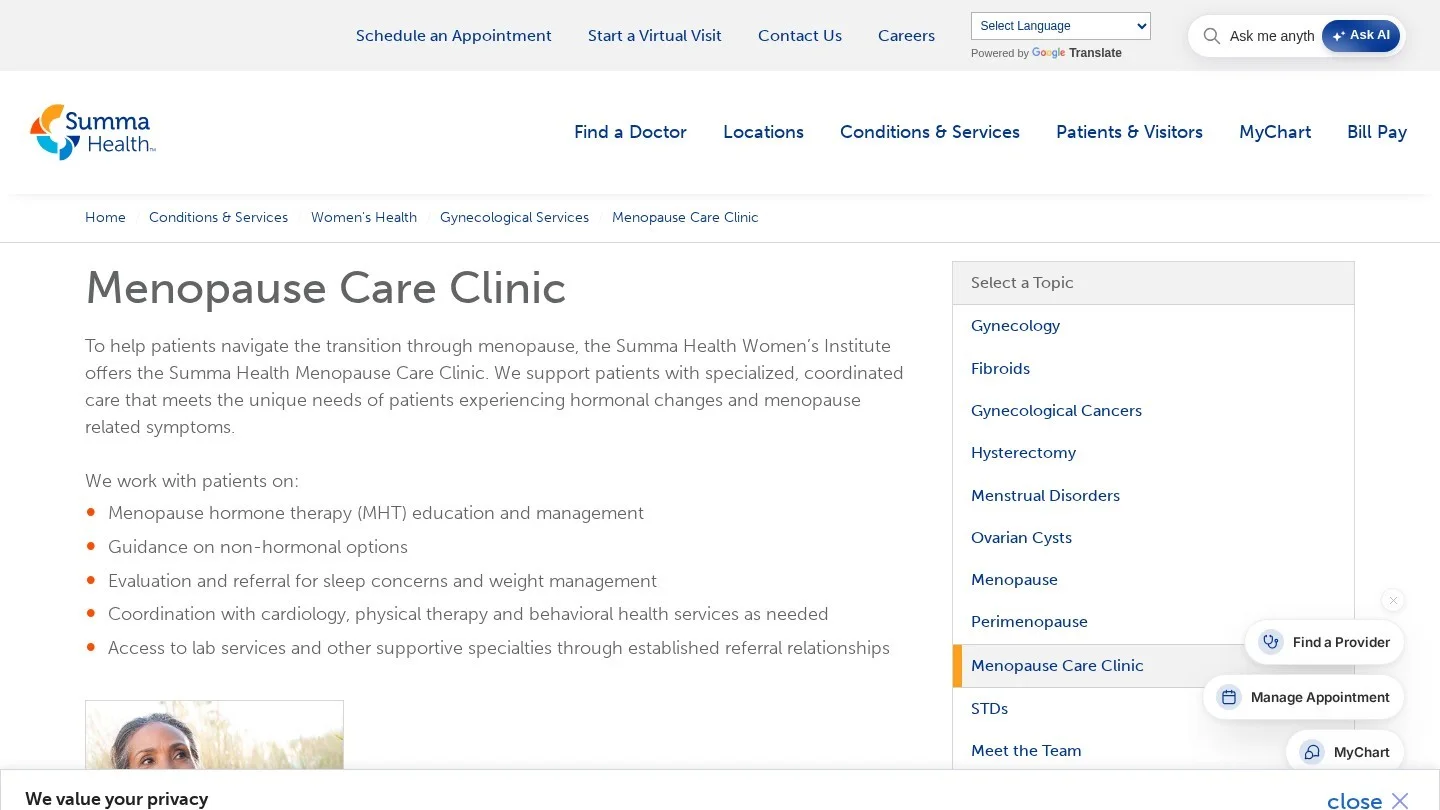
Summa Health in Akron does this on its clinic page. It names three physicians and labels each as a Menopause Society Certified Practitioner. It also states “No referral is necessary,” which answers a common patient question before the phone rings.
Get Every Clinician Into the Society’s Practitioner Directory
The Menopause Society runs a searchable “Find a Menopause Practitioner” directory. The list shows members’ contact details and marks those with the MSCP credential. Patients can weigh location, insurance, telemedicine and specialty when they search.
That listing does two jobs. It sends patients who are already looking for a certified clinician. It also works as a trusted citation for your clinic name, address and website. So list every eligible clinician, and use the same practice name and address you use on Google.
Put a Clinician’s Review Line on Each Treatment Page
Mayo Clinic’s perimenopause care page carries a byline, a review date and 27 numbered references. That is a large health system, but the method scales down. Put “Medically reviewed by [Name], MD, MSCP” and a date at the top of each HRT, symptom and treatment page.
Also write the reviewer’s bio once and link to it from every review line. Then refresh the date only when a clinician actually rereads the page. For example, the FDA label change is a real reason to review every HRT page this quarter.
Publish a Page for Each State Your Clinicians Are Licensed In
Some states require a clinician who treats a patient by telehealth to hold a license in the state where the patient is located. So a telehealth menopause clinic can only serve, and should only target, the states its clinicians cover.
That makes the state page the main ranking page for online care. Midi Health’s Texas page is a public example. Its Texas page names its Texas-licensed clinicians, the insurers it takes in Texas and the cities it serves. It also explains that labs and mammograms happen at local facilities.
Each state page needs facts that only apply to that state. Otherwise, fifty near-copies compete with each other and add little. We compiled this list of what to put on each one.
| Page element | What to write | Why patients and Google need it |
|---|---|---|
| Licensed clinicians | Names, credentials and license states, linked to bios | Shows the patient can legally be seen |
| Insurance | Plans accepted in that state, with any limits | Answers the second most common question |
| Lab and imaging | How labs, Pap tests and mammograms are arranged locally | Shows what happens outside the video visit |
| Prescriptions | How and where prescriptions are filled in that state | Sets expectations for HRT start dates |
| Cities | The metro areas you serve, written naturally | Matches “online menopause doctor [city]” searches |
| State FAQ | Two or three questions specific to that state | Gives the page facts no other state page repeats |
Only publish a state page after a clinician there is licensed and taking patients. Firms in our list of digital health marketing agencies often build these pages for telehealth brands. Also, if a license lapses, remove the page or mark the state as a waitlist.
Keep Map Profiles for Real Offices Only
Google Business Profile requires a business to make in-person contact with customers during its stated hours. Google lists online-only businesses as ineligible. So a telehealth clinic with no physical office should not create a Maps profile for each state.
Hybrid clinics are different. If you see patients in person at an office, that office can have a profile. Then your state pages handle the online searches, and your profile handles the “near me” searches.
Mark Up Clinicians, Treatments and Offices for Search Engines
Run every new page through Search Console’s URL Inspection tool after you publish it. Then check the Pages report each month for pages marked “Crawled, currently not indexed.” State pages often land there when they read too much alike. If they do, add more state-only facts before you request indexing again.
Next, look at speed on a phone. Booking widgets and symptom quizzes are often the slowest parts of a clinic site. So load them only when a visitor taps a button. Also, set one canonical URL for each page, and keep each state page as its own canonical.
Add MedicalClinic and Credential Schema
Schema.org has no menopause-specific type. So use MedicalClinic for each office, Person for each clinician with a hasCredential entry for MSCP, and MedicalTherapy for treatments. A telehealth-only clinic can use MedicalOrganization with areaServed for its states. We wrote this sample for a hybrid clinic.
{
  "@context": "https://schema.org",
  "@graph": [
    {
      "@type": "MedicalClinic",
      "@id": "https://www.example-midlife.com/locations/denver/#clinic",
      "name": "Example Midlife Health - Denver",
      "url": "https://www.example-midlife.com/locations/denver/",
      "telephone": "+1-555-010-0177",
      "address": {
        "@type": "PostalAddress",
        "streetAddress": "200 Example St, Suite 300",
        "addressLocality": "Denver",
        "addressRegion": "CO",
        "postalCode": "80202",
        "addressCountry": "US"
      },
      "medicalSpecialty": "Gynecologic",
      "areaServed": [
        {"@type": "State", "name": "Colorado"},
        {"@type": "State", "name": "Utah"}
      ],
      "availableService": [
        {"@type": "MedicalTherapy", "name": "Menopausal hormone therapy"},
        {"@type": "MedicalTherapy", "name": "Non-hormonal treatment for hot flashes"},
        {"@type": "MedicalTherapy", "name": "Vaginal estrogen therapy"},
        {"@type": "MedicalTest", "name": "Bone density testing referral"}
      ]
    },
    {
      "@type": "Person",
      "@id": "https://www.example-midlife.com/clinicians/jane-example/#person",
      "name": "Jane Example, MD",
      "jobTitle": "Gynecologist",
      "url": "https://www.example-midlife.com/clinicians/jane-example/",
      "worksFor": {"@id": "https://www.example-midlife.com/locations/denver/#clinic"},
      "hasCredential": {
        "@type": "EducationalOccupationalCredential",
        "name": "Menopause Society Certified Practitioner (MSCP)",
        "recognizedBy": {"@type": "Organization", "name": "The Menopause Society"}
      }
    }
  ]
}
Then test each template in Google’s Rich Results Test and the Schema Markup Validator. Also, keep schema facts identical to the visible page. If the page lists two states, the markup lists the same two.
Block Ad Pixels on Symptom Quizzes and Intake Forms
HHS’s Office for Civil Rights published a bulletin on online tracking by HIPAA-covered entities. It warns that tracking code on patient portals, and on pages where people enter health details, can send protected health information to vendors. A federal court in Texas vacated part of that bulletin in June 2024, and the vacated part dealt with some public pages. Even so, the parts on portals and forms still apply.
Menopause sites carry extra risk because symptom quizzes collect health details. For example, a quiz answer such as “night sweats, 3 years” is health information once it is tied to a person. So remove ad pixels from quiz, intake and booking pages. Then send conversions through a server-side setup or a vendor that signs a business associate agreement. Our guide to track AI referral traffic for medical practices shows how to count visits without sharing patient data.
Claim Map Listings for Every Office and Clinician
Google’s guidelines allow doctors and other individual practitioners to have their own Business Profile, alongside the office profile. So a three-clinician menopause clinic can have four profiles at one address. Name each clinician profile with the person’s name only, and link it to that clinician’s bio page.
Pick the primary category with care. Many menopause practices choose “Women’s health clinic” or “Gynecologist.” Type “menopause” into the category field to see whether a closer match exists for your country. Then add services such as menopausal hormone therapy, vaginal estrogen therapy and bone density referrals. Each service gets a short description in plain words.
Northwestern Medicine’s Center for Sexual Medicine and Menopause page lists the suite number, weekday hours, phone with TTY and parking rates. Those details match what Maps shows, so patients see the same facts in both places.
Next, add photos of the waiting room, the front of the building and the parking entrance. Skip photos of patients. Then post a short update when something changes for patients, such as new evening hours or the HRT label news.
Grow Referral Links Through Midlife Health Partners
Google’s spam policies count buying links and excessive link exchanges as link spam. So build links from places that send patients anyway. The Menopause Society directory is the first one, and it lists society members.
After that, we listed five partner groups that send menopause patients. Each one has a page where a link makes sense to its own readers.
| Partner | What to offer | Where the link appears |
|---|---|---|
| Breast cancer survivorship programs | A guide to non-hormonal symptom care after cancer | Their survivorship resources page |
| Pelvic floor physical therapists | Two-way referral notes for GSM and urinary symptoms | Their “partners” or referral page |
| Employers with menopause benefits | A lunch talk for staff, plus a one-page handout | Their benefits or wellness portal |
| Local news and podcasts | A clinician who can explain the FDA label change | The story or episode notes |
| Gyms, yoga studios and running clubs | A talk on sleep, bone and strength after 45 | Their events or blog page |
Johns Hopkins runs a women’s wellness program with a patient navigator who books visits across cardiology, bone health, sexual health, gastroenterology and psychiatry. That model creates links in a natural way. Each partner department has a reason to link back to the menopause program page.
Smaller clinics can copy it with local partners. For instance, agree with a local cardiology group to write one guest article each. Then each side links to the other’s relevant page, which is normal editorial linking.
Prepare Plain HRT Answers That AI Search Can Quote
AI Overviews, ChatGPT and Perplexity answer questions such as “Is HRT safe now?” with text pulled from pages they trust. So put a two- to three-sentence answer at the top of each question section. Then add detail, sources and a link to book.
Mayo Clinic’s care page states that its experts see more than 20,000 people each year for perimenopause and menopause. AI tools repeat plain, checkable facts like that one. Write your own version, such as the number of clinicians with MSCP or the states you serve, and only if it is true.
Next, keep your name, address and services the same on your site, Google, the society directory and insurer directories. AI tools compare these sources. Also, use FAQ blocks on HRT, symptom and state pages, written as real patient questions. Then track AI referrals in GA4 so you know which pages get cited. Our list of healthcare AEO and GEO agencies covers firms that do this work if you need help.

Request Reviews Without Mentioning Symptoms
Ask for a review by text or email two or three days after the first visit. Keep the request generic, such as “Thanks for visiting [Practice]. Would you share your experience on Google?” Never name the symptom or treatment in the request, because the message may show on a lock screen.
When you reply, do not confirm that the reviewer is a patient or mention any care detail. HIPAA applies to review replies too. So thank the reviewer, invite them to call the office and stop there.
The FTC’s rule on fake reviews and testimonials took effect in October 2024. It bans fake reviews, paying for reviews that must be positive, and hiding negative ones. So never offer gift cards for five-star reviews, and never filter out unhappy patients before sending the request. Our page on healthcare reputation management agencies lists firms that run compliant review programs.
Tie Search Data to New Patient Visits by State
Rankings alone do not pay the rent, so measure new patients. Set up GA4 key events for booking clicks, form submissions and calls from the site. Then add a “state” dimension for telehealth clinics, so you can see which state pages bring in visits.
Also, use HIPAA-compliant call tracking with a signed business associate agreement. Keep form contents out of analytics. We built this monthly report for a menopause clinic.
| Metric | Where to find it | What to look for |
|---|---|---|
| Clicks to symptom pages | Search Console, filtered to symptom URLs | Growth in early-stage searches |
| Clicks to HRT pages | Search Console, filtered to HRT URLs | Gains after the label update article |
| Map views and calls | Business Profile Performance | Calls by office and by clinician profile |
| Booked first visits | GA4 key events and practice software | Visits by state and by landing page |
| AI referrals | GA4 traffic from AI tools | Which pages AI tools send people to |
| New reviews | Business Profile | Count and average rating each month |
For a quick check, divide booked first visits by organic sessions to each state page. If one state converts at half the rate of the others, its page likely lacks insurance or license details.
Schedule the First Quarter Week by Week
We put the work in this order because the FDA label update and credentials affect every other page. So fix those first, then build out.
| Weeks | Work | Done when |
|---|---|---|
| 1 to 2 | Audit the site for old boxed warning copy; fix every hit; add reviewer lines | No page repeats the old warning wording |
| 3 to 4 | Write the FDA label update article; add MSCP details to every clinician bio | Article live and linked from the HRT page |
| 5 to 6 | Build or rewrite the perimenopause, hot flash, sleep and GSM pages | Each page has a short answer, options and a booking link |
| 7 | Add MedicalClinic and Person schema; remove pixels from quiz and intake pages | Rich Results Test passes; tracking audit signed off |
| 8 to 9 | Publish state pages for licensed states only; update Business Profiles for real offices | One state page per licensed state |
| 10 | List clinicians in The Menopause Society directory and insurer directories | Listing sheet complete with logins |
| 11 | Pitch the label change story to local news; contact two referral partners | Two pitches and two partner emails sent each week |
| 12 to 13 | Launch review requests; build the monthly report | First report sent to the practice owner |
Answer Owners’ Questions on HRT Pages, Telehealth and Rankings
Should HRT and MHT Have Separate Pages?
No. They are two names for the same treatment, so separate pages would compete. Use “HRT” in the title if patients in your area search that term more, then define MHT in the first paragraph.
Can We Name Specific Hormone Products on Our Site?
Yes, as long as you describe them within their FDA-approved uses. However, labels are changing product by product. So check each product’s current label on DailyMed before you quote warnings. Google Ads has stricter rules on prescription drug names, which our guide to Google’s healthcare ad rules explains.
Do State Pages Count as Duplicate Content?
They can, if only the state name changes. So give each page its own clinicians, insurers, lab details and FAQ. Pages with real local facts get indexed. Near-copies often sit in the “Crawled, currently not indexed” report.
Is the MSCP Credential Required to Run a Menopause Clinic?
No. It is a voluntary credential from The Menopause Society. Still, the society’s directory marks it, and patients search for “certified menopause practitioner.” That is why we list it on every clinician page.
When Should a Menopause Practice Hire Outside SEO Help?
Clinics with several offices or several licensed states often need help with technical work and state pages. In that case, compare firms in our list of women’s health marketing agencies. For search work alone, see our women’s health SEO agencies and healthcare SEO agencies. You can also ask us to match you with an agency.
Compare Agencies for This Topic
Digital Health and Healthtech Marketing AgenciesMedical Practice Marketing AgenciesWomen's Health and OB-GYN Marketing AgenciesHealthcare SEO Agencies
More From the Blog

Statistics
Chiropractic Treatment Usage Statistics
How many people see a chiropractor, who goes, why and how often, with BLS, Medicare and international figures plus our own patients-per-chiropractor model.
Nov 6, 2026

Guides
How Podiatrists Can Rank for Diabetic Foot Care
A podiatry SEO guide for diabetic foot care covering patient searches, ulcer, neuropathy and Medicare shoe pages, referrals, Maps, schema, diabetes educator links and…
Nov 6, 2026

Statistics
Private Hospital vs Public Hospital Cost Statistics
Hospital costs by ownership in the US, India and the UK, with our own ratios, growth rates and price-page advice for hospital marketers.
Nov 5, 2026