
Podiatrists rank for diabetic foot care by building one page for each diabetic service, then feeding those pages with referrals and local trust. The best first step for most practices is a diabetic foot exam page and a Medicare diabetic shoe page. Tie both to a Google Business Profile with the “Podiatrist” category. Those three assets match what patients and referring doctors search for most often, so we built this guide around them.
We researched public pages from podiatry groups, hospital foot programs and diabetes centers. We also read Medicare’s coverage pages, CDC survey data and the international foot ulcer guideline. Every number here comes from a public source we opened, or from our own math with the method shown.

Study How Diabetic Foot Patients Search
About 40.1 million Americans had diabetes in 2023, or 12.0% of the population, in CDC data. Of adults with diabetes, 27.6% did not know they had it. That gap shapes search. Many future patients first type a symptom, such as “numb toes at night,” long before they type “podiatrist.”
Age shapes demand too. The latest national exam survey ran from August 2021 to August 2023. In it, total diabetes rose from 3.6% of adults aged 20 to 39 to 27.3% of adults aged 60 and older. So the oldest group has about 7.6 times the rate of the youngest. For that reason, most diabetic foot pages should speak to Medicare-age patients and the adult children who book for them.
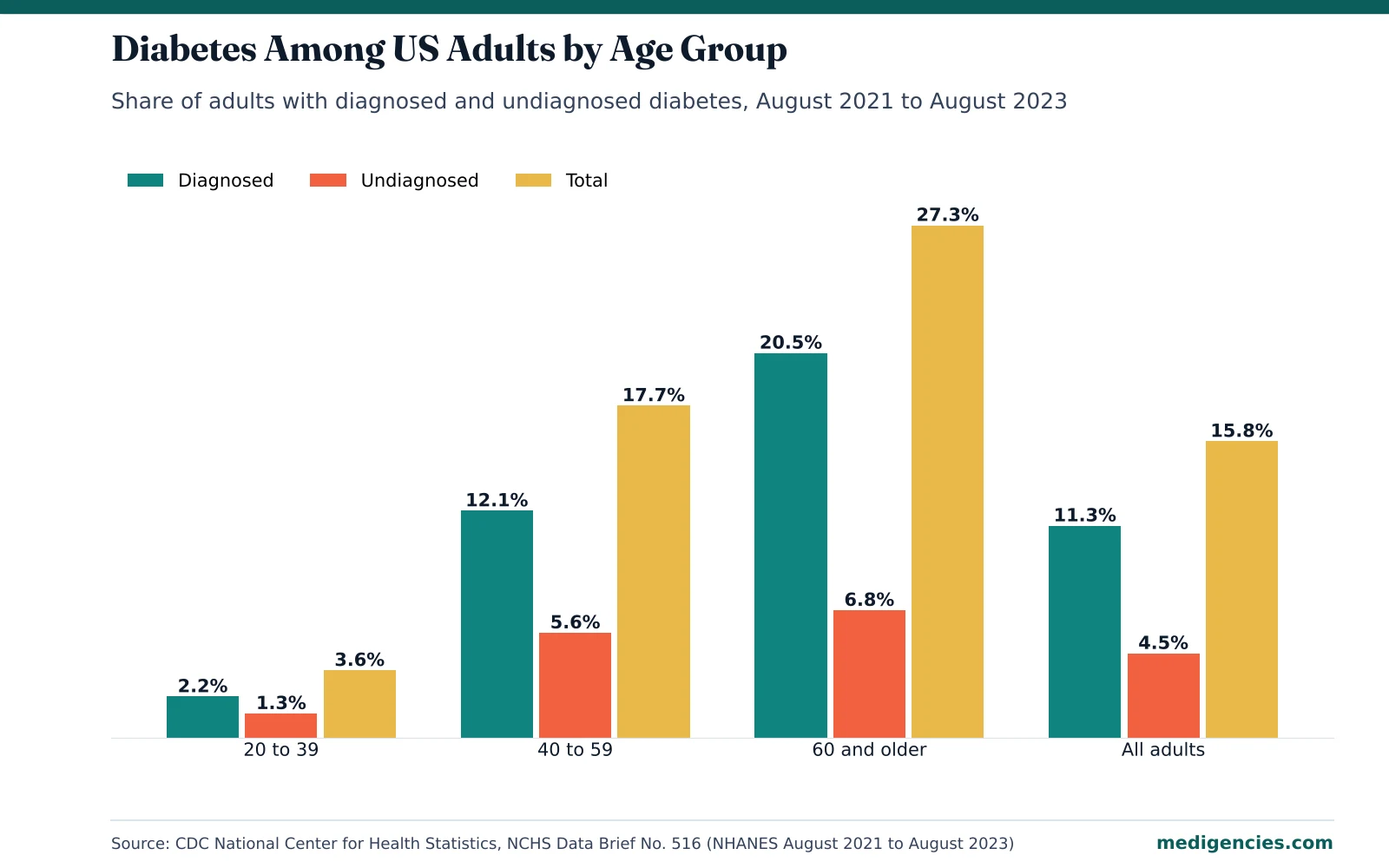
We also ran the undiagnosed share for each age band. It works out to 36% of cases among adults aged 20 to 39, 32% at 40 to 59 and 25% at 60 and older. So younger adults are the least likely to know. As a result, symptom pages on numbness, burning and slow-healing sores catch people who have not yet heard the word “neuropathy” from a doctor.
Group Diabetic Foot Keywords by Risk and Urgency
We compiled the keyword groups in the table from the way patients, caregivers and referring offices phrase diabetic foot problems. Each group maps to one page type, so no two pages fight for the same search. Also, the urgent group needs a phone number above the fold, because those visitors call and do not read.
| Keyword group | Example searches | Intent | Page to build | Example title tag |
|---|---|---|---|---|
| Early symptoms | numb toes at night; burning feet diabetes; tingling feet when lying down | Research, worried | Diabetic neuropathy page | Numb or Burning Feet With Diabetes in [City] |
| Exams and checkups | diabetic foot exam near me; how often diabetic foot exam; podiatrist for diabetics | Ready to book | Annual diabetic foot exam page | Diabetic Foot Exams by a Podiatrist in [City] |
| Wounds and ulcers | diabetic foot ulcer treatment; sore on bottom of foot won’t heal; foot wound doctor | Urgent, high value | Diabetic foot ulcer page and wound care page | Diabetic Foot Ulcer Treatment and Wound Care in [City] |
| Shoes and inserts | does medicare cover diabetic shoes; diabetic shoes near me; extra depth shoes for diabetics | Coverage question, then booking | Medicare therapeutic shoe page | Medicare Diabetic Shoes and Inserts at [Practice] |
| Nail and skin care | diabetic toenail cutting; podiatrist for thick toenails diabetic; calluses diabetes | Routine, repeat visits | Diabetic nail and callus care page | Toenail and Callus Care for Diabetic Feet in [City] |
| Emergencies | red swollen foot diabetes; black toe diabetic; Charcot foot doctor | Same-day need | Urgent diabetic foot page with same-day slots | Same-Day Diabetic Foot Care in [City] |
| Caregivers | foot care for elderly parent with diabetes; podiatrist home visits diabetic | Booking for someone else | Caregiver guide and booking page | Helping a Parent With Diabetic Foot Care |
| Referrers | podiatry referral diabetic ulcer [city]; refer patient to podiatrist | Doctor or nurse referring | Referring providers page | Refer a Diabetic Foot Patient to [Practice] |
Size Each Keyword Group in Keyword Planner and Search Console
Open Google Keyword Planner inside a Google Ads account and choose “Discover new keywords.” Then paste five seed terms from one row of the table. Next, set the location to the counties your offices draw from. Small accounts see volume as ranges, but even ranges show whether “diabetic shoes” beats “diabetic foot exam” in your area.
After that, open the Search Console Performance report and set the date range to 16 months. Filter queries that contain “diabetic,” “neuropathy,” “ulcer” or “wound.” Sort by impressions. Then look for queries where your average position sits between 8 and 20. Those pages are close to page one, so they are first in line for a rewrite.
Also watch January. Medicare’s shoe benefit runs per calendar year, so shoe searches and calls tend to bunch up when the year resets. Compare January against the prior October in Search Console to see whether your own data shows that pattern.
Follow Patients From First Numbness to Wound Clinic
The International Working Group on the Diabetic Foot (IWGDF) sorts people with diabetes into four risk groups. Its 2023 prevention guideline then sets a screening interval for each group. We used those groups as the spine of a patient pathway, because each group searches, books and returns at a different pace.
| Stage | Who it is (IWGDF risk group) | Screening interval | Who usually sends them | What they search | Page and call to action |
|---|---|---|---|---|---|
| 1. Newly diagnosed | Group 0: no loss of protective sensation (LOPS) and no peripheral artery disease (PAD) | Once a year | Primary care, diabetes educators | “do diabetics need a podiatrist”; “diabetic foot exam near me” | Annual exam page; “Book your yearly foot check” |
| 2. Early nerve or blood flow change | Group 1: LOPS or PAD | Every 6 to 12 months | Primary care, endocrinology | “numb feet diabetes”; “neuropathy podiatrist” | Neuropathy page; “Get your feet tested” |
| 3. Higher risk | Group 2: LOPS plus PAD, or either one plus a foot deformity | Every 3 to 6 months | Endocrinology, podiatry recall | “diabetic shoes covered by medicare”; “bunion with diabetes” | Medicare shoe page; “See if you qualify” |
| 4. Past ulcer or amputation | Group 3: LOPS or PAD plus a past ulcer, a lower-limb amputation or end-stage kidney disease | Every 1 to 3 months | Wound clinics, vascular surgery, dialysis units | “prevent foot ulcer coming back”; “custom diabetic shoes” | Recall program page; “Keep your standing visit” |
| 5. Active wound | Any group with an open ulcer | Treatment visits set by the podiatrist | Urgent care, ER, home health nurses | “foot ulcer treatment near me”; “wound doctor for feet” | Ulcer and wound care pages; “Call for a same-day wound visit” |
Next, we turned the IWGDF intervals into visits per year. Group 0 means one screening a year. Group 1 means one or two, group 2 means two to four, and group 3 means four to twelve. So a single group 3 patient can bring up to twelve times the visits of a group 0 patient.
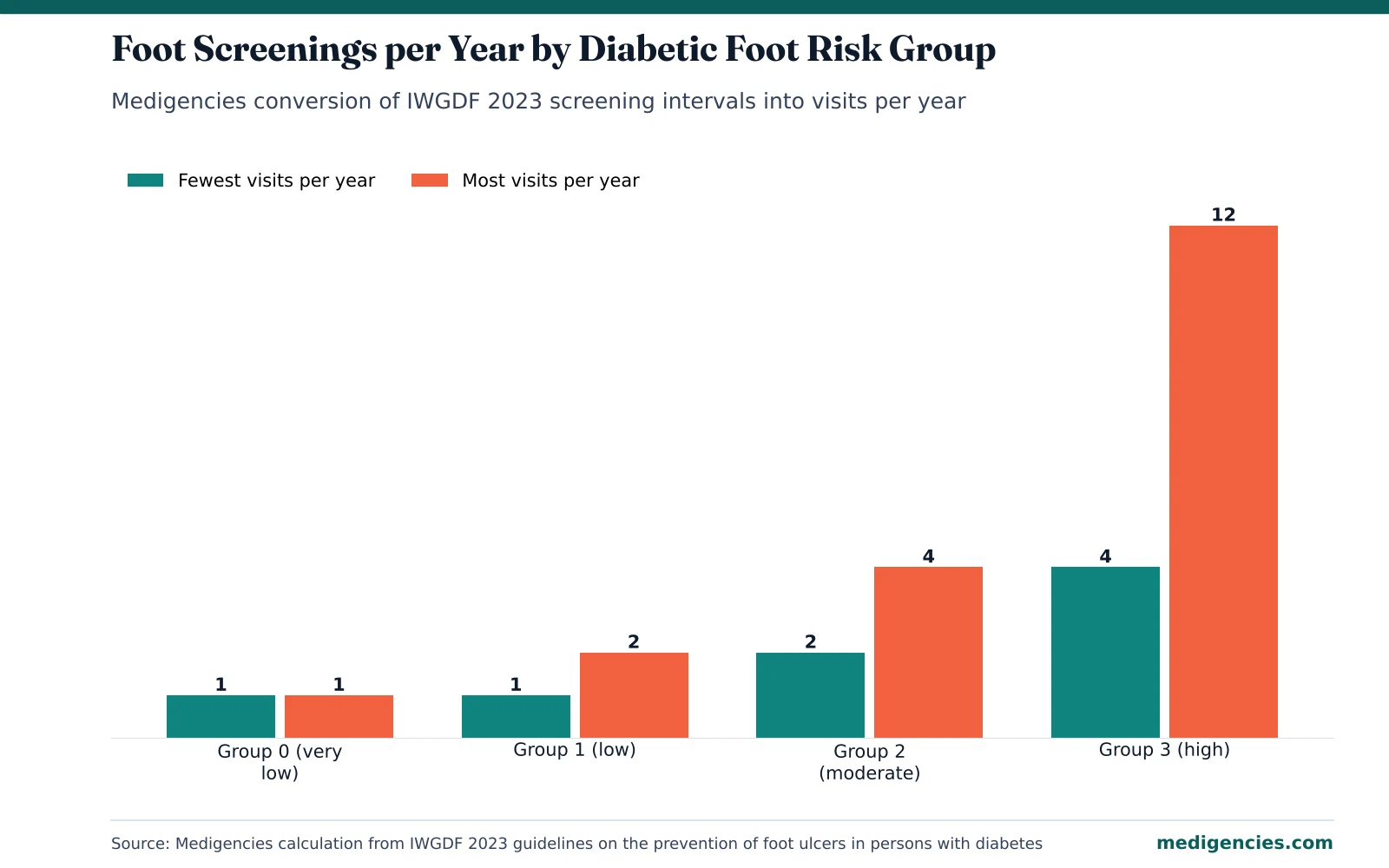
That spread changes how you judge SEO. A new group 0 patient is worth one visit a year at first. However, the same patient may move up a risk group over time, and the guideline asks for yearly checks for exactly that reason. So treat the annual exam page as the entry point to a long care relationship.
The stakes are high for patients. A 2017 review in the New England Journal of Medicine put the lifetime chance of a diabetic foot ulcer at about one in three. It also found that up to 40% of healed patients have a recurrence within a year. If the one-in-three figure holds for today’s 40.1 million Americans with diabetes, about 13 million could face an ulcer in their lifetime. We divided 40.1 million by three to get that estimate.
Give Every Diabetic Foot Service Its Own Page
Google ranks single pages. So one “Diabetic Foot Care” page that lists ten services will lose to a competitor with one page for each. Build the five pages in this section first, then link them to each other and to every location page.
Use one folder for conditions and one for services. For example, use /conditions/diabetic-foot-ulcer/ and /services/diabetic-shoes/. Then keep each URL short and readable, because patients share these links with family members.
Write the Diabetic Foot Ulcer Page Around the Healing Plan
People who search for an ulcer page want to know what happens next. So lay out the visits in order. First comes the wound check and any imaging. Then cover cleaning and debridement, offloading with a boot or cast, and infection checks. Finally, explain how often the patient returns and what shoes come after healing.
Add a short “Call us the same day if” box. List the signs your podiatrists treat as urgent, such as spreading redness or a foot that turns cold. Also put the direct phone line in that box. Because many ulcer searches happen on phones, a tap-to-call button near the top matters more than a long form.
Explain Neuropathy With the Tests Your Office Runs
Neuropathy pages rank better when they name the real tests. For example, list the monofilament test for protective sensation, a tuning fork for vibration and pulse checks for blood flow. Then say how long the visit takes and whether the patient needs to bring shoes or socks.
Medicare Part B covers a foot exam every six months for people with diabetic peripheral neuropathy and loss of protective sensation. That holds as long as the patient has not seen a foot care professional for another reason between visits. Put that fact on the page in plain words, because older patients ask about it on the phone.
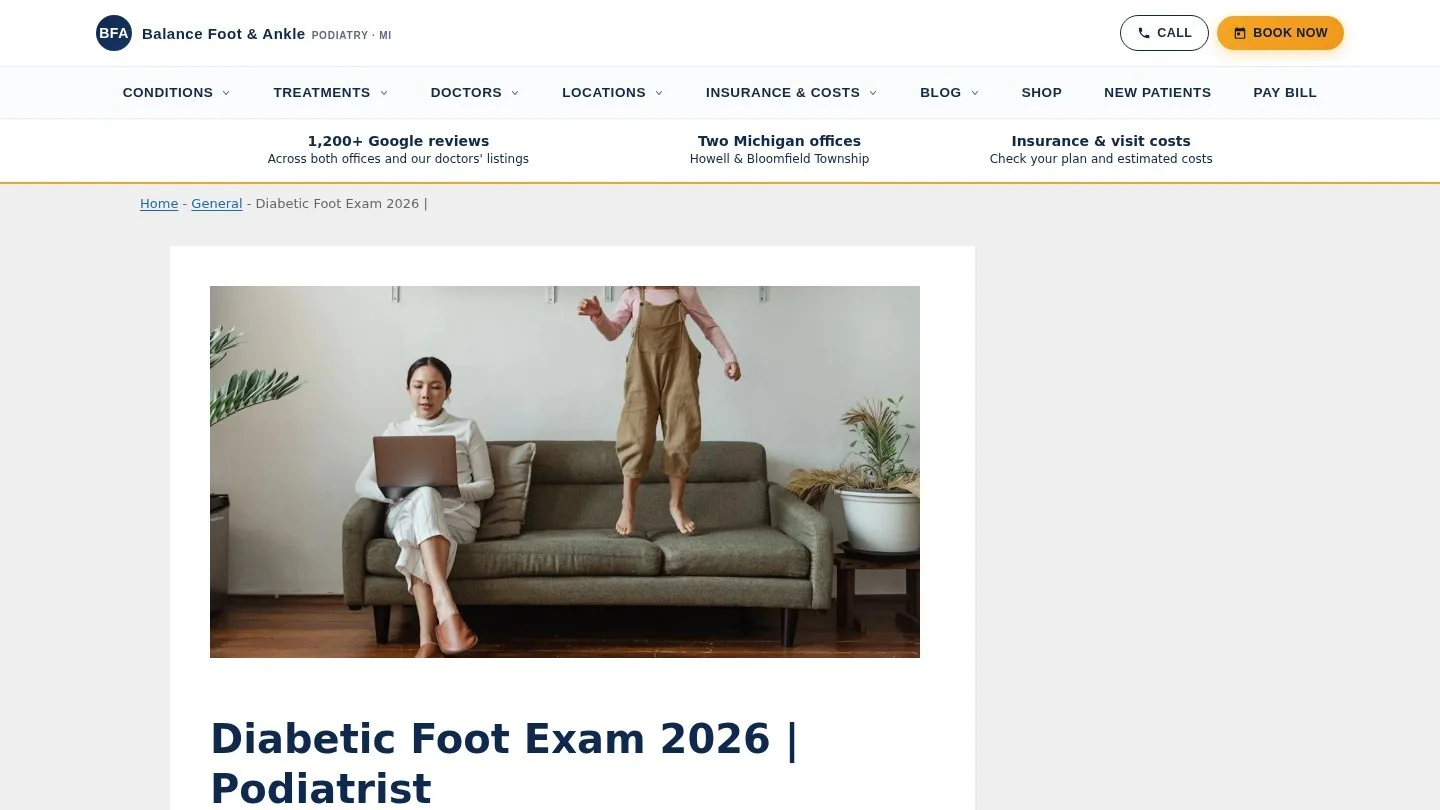
Balance Foot & Ankle in Michigan does this well on its diabetic foot exam page. The page lays out each part of the exam in a table, from the monofilament to the ankle-brachial index. It also covers Medicare rules, lists booking details for its Howell and Bloomfield Township offices and names a podiatrist as the medical reviewer.
Describe Wound Care Visits Week by Week
Wound care deserves a page apart from the ulcer page. The ulcer page explains the condition. The wound care page explains the service, so it covers visit length, dressing changes, home care and who else joins the team. For example, name the vascular surgeons or wound centers you work with, if they agree to be named.
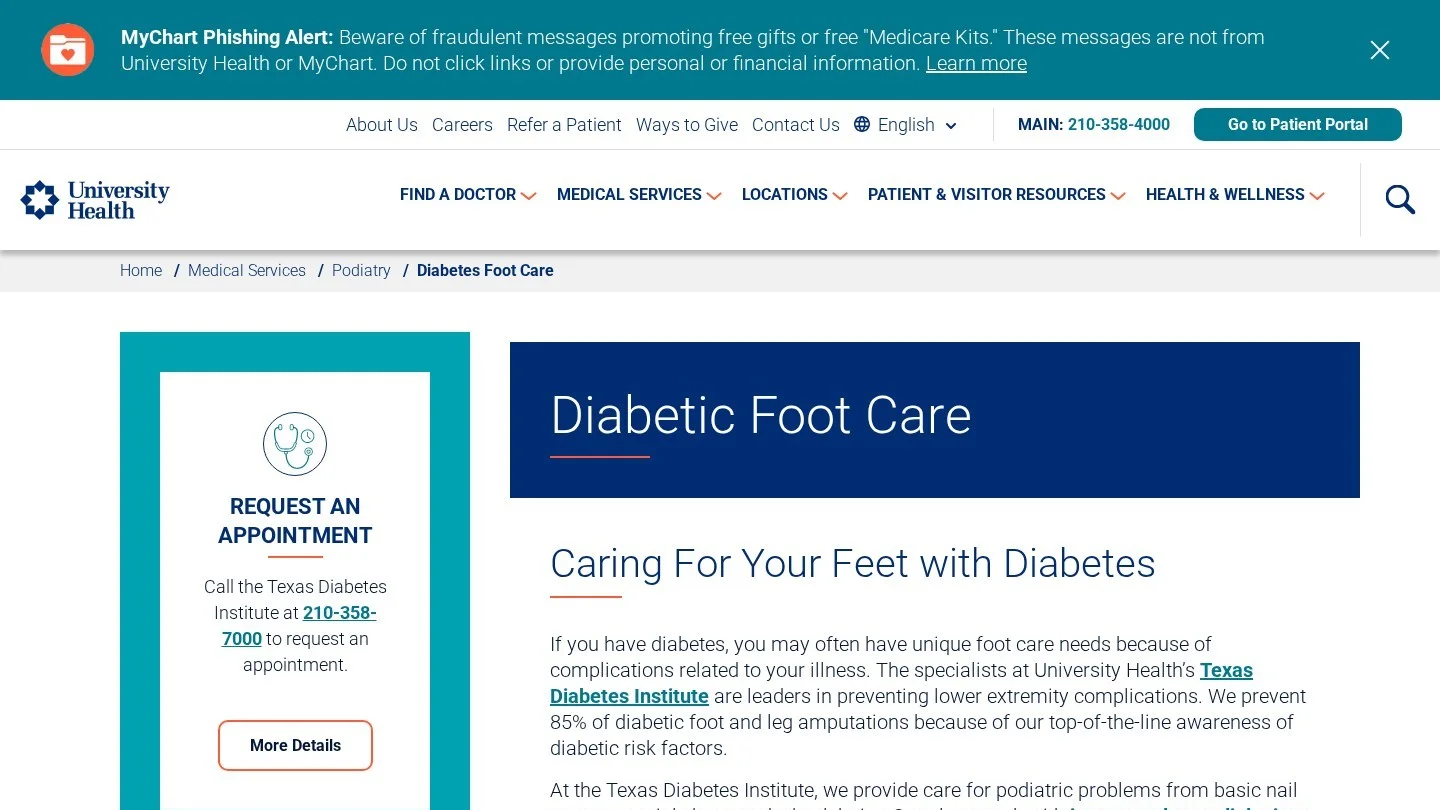
University Health in San Antonio runs its diabetic foot care through the Texas Diabetes Institute. Its page lists the conditions treated, from calluses to poor circulation. It also names three podiatrists and points patients with severe disease to a Limb Salvage Clinic. That structure shows Google, and patients, that podiatry sits inside a wider diabetes program.
Spell Out the Medicare Therapeutic Shoe Steps
Medicare Part B covers therapeutic shoes and inserts for people with diabetes and severe diabetic foot disease. Each calendar year, it covers one of two options. The first is one pair of custom-molded shoes with inserts, plus two more pairs of inserts. The second is one pair of extra-depth shoes plus three pairs of inserts.
Three roles must line up. The doctor who treats the patient’s diabetes certifies the need. Then a podiatrist or other qualified doctor orders the shoes. Finally, a podiatrist, orthotist, prosthetist or pedorthist supplies them. After the Part B deductible, the patient pays 20% of the Medicare-approved amount when the supplier accepts assignment.
| Step | Who does it | What to say on your page |
|---|---|---|
| 1. Check eligibility | Your front desk | Call us to confirm Medicare Part B and your diabetic foot findings |
| 2. Certify the need | The doctor who treats the patient’s diabetes | We send the form to your primary care doctor or endocrinologist |
| 3. Order the shoes | Your podiatrist | Our podiatrist examines your feet and writes the order |
| 4. Fit and supply | Your office, if it is an enrolled supplier | We measure, fit and dispense the shoes and inserts |
| 5. Renew | Patient and front desk | Your benefit resets each calendar year, so we remind you in January |
Tanglewood Foot Specialists in Houston publishes a long shoe guide written by Dr. Andrew Schneider. It explains who qualifies and the two-doctor rule. It then walks patients through five steps, from the first call to the January reset. That last step is smart, because it gives patients a reason to come back every year.

Turn the Annual Foot Exam Into a Yearly Habit
The IWGDF guideline asks for yearly screening even for the lowest-risk group. So the annual exam page should read like a reminder service. Say what the visit checks, how long it takes and that you send a reminder each year. Then add a “Book next year’s exam” link to the visit summary email.
Also add a nail and callus care page. Those visits bring diabetic patients back often. However, Medicare limits payment for routine foot care, so tell patients to ask your office what their plan covers. Keep that line factual and avoid promises about coverage.
Build a Referral Desk for Endocrinologists and Primary Care
Endocrinologists and primary care doctors send a large share of diabetic foot patients. They also certify Medicare shoes. So give them a page built for a busy nurse or medical assistant. List the fax number, the referral phone line and what to include with each referral.
Next, sort referrals by speed. For example, split them into “same day,” “within two weeks” and “routine.” After that, promise a turnaround time and a consult note back to the referring office. Also add a printable shoe certification checklist, because that form often stalls between offices.
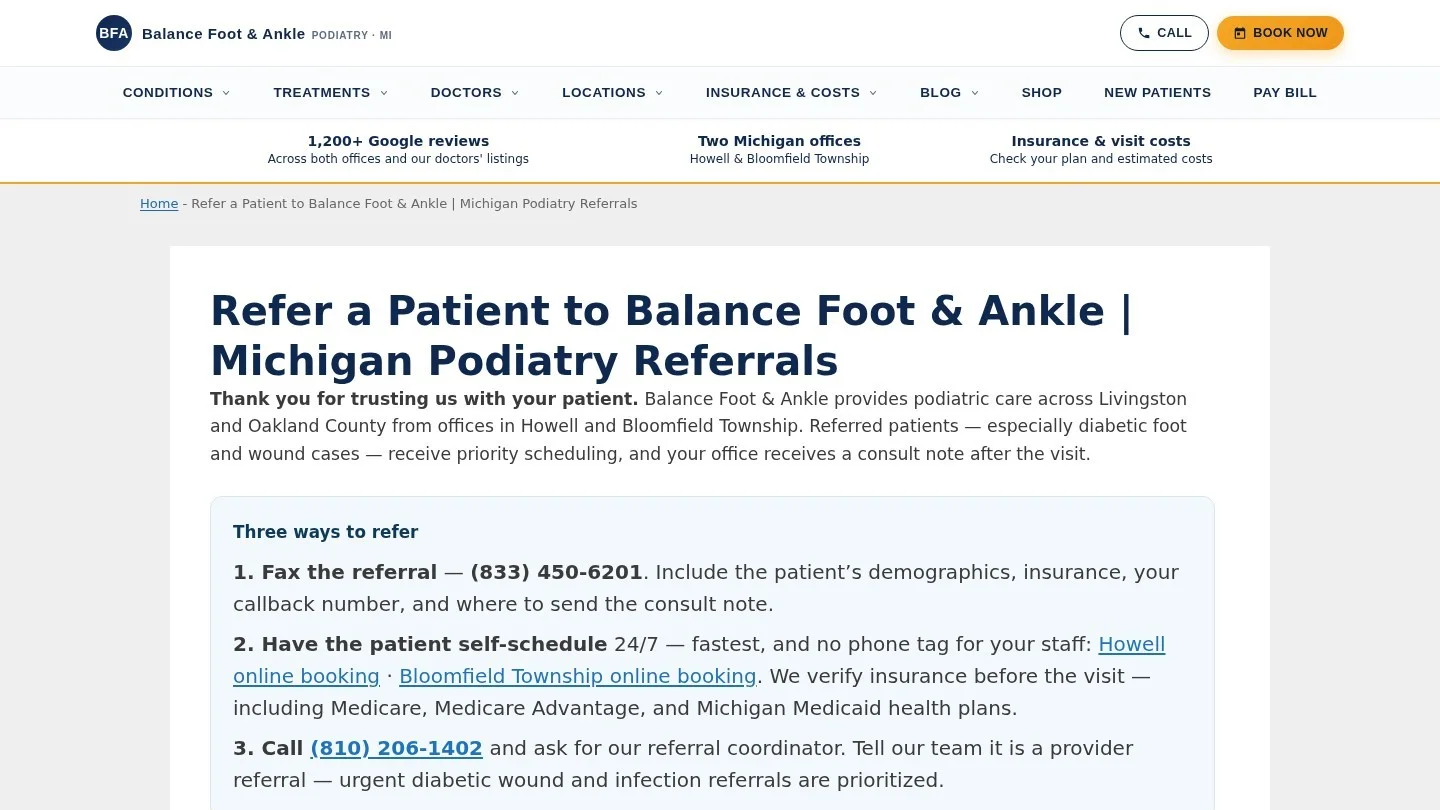
Balance Foot & Ankle’s referring providers page follows this pattern. It lists a referral fax and phone line, then sorts cases into immediate, one-to-two-week and routine groups. Open diabetic wounds sit in the immediate group. The page also says the office contacts referred patients within one business day and sends a consult note after the visit.
Hospital programs show the same idea at a larger scale. Take the Division of Podiatry at Beth Israel Deaconess Medical Center in Boston. It runs its diabetic foot and leg care with Joslin Diabetes Center. Its page puts a “Refer a Patient” link next to that diabetes partnership. So a referring endocrinologist can see the link between the two programs at a glance.

A referral page also earns search traffic. Doctors and nurses search for “podiatry referral” plus a city, and few practices answer that query. Besides, the page gives your outreach team something concrete to send after a lunch visit.
Tune the Google Business Profile for Diabetic Foot Searches
Set “Podiatrist” as the primary category on every office profile. Then add secondary categories only for services the office really offers, and test each one in the category search box. Next, add services such as “Diabetic foot exam,” “Diabetic shoes” and “Wound care” in the Services section, each with a one-line description.
Each profile should link to its own location page. That page needs the same name, address and phone number as the profile, plus office hours, parking and a map. For example, add a line on wheelchair access, because many diabetic foot patients use a boot, a walker or a chair.
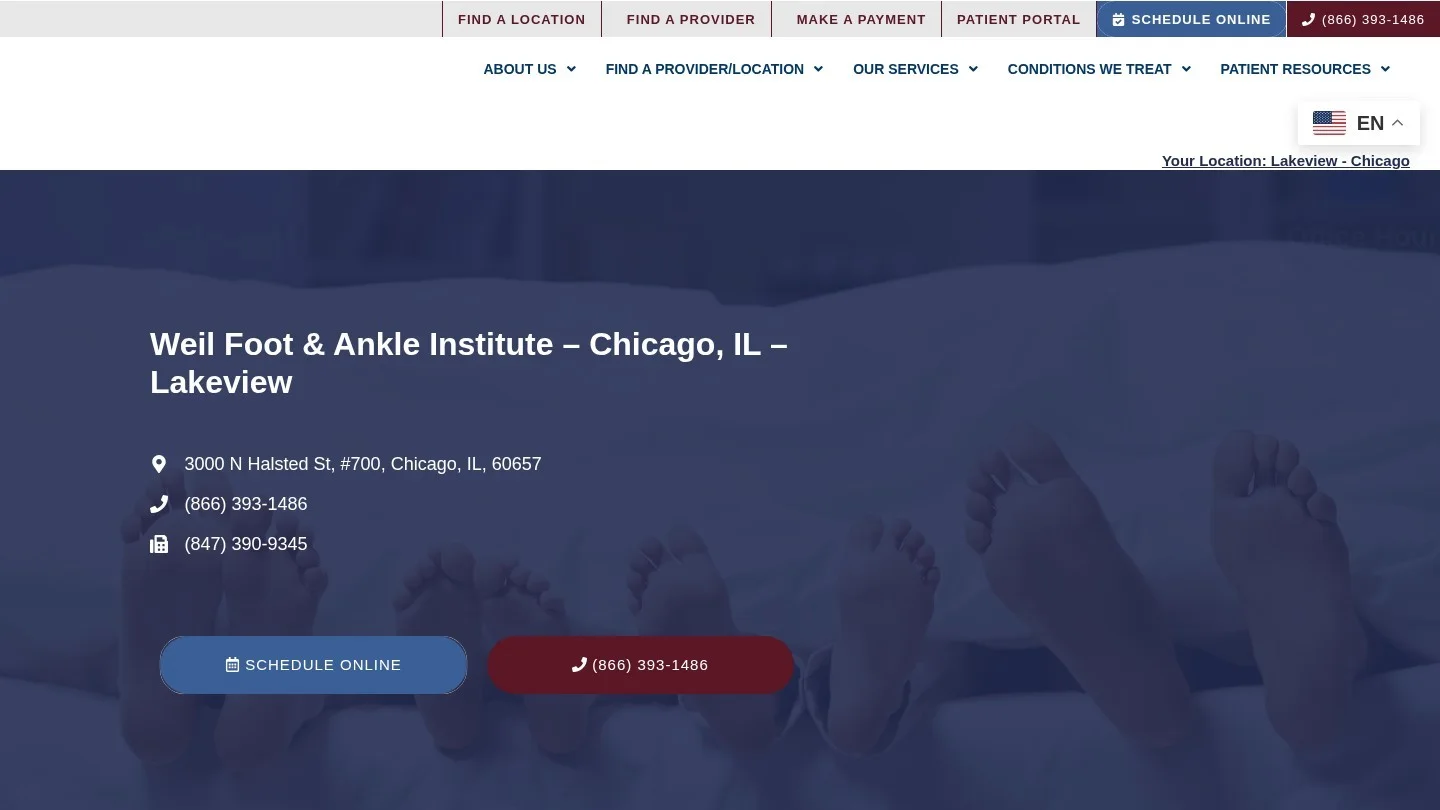
The Weil Foot & Ankle Institute Lakeview office in Chicago shows what a full location page looks like. It lists hours by day, five podiatrists with their DPM degree, about 31 services and an embedded map. It also notes local details, such as the office’s spot inside a hospital campus, Spanish-language service and wheelchair access. Those details give Google local signals that a generic city page lacks.
Choose Practitioner or Office Listings Under Google’s Rules
Google allows individual practitioners, such as podiatrists, to have their own Business Profiles. But a solo podiatrist who is the only public face of a branded practice should use one profile. Google’s guidelines suggest the name format “[Practice]: [Practitioner name]” in that case. Group practices can keep one office profile plus one profile per podiatrist.
Also post photos that patients will find useful. Show the entrance, the waiting room, the shoe fitting area and the parking lot. Then add a post each month about one service, such as January shoe renewals or a free foot check day. Keep keyword stuffing out of the business name, because Google can suspend profiles for that.
Merge Duplicate Diabetic Articles and Add Podiatric Schema
Open the Page indexing report in Search Console first. Check that every condition, service and location page shows as indexed. Then fix “Duplicate without user-selected canonical” warnings, because many podiatry sites run near-copies of the same diabetic article.
That last point is common. Some practices publish five or six blog posts on diabetic shoes, each with a slightly different title. Pick the best one as the main shoe page and fold the others into it. Then redirect the old URLs with a 301, so their links pass to the main page.
Enlarge Text and Cut Load Time for Older Readers
Check Core Web Vitals in Search Console for mobile URLs. Compress large photos and serve them in WebP format. Next, set body text to at least 16 pixels and make buttons large enough for a thumb. Many readers have vision changes or nerve damage in their hands. Our healthcare mobile search statistics show why phones deserve this care.
Also give every page a self-referencing canonical tag and HTTPS. Then list only canonical, indexable URLs in your XML sitemap. Submit it in the Sitemaps report after each new batch of pages.
Label Offices and Foot Conditions With Schema.org Types
Schema.org lists “Podiatric” as a value of MedicalSpecialty. So mark each office as a MedicalClinic with that specialty. Then list exams, treatments and shoes under availableService. On each condition page, describe the condition with MedicalCondition and link it to its tests and treatments.
Google shows no special result for these medical types. Even so, they label your entities clearly for search engines and AI tools. The sample covers one office and one condition page.
{
  "@context": "https://schema.org",
  "@graph": [
    {
      "@type": "MedicalClinic",
      "@id": "https://www.example-foot.com/locations/riverside/#clinic",
      "name": "Example Foot & Ankle - Riverside",
      "url": "https://www.example-foot.com/locations/riverside/",
      "telephone": "+1-555-010-0177",
      "medicalSpecialty": "https://schema.org/Podiatric",
      "address": {
        "@type": "PostalAddress",
        "streetAddress": "200 Example Rd, Suite 3",
        "addressLocality": "Riverside",
        "addressRegion": "CA",
        "postalCode": "92501",
        "addressCountry": "US"
      },
      "availableService": [
        {"@type": "MedicalTest", "name": "Diabetic foot exam"},
        {"@type": "MedicalTherapy", "name": "Diabetic foot ulcer wound care"},
        {"@type": "MedicalTherapy", "name": "Medicare therapeutic shoes and inserts"}
      ]
    },
    {
      "@type": "MedicalWebPage",
      "@id": "https://www.example-foot.com/conditions/diabetic-foot-ulcer/#webpage",
      "url": "https://www.example-foot.com/conditions/diabetic-foot-ulcer/",
      "lastReviewed": "2026-10-20",
      "reviewedBy": {"@type": "Person", "name": "Jane Example, DPM"},
      "about": {
        "@type": "MedicalCondition",
        "name": "Diabetic foot ulcer",
        "associatedAnatomy": {"@type": "AnatomicalStructure", "name": "Foot"},
        "riskFactor": [
          {"@type": "MedicalRiskFactor", "name": "Loss of protective sensation"},
          {"@type": "MedicalRiskFactor", "name": "Peripheral artery disease"}
        ],
        "typicalTest": {"@type": "MedicalTest", "name": "Monofilament test"},
        "possibleTreatment": [
          {"@type": "MedicalTherapy", "name": "Debridement"},
          {"@type": "MedicalTherapy", "name": "Offloading"}
        ]
      }
    }
  ]
}
Every value must match what the page shows. Then run each template through Google’s Rich Results Test and the Schema Markup Validator. Both are free, and we cover more of them in our healthcare SEO tools roundup.
Strip Tracking Code From Wound Photo and Intake Forms
Diabetic foot forms collect health data, such as wound photos, A1C results and insurance numbers. The HHS Office for Civil Rights guidance says HIPAA applies when tracking code on a covered entity’s site collects protected health information. A federal court in Texas vacated the part of that guidance about unauthenticated public pages in June 2024. However, pixels inside portals, booking flows and intake forms still fall under HIPAA.
So remove ad and analytics pixels from forms and booking pages unless the vendor signs a business associate agreement. Then count form starts and completions with server-side events that carry no health details. Our guide to Google’s healthcare ad rules covers the ad side of the same problem.
Partner With Diabetes Educators for Links and Mentions
Diabetes self-management education programs reach the exact people who need foot checks. Two national bodies accredit or recognize these programs for Medicare billing. They are the Association of Diabetes Care & Education Specialists (ADCES) and the American Diabetes Association. So every hospital or clinic that runs a program near you is a natural partner.
First, find the local programs in the ADCES program finder. Then offer a podiatrist as a guest speaker for one class each quarter. Bring a footwear sample kit and a one-page “check your feet” handout. After that, ask the program to list your practice on its resource page, with a link to your annual exam page.
Hospitals publish these talks as news. For example, Regional West in Scottsbluff, Nebraska posted a news item about a podiatrist speaking to its Diabetes Care Center support group. The talk covered foot care, footwear and preventing diabetic foot disease. A page like that becomes a local link, especially when you ask the hospital to name and link your practice.
Free foot check events work the same way. UT Health San Antonio ran a free Diabetic Foot Health Fair with foot exams, neuropathy and circulation checks and footwear reviews. Its event page names five podiatrists. Smaller practices can copy that idea with a library, senior center or YMCA. Then send the date to local event calendars and the health reporter at the local paper.

List Each DPM in Board and Health Directories
Next, claim the directory listings that patients and AI tools trust. These include your state podiatric medical association’s “find a podiatrist” page and the ABFAS Find a Surgeon tool for board-certified surgeons. Also check health directories such as Healthgrades, Vitals, WebMD and Zocdoc, plus insurer provider directories. Keep the practice name, address and phone number identical on each one.
Link building stops at buying links. Google’s spam policies treat paid links that pass ranking credit as link spam. So focus on links you earn through talks, events, referral partners and useful patient handouts. In fact, one link from a hospital diabetes program is worth more than dozens of paid directory links.
Prove DPM Training and Board Status on Every Doctor Page
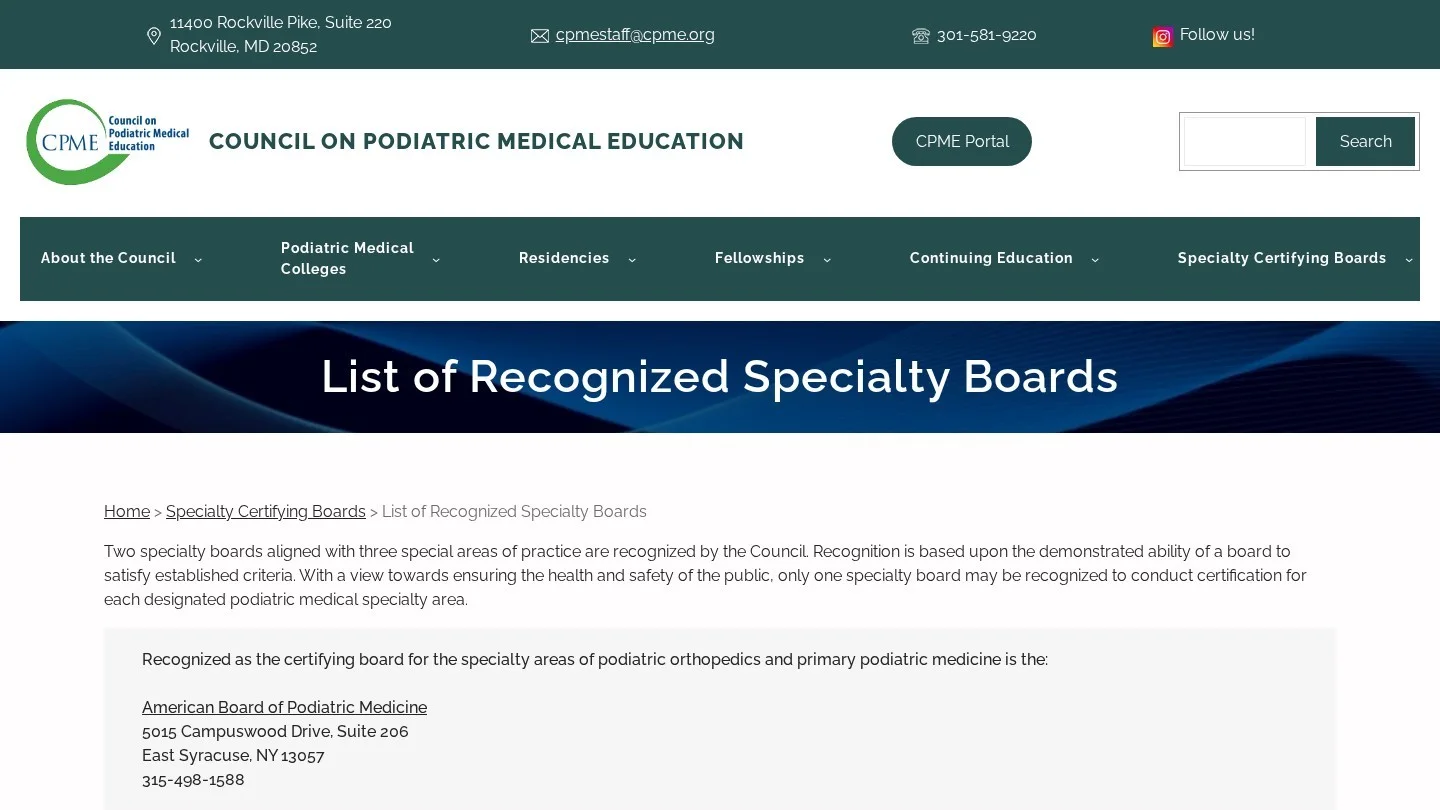
The Council on Podiatric Medical Education (CPME) lists two recognized specialty boards for podiatry. The American Board of Foot and Ankle Surgery (ABFAS) certifies in podiatric surgery. The American Board of Podiatric Medicine (ABPM) certifies in podiatric orthopedics and primary podiatric medicine. So each podiatrist page should name the board, the certification area and the year.
Next, list the DPM school, the residency and any hospital privileges. Then add memberships, such as APMA. For diabetic care, also add wound care training and any diabetes programs the podiatrist works with. Link each credential to a public verification page where one exists, such as the ABFAS verification pages.
Then add a “Medically reviewed by” line with a date to every condition page. For example, Balance Foot & Ankle’s exam page names a DPM as both author and reviewer. His bio lists his ABFAS and ABPM board status. That small line answers the trust question Google’s quality raters are told to ask about health pages.
Be careful with outcome claims. If a page says your team prevents amputations, back it with data you can show, or leave the number out. Also keep patient stories and wound photos behind signed consent. Then follow the FTC’s rules on testimonials, which require that stories reflect typical results or say clearly that they do not.
Win AI Citations With Short Medicare and Exam Answers
Google AI Overviews, ChatGPT and Perplexity pull short, direct answers from pages they trust. So open each diabetic page with a two- or three-sentence answer to the main question. For example, the shoe page should answer “Does Medicare cover diabetic shoes?” in its first lines, with the one-pair-per-year rule.
Then add a short questions block on each page, written from real phone calls. Ask your front desk for the ten questions they hear most about diabetic feet. After that, keep the answers consistent across your site, your Business Profile and your directory listings. AI tools compare sources, and mismatched facts make them less likely to cite you.
| Question patients ask | Answer block to put on the page | Page |
|---|---|---|
| How often should a diabetic see a podiatrist? | The IWGDF guideline sets screening from once a year for the lowest-risk group to every 1 to 3 months for the highest. | Annual exam page |
| Does Medicare cover diabetic shoes? | Part B covers one pair of extra-depth or custom-molded shoes per calendar year, with inserts, for people with diabetes and severe diabetic foot disease. | Shoe page |
| Does Medicare pay for diabetic foot exams? | Part B covers a foot exam every six months for people with diabetic neuropathy and loss of protective sensation. | Neuropathy page |
| When is a foot sore an emergency? | Your practice’s own urgent signs, written by your podiatrists, plus the same-day phone line. | Ulcer and urgent care pages |
Next, track AI visits in GA4. Build an exploration that filters sessions by referrer, such as chatgpt.com and perplexity.ai. Our guide on tracking AI referral traffic for medical practices shows the exact setup. If you want outside help, our list of healthcare AEO and GEO agencies covers firms that do this work.
Send Review Links After Shoe Fittings and Healed Wounds
Two moments produce the warmest reviews in diabetic care. The first is the shoe fitting, when the patient walks out in new shoes. The second is the last wound visit, when the ulcer has closed. So send a review link by text or email within a day of each one.
Ask every patient the same way. Google’s policies bar review gating, which means asking only happy patients. Also, the FTC rule on consumer reviews and testimonials took effect in October 2024. It bans fake reviews and bans offering rewards for positive reviews. So never offer a discount or gift for a review.
Reply to reviews without confirming that the writer is a patient. For example, “Thank you for the kind words about our Riverside team” works, but “Glad your ulcer healed” discloses health information. For a negative review, invite the writer to call the office manager by name. Our list of healthcare reputation management agencies covers firms that run this at scale.
Measure Booked Foot Exams, Shoe Orders and Referrals
Rankings alone do not pay the rent, so tie SEO to booked visits. In GA4, mark call clicks, booking starts and referral form submits as key events. Then use a call tracking vendor that signs a business associate agreement, so call recordings stay inside HIPAA rules.
Next, pull GBP Performance data each month for calls, direction requests and website clicks. Also ask the front desk to log how each new diabetic patient heard about you. For example, add “Google search,” “Google Maps,” “doctor referral” and “diabetes class” to the intake form.
| Metric | Where to find it | What to look for each month |
|---|---|---|
| Impressions and clicks for diabetic queries | Search Console, filtered by “diabetic,” “neuropathy,” “ulcer,” “wound” | Rising clicks on the five core pages |
| Calls, directions and website clicks | GBP Performance, per office | Change against the same month last year |
| Booking starts and call clicks | GA4 key events | Which page sent each booking |
| Referral form submits | GA4 key event on the referring providers page | Number of referring offices using it |
| New diabetic patients by source | Front desk intake log | Share from search, Maps, referrals and classes |
| Shoe orders | Practice management system | January renewals against the prior year |
| AI referral sessions | GA4 exploration by referrer | Which pages AI tools send visitors to |
Compare each month with the same month a year earlier, because shoe demand shifts with the calendar year. Then send the practice owner one page with five numbers. Keep it short, so the owner reads it.
Sequence Twelve Weeks of Diabetic Foot SEO Work
The first month fixes what blocks rankings, and the second builds pages. Then the third month builds trust and links. If January is near, move the shoe page to week one, because the benefit resets then.
| Weeks | Tasks | Done when |
|---|---|---|
| 1 to 2 | Audit indexing, speed and HTTPS; set “Podiatrist” as the primary category on each profile | Each profile links to a matching location page |
| 3 to 4 | Merge duplicate diabetic articles; fix canonicals and the sitemap; remove pixels from forms | Page indexing report shows all core pages as indexed |
| 5 to 6 | Write the annual exam, neuropathy and Medicare shoe pages | Each page opens with a direct answer and a phone button |
| 7 to 8 | Write the ulcer, wound care and referring providers pages; add schema | Rich Results Test and Schema Markup Validator pass |
| 9 to 10 | Update podiatrist bios with boards and review dates; claim directory listings | Every bio shows ABFAS or ABPM status where it applies |
| 11 | Contact three diabetes education programs; offer a talk or a free foot check day | One event date confirmed |
| 12 | Launch review requests after fittings and final wound visits; send the first monthly report | Report delivered to the practice owner |
Some practices will want help with part of this plan. For instance, our directory of podiatry marketing agencies lists firms that work with foot and ankle practices. You can also browse healthcare SEO agencies or ask us to match you with an agency.
Resolve Five Questions Podiatry Offices Raise
Should Diabetic Shoes Live on the Diabetic Foot Care Page?
No. Shoe searchers ask about coverage, while foot care searchers ask about exams and wounds. So give shoes their own page and link it from the diabetic foot care hub. Then each page can answer its own question in the first lines.
Can a Podiatrist Sign the Medicare Shoe Certification?
No. Medicare requires the doctor who treats the patient’s diabetes to certify the need. Medicare’s equipment rules treat that certifying doctor as an MD or DO. A podiatrist can order and supply the shoes. So your page should say plainly that you will contact the patient’s primary care doctor or endocrinologist.
How Many Location Pages Does a Two-Office Practice Need?
Two, one for each real office. Each one should link to its own Business Profile and list its own hours and podiatrists. Avoid pages for towns where you have no office, because Google treats near-copy city pages as low value.
May We Post Wound Photos on Ulcer Pages?
Only with written patient consent and no faces, tattoos or other identifying marks. Even so, many readers find wound photos upsetting. So show one healed-result photo lower on the page, and lead with diagrams of the care steps.
When Do New Diabetic Foot Pages Start Producing Calls?
New pages often take a few months to settle in rankings, and competitive cities take longer. However, referral pages and Business Profile fixes can bring calls sooner, because they do not depend on rankings alone. For related reading, see our podiatry SEO agencies page and our allergy and immunology SEO guide, which uses a similar referral model.
Compare Agencies for This Topic
Medical Practice Marketing AgenciesPodiatry Marketing AgenciesHealthcare SEO Agencies
More From the Blog

Statistics
Chiropractic Treatment Usage Statistics
How many people see a chiropractor, who goes, why and how often, with BLS, Medicare and international figures plus our own patients-per-chiropractor model.
Nov 6, 2026

Guides
SEO for Menopause Treatment Clinics
An SEO guide for menopause clinics covering symptom keywords, HRT pages after the FDA label change, MSCP credentials, telehealth state pages, schema, Maps, links…
Nov 6, 2026

Statistics
Private Hospital vs Public Hospital Cost Statistics
Hospital costs by ownership in the US, India and the UK, with our own ratios, growth rates and price-page advice for hospital marketers.
Nov 5, 2026