
Allergy and immunology SEO is the work of getting an allergy practice found when people search for allergy testing, allergy shots, food allergy care or an “allergist near me.” The best first move for most practices is one page for each test and treatment, plus one Google Business Profile for each office. Those two pieces drive most local rankings, so we built this plan around them.
We researched public pages from allergy groups, children’s hospitals and the two national allergy societies. We also pulled federal survey data on how many Americans have allergies. Every number here comes from a public source we opened, or from our own math with the method shown.
Learn How Allergy Patients Search Through the Year
About 31.8% of US adults had at least one diagnosed allergic condition in 2021, in the National Health Interview Survey. Seasonal allergy was the most common, at 25.7%. Eczema came next at 7.3%, then food allergy at 6.2%. For children, however, eczema runs higher, at 10.8%.
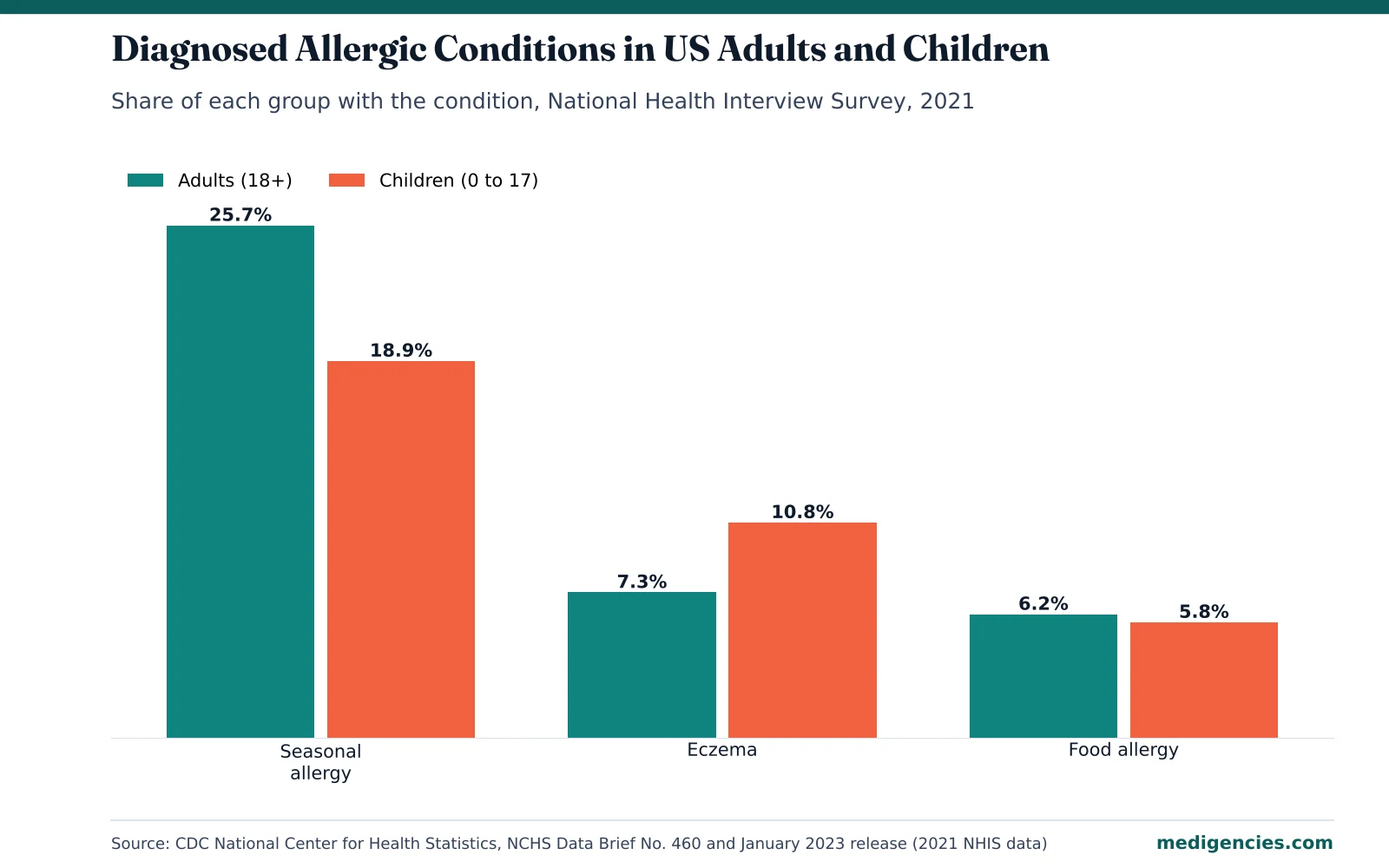
We ran our own comparisons on the same survey. Children have eczema at a rate about 48% higher than adults (10.8% vs 7.3%). Women report seasonal allergy about 42% more often than men (29.9% vs 21.1%). In fact, the gap for food allergy is wider, at about 70% (7.8% vs 4.6%). That is why we put childhood eczema and adult food allergy pages early on the content list.
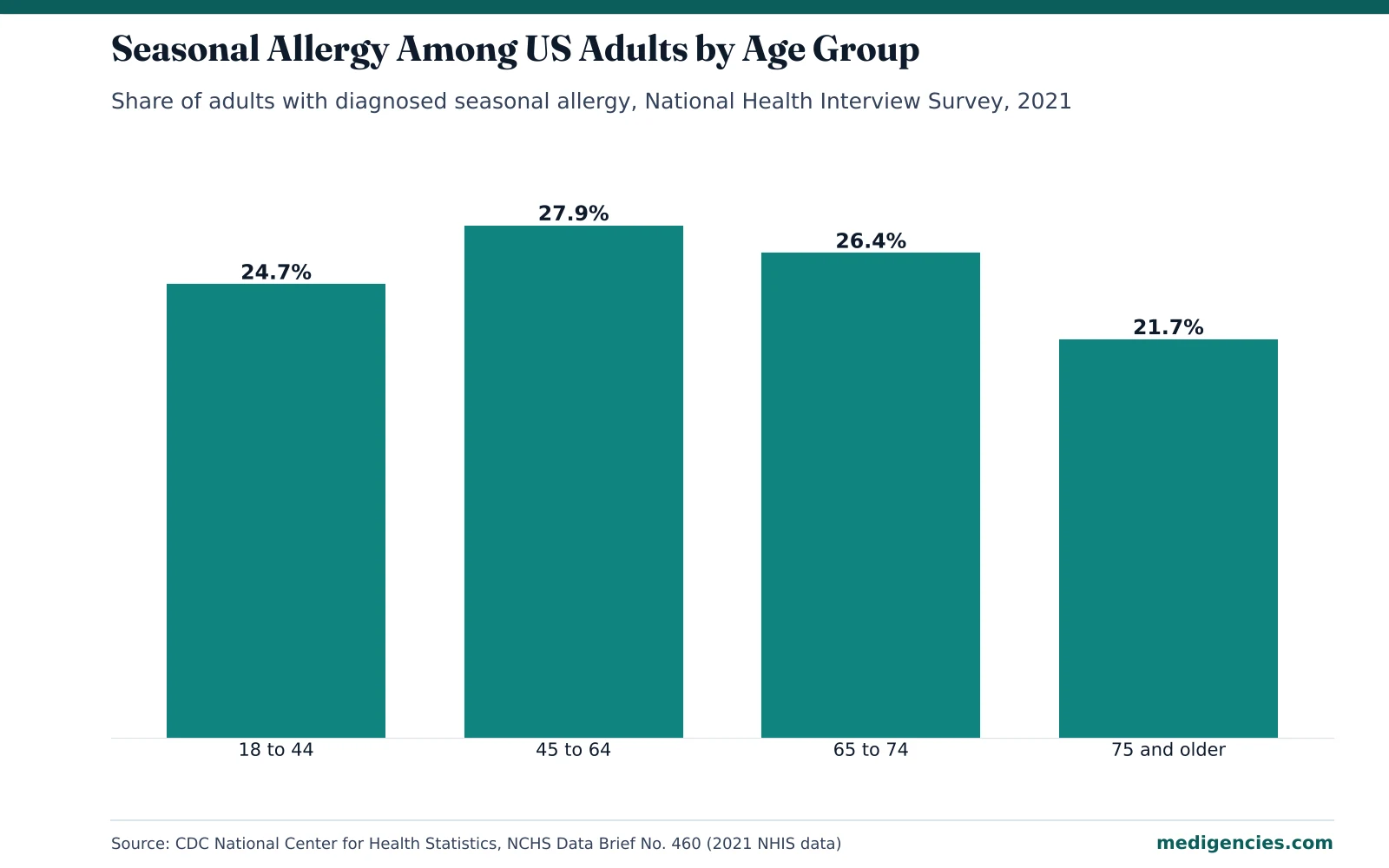
Age matters too. Seasonal allergy peaks at 27.9% among adults aged 45 to 64, then falls to 21.7% after age 75. So the middle-aged band reports more seasonal allergy than the youngest adults (24.7%). As a result, allergy shot pages should speak to working adults who weigh weekly visits against time off.
Sort Allergy Keywords by the Problem Behind Them
Allergy searches fall into clear groups. For example, a parent after a first reaction types a food name plus “allergy test.” An adult with spring symptoms types “allergy shots near me.” Meanwhile, a primary care doctor looks for a place to send a patient with a penicillin label. We compiled this starting keyword set from those patterns, and each group maps to one page type.
| Patient need | Example searches | Page type | Example title tag |
|---|---|---|---|
| Seasonal symptoms | pollen allergy doctor; tree pollen allergy symptoms; allergy testing near me | Seasonal allergy page | Pollen Allergy Testing and Treatment in [City] |
| Allergy shots | allergy shots near me; how long do allergy shots take to work; allergy shot hours | Allergy shots page and location pages | Allergy Shots in [City]: Schedule, Hours and Cost |
| Drops and tablets | sublingual immunotherapy; allergy drops vs shots; grass pollen tablet | Sublingual immunotherapy page | Allergy Drops and Tablets and Who Can Use Them |
| Food allergy | peanut allergy test for toddler; oral food challenge; oral immunotherapy near me | Food allergy hub, OIT page, food challenge page | Peanut Oral Immunotherapy for Children in [City] |
| Biologics | xolair for food allergy; biologic shot for asthma; allergist for eczema biologic | Biologics page | Biologic Treatment for Asthma, Hives and Food Allergy |
| Drug allergy | penicillin allergy test; am I really allergic to penicillin | Drug allergy testing page | Penicillin Allergy Testing for Adults and Children |
| Skin and hives | chronic hives doctor; eczema allergist; patch testing near me | Hives, eczema and patch testing pages | Chronic Hives Care From an Allergist in [City] |
| Immunology | immunodeficiency specialist; recurrent infections in adults; hereditary angioedema doctor | Immunology condition pages | Immune Deficiency Evaluation in [City] |
| School and emergencies | epinephrine nasal spray; anaphylaxis action plan; school allergy forms | School forms and epinephrine pages | Allergy and Asthma School Forms for [Practice] Patients |
Next, open Google Keyword Planner in your Google Ads account and choose “Discover new keywords.” Paste five seed terms from one row. Then set the location to the counties around your offices. Small accounts see volume as ranges. Even so, ranges are enough to tell how “allergy shots” compares with “allergy drops” in your area.
Pull Seasonal Spikes From Search Console
Allergy demand moves with pollen, so compare your data month by month. In the Search Console Performance report, set the range to the last 16 months. Then filter queries that contain “pollen,” “allergy” or “hay fever.” Finally, switch to compare mode and line up March against September.
Trees pollinate first in spring, and weeds take over in late summer and fall. So publish or refresh each seasonal page six to eight weeks before its local peak, because Google needs time to recrawl it. Put those dates on a shared calendar so the update does not slip.
Google’s personalized advertising policy restricts targeting based on health. As a result, organic pages carry much of the research stage for allergy patients. Our guide to Google’s healthcare ad rules covers that policy, along with how prescription drug names are handled in ads.

Repair the Site Plumbing Allergy Patients Never See
First, open the Page indexing report in Search Console. Every test, treatment, condition and office page should show as “Indexed.” Pages marked “Crawled, currently not indexed” are often thin copies. Allergy sites tend to collect these, because many publish a near-identical pollen post every spring.
Nest Tests, Treatments and Conditions in Their Own Folders
Patients arrive with one of three needs. They have a condition, they need a test, or they want a treatment. So build three folders and link them to each other. A practice with three offices might use this plan.
| Page | URL pattern | Links to |
|---|---|---|
| Conditions hub | /conditions/ | Each condition page |
| Condition page | /conditions/food-allergy/ | Tests and treatments for that condition, allergists who treat it |
| Test page | /testing/skin-prick-test/ | Conditions it checks, prep steps, booking |
| Treatment page | /treatments/allergy-shots/ | Shot hours by office, cost page, consent forms |
| OIT page | /treatments/oral-immunotherapy/ | Food allergy page, food challenge page, OIT team |
| Location page | /locations/[town]/ | Allergists at that office, shot hours, directions |
| Allergist page | /allergists/[name]/ | Locations, conditions treated, reviews |
| Referring provider page | /referring-providers/ | Referral form, fax line, prep sheet |
Keep every treatment page within two clicks of the home page. In body copy, use plain anchor text such as “allergy shot hours in Oak Park.” Also, link each condition page to its matching test. A patient reading about hives usually wants to know how it is diagnosed next.
Load Shot Hours and Forms Fast on a Phone
Shot patients often check hours on a phone right before they leave. Therefore, location pages have to load fast on mobile. The Core Web Vitals report in Search Console groups slow URLs by issue. For instance, it flags pages where Largest Contentful Paint takes longer than 2.5 seconds.
Allergy sites often slow down because of pollen widgets, chat pop-ups and large PDF forms. Load any widget after the main text, and compress hero images to WebP. Where you can, turn long PDFs into web forms. Also, serve every page over HTTPS, with a single 301 redirect from the http and non-www versions. If the site needs a full rebuild, our list of healthcare web design agencies is one place to compare firms.
Retire Town Pages That Copy Each Other
A practice that clones “Allergist in [Town]” into 30 suburbs ends up with 30 near-duplicate pages. Google tends to index only a few of them. So build a location page only where you have an office. Then fill each one with its own allergists, shot hours, parking notes and directions.
Allergy Partners does this for its office in Burke, Virginia. The page gives the street address, names the two physicians and lists shot hours by day. For example, Monday shots run from 8:30 to 11:45 a.m. and from 1:30 to 6:30 p.m. The page also lists the tests and treatments offered there, including patch testing and food oral immunotherapy.
Next, give each page a self-referencing canonical tag. When the same article lives at two URLs, point the copy at the main version. In your XML sitemap, list only canonical URLs that return a 200 status. Then submit it in the Sitemaps report.
Describe Allergy Services in Schema Without a Specialty Code
Schema.org has no allergy or immunology value in its MedicalSpecialty list. We went through all 43 values, and none of them names the specialty. So do not force a wrong specialty such as Pulmonary into the markup. Instead, describe each office as a MedicalClinic and list its tests and treatments under availableService.
Each test can be a MedicalTest, and each treatment can be a MedicalTherapy or a MedicalProcedure. Then use knowsAbout for the conditions you treat. For each allergist, use IndividualPhysician with practicesAt pointing to the clinic. A sample for one office follows.
{
  "@context": "https://schema.org",
  "@graph": [
    {
      "@type": "MedicalClinic",
      "@id": "https://www.example-allergy.com/locations/oak-park/#clinic",
      "name": "Lakeside Allergy & Asthma - Oak Park",
      "url": "https://www.example-allergy.com/locations/oak-park/",
      "telephone": "+1-555-010-0142",
      "address": {
        "@type": "PostalAddress",
        "streetAddress": "100 Example Ave, Suite 200",
        "addressLocality": "Oak Park",
        "addressRegion": "IL",
        "postalCode": "60301",
        "addressCountry": "US"
      },
      "knowsAbout": ["Allergic rhinitis", "Food allergy", "Asthma", "Chronic urticaria", "Primary immunodeficiency"],
      "availableService": [
        {"@type": "MedicalTest", "name": "Allergy skin prick testing"},
        {"@type": "MedicalTherapy", "name": "Allergen immunotherapy (allergy shots)"},
        {"@type": "MedicalTherapy", "name": "Peanut oral immunotherapy"},
        {"@type": "MedicalProcedure", "name": "Oral food challenge"}
      ]
    },
    {
      "@type": "IndividualPhysician",
      "@id": "https://www.example-allergy.com/allergists/jane-example/#physician",
      "name": "Jane Example, MD",
      "url": "https://www.example-allergy.com/allergists/jane-example/",
      "practicesAt": {"@id": "https://www.example-allergy.com/locations/oak-park/#clinic"}
    }
  ]
}
Every value must match what the page shows. Before launch, test each template in Google’s Rich Results Test. Google’s free testing tools are also in our healthcare SEO tools roundup.
Audit Intake and Booking Forms for Tracking Code
Allergy practices collect a lot of health data online, from intake history to reaction details. The HHS Office for Civil Rights guidance says HIPAA applies when tracking code on a covered entity’s site collects protected health information. However, in June 2024 a federal court in Texas vacated the part of that guidance about unauthenticated public pages.
Even so, the rest still stands. Pixels inside patient portals, booking flows and intake forms still fall under HIPAA. So keep ad and analytics pixels off those pages unless the vendor signs a business associate agreement. Then test each form with your browser’s network panel to confirm no field values leave the page.
Explain Each Test and Treatment on Its Own Page
Each treatment page should answer the questions a patient asks at the front desk. Who is it for? How many visits does it take? What happens on day one? What does it cost? The visit schedule matters most in allergy care, because shots and oral immunotherapy run for months.
Give Food Allergy Families an OIT Page With Real Timelines
Oral immunotherapy asks a family for months of visits. So the page should spell out the schedule in plain numbers. Cone Health’s Allergy and Asthma Center in Greensboro, North Carolina, does this. Its page describes a four-hour first appointment, then weekly updosing visits for about 18 weeks, then follow-ups every 6 to 12 months.
The same page lists who is a candidate. First on the list are families motivated enough for the first 18 weeks. It also notes that OIT patients get 24/7 on-call support. Parents type those exact worries into Google late at night.
Lurie Children’s Hospital in Chicago takes a different approach. Its food allergy program page compares Xolair, OIT and sublingual immunotherapy under the same labels, such as time commitment, side effects and cost notes. It also names the foods it treats with OIT, which are egg, peanut and cashew. OIT there means clinic visits every two weeks for about six months.
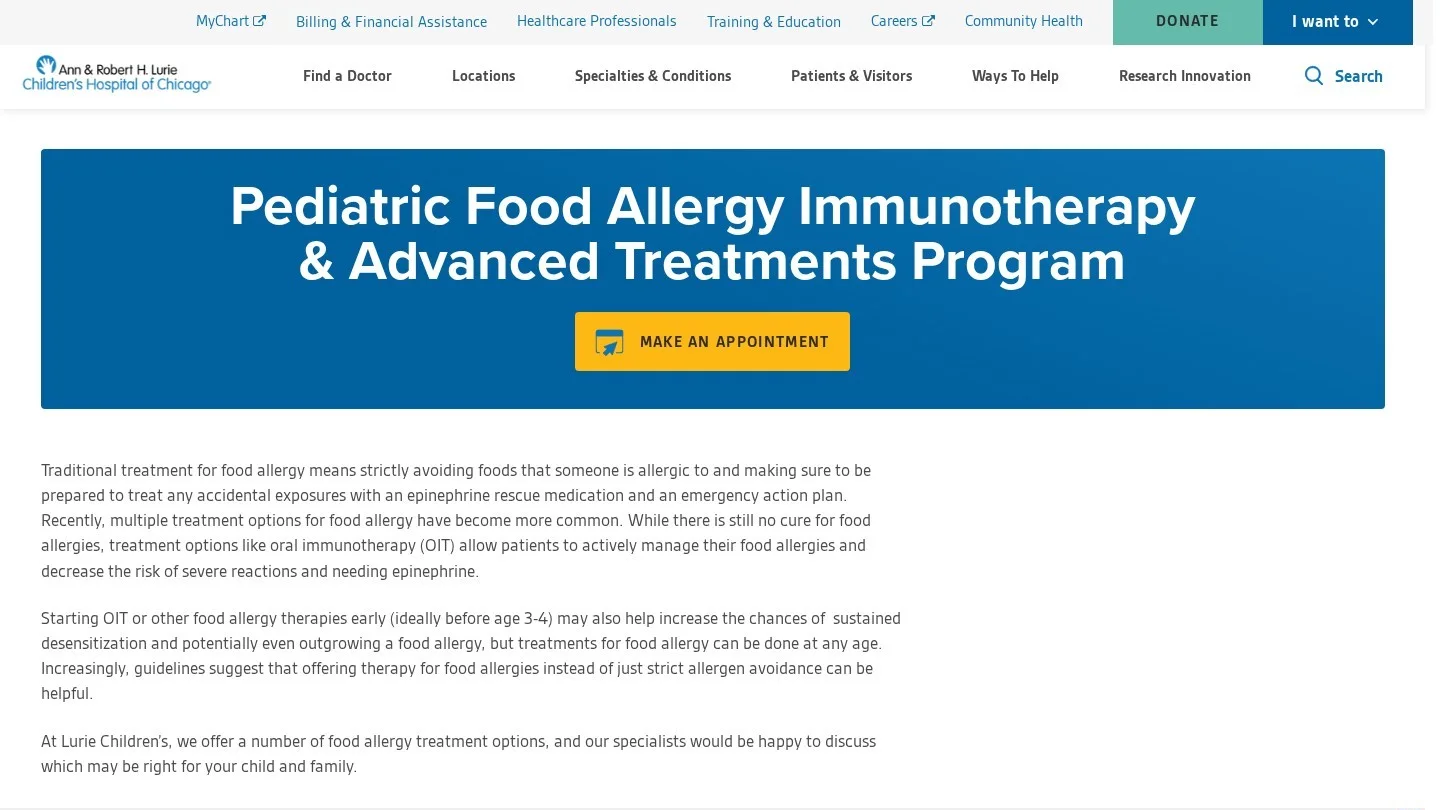
A comparison block like Lurie’s answers the “OIT vs Xolair” searches in our keyword table. So add one to each food allergy treatment page, and link every option to its own page.
Post Testing-Day Prep Before Patients Call
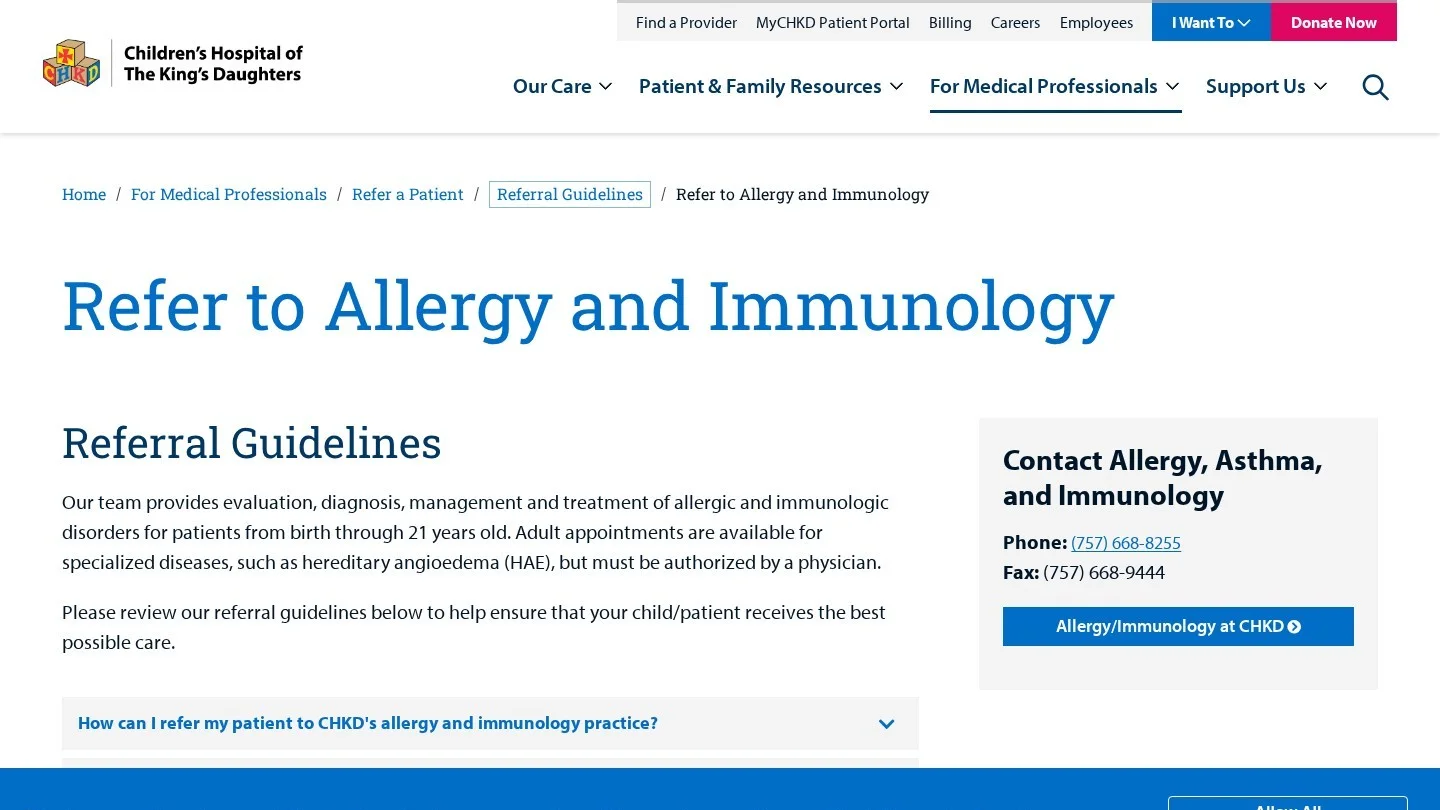
Testing day causes more front-desk calls than almost any other visit. For example, CHKD in Virginia gives prep advice on its referral page. Families should stop oral and nasal antihistamines about seven days before the first visit, if possible. It also says to plan for two to three hours at that visit.
Put the same kind of prep on a dedicated testing page. Then list which medicines to pause, what to wear, how long the visit takes and whether children can eat beforehand. Have your allergists approve each line, because rules differ by test.
Publish New Treatment News Within a Week
On February 16, 2024, the FDA approved Xolair for food allergy. It reduces allergic reactions, including anaphylaxis, that may occur after accidental exposure to one or more foods. It covers people aged 1 and older with IgE-mediated food allergy. It is not an emergency treatment, and patients still avoid their trigger foods.
Atlanta Allergy & Asthma posted an article on the approval with a quote from one of its board-certified allergists. The article explains how often the drug is given and repeats that epinephrine is still needed. Then it sends readers to the practice’s office locations. Careful news posts like this catch searches while patients are still hearing about a new drug.
Also, add a medical review line to news posts. The Atlanta article quotes an allergist but has no byline. A named reviewer and a review date could make a good article even more trustworthy.
Add a Penicillin Allergy Testing Page
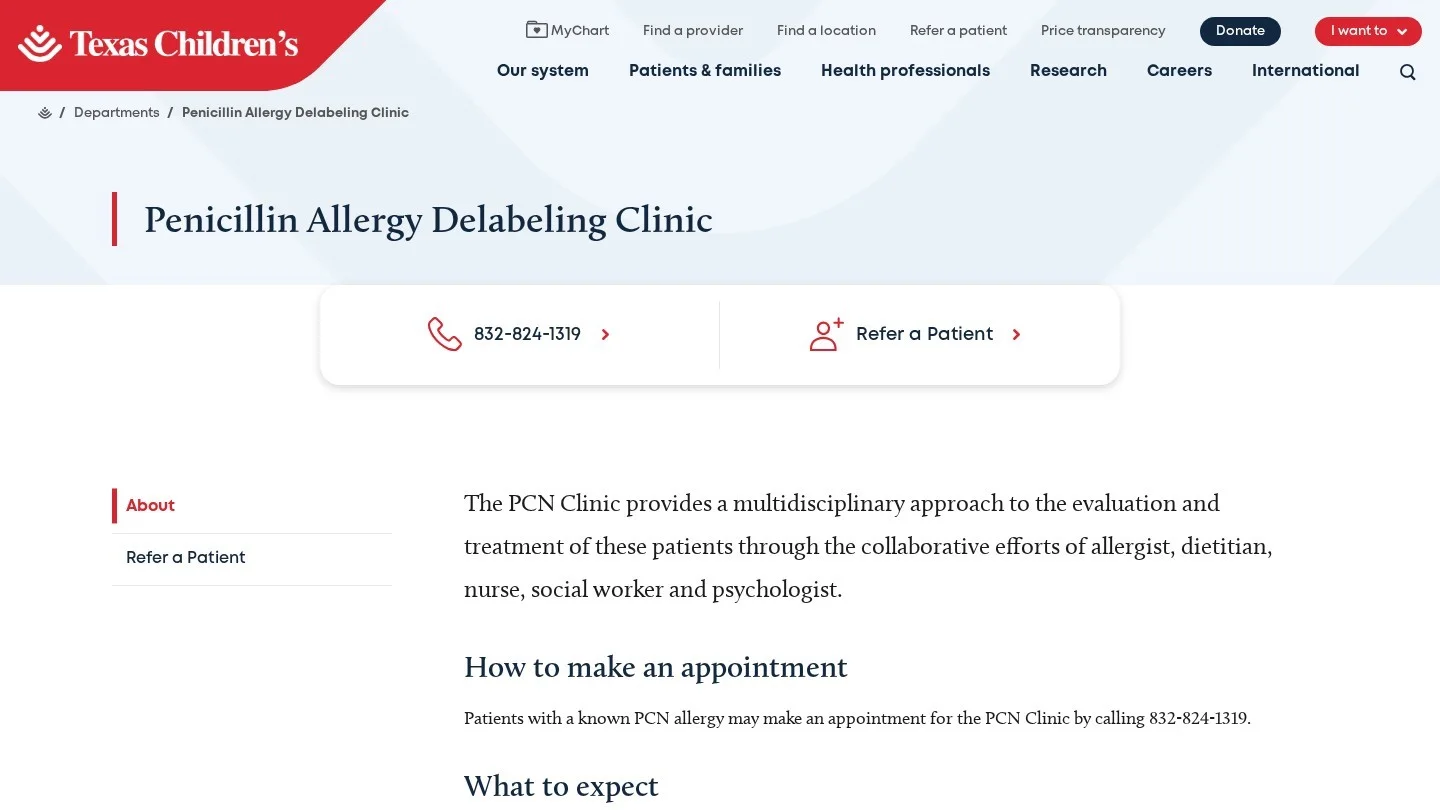
Next, add penicillin allergy testing, because it brings referrals from primary care doctors and hospitals. Texas Children’s Hospital explains the need on its Penicillin Allergy Delabeling Clinic page. The clinic puts the share of people with a penicillin allergy label at about 10%. Over 90% of them test negative and can take penicillins.
Next, the page lays out a two-visit process. The first visit is virtual and covers the history of the reaction. The second is in person, with skin testing and an oral penicillin challenge. The page also gives a referral link and a phone line, so doctors and parents both know the next step.
Cover Immunology Conditions Beyond Allergies
Immunology work brings in smaller groups of searches with high intent. Examples include primary immunodeficiency, recurrent infections, hereditary angioedema and chronic hives. CHKD names hereditary angioedema on the same referral page, so referring doctors know the service exists.
Give each condition its own page with signs, tests and treatment options. Then link it to the allergist who leads that clinic. Because these patients often travel farther, add drive times from nearby cities to the location pages.
Hand Primary Care Offices a Referral Page and Prep Sheet
Referring doctors need their own page too. For example, Family Allergy & Asthma keeps one for referring providers. It lists a fax number and a phone line, and it names conditions worth a referral. Those include severe seasonal rhinitis, chronic sinusitis, poorly controlled asthma, hives, penicillin allergy and stinging insect allergy.
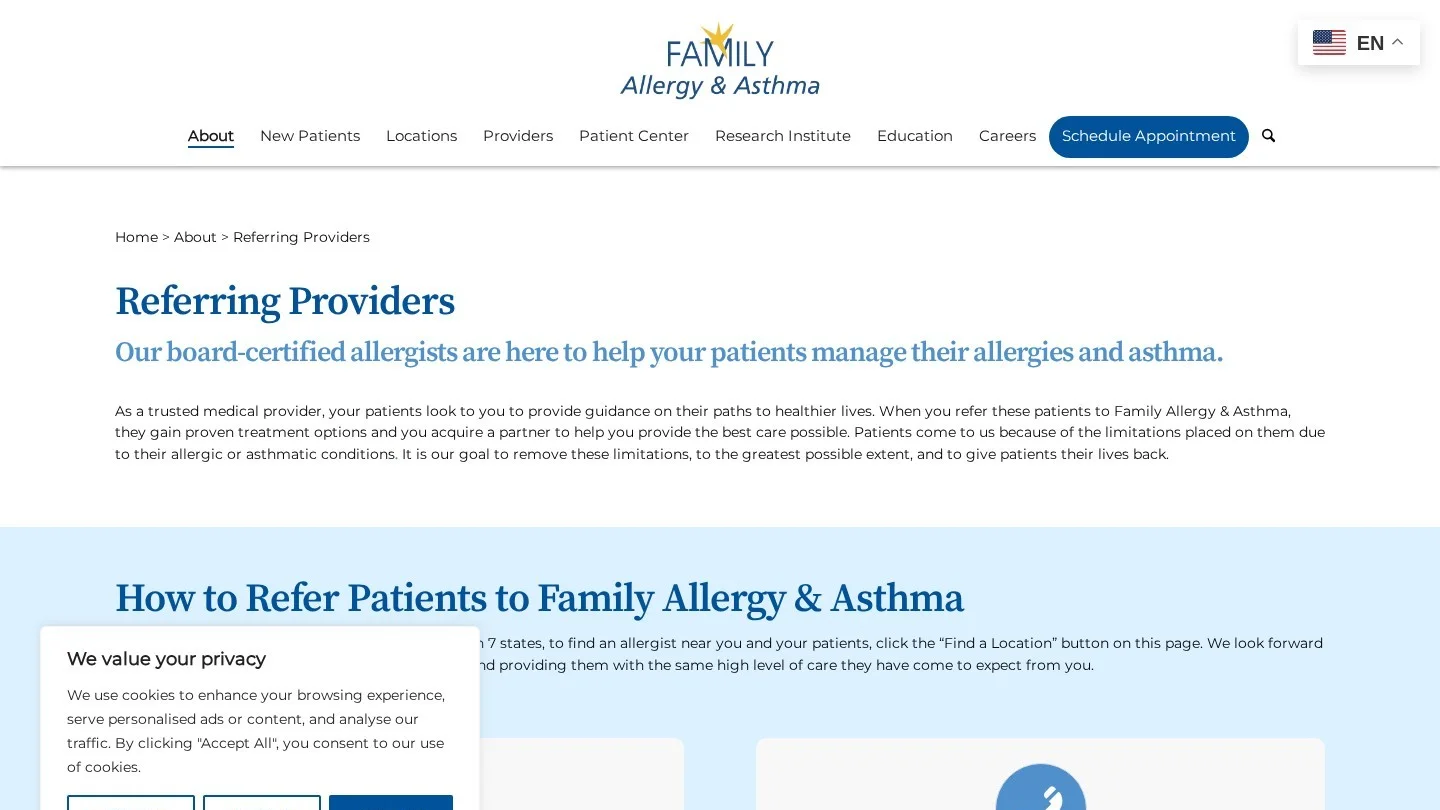
The page also mentions late evening hours at many offices, which makes weekly shots easier for working patients. In addition, it promises to keep the referring doctor informed. Copy that structure, and add a downloadable prep sheet that the referring office can hand to the patient.
Share Local Pollen Data People Check Daily
Atlanta Allergy & Asthma runs a pollen counting station certified by the National Allergy Bureau. Its pollen count page shows the daily total along with the top trees, grasses and weeds. Each type has its own scale. For instance, trees count as high from 90 grains per cubic meter, while grass reaches high at 20.
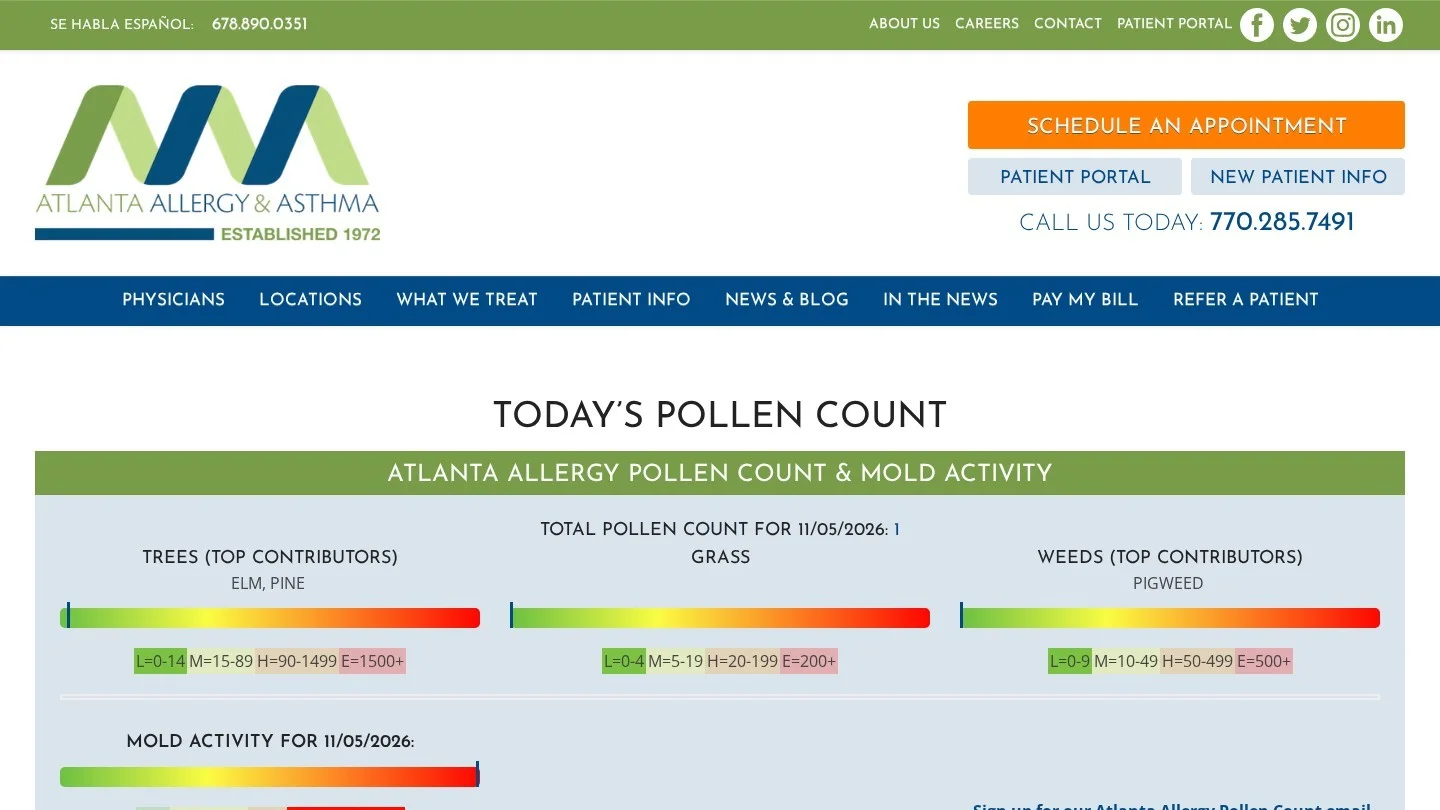
A daily count brings people back every spring. It also gives local reporters a number to quote. If you cannot run a certified station, publish a season calendar for your region, with the main trees, grasses and weeds by month. Then link it to your seasonal allergy and allergy shot pages.
Rank in Google Maps for Allergist Near Me Searches
Google ranks local results on relevance, distance and prominence. You control relevance through the Business Profile. So set “Allergist” as the primary category for each office. Next, type “allergy” and “immun” into the category box to see related options, and add only those that match services at that office.
Then fill the Services list with your tests and treatments, using the same words as your website. Add photos of the waiting room, the shot room and the outside sign. Also, use posts for seasonal updates, such as when tree pollen starts rising or when you add evening shot hours.
Google has removed the public Q&A section from Maps. An “Ask” feature now answers questions from the profile details and reviews. As a result, common answers belong in the profile description and on the location page. For example, cover shot hours, parking and the youngest age your allergists see.
Split Office and Allergist Profiles the Way Google Allows
Google’s guidelines allow a profile for a public-facing practitioner who can be reached at the verified location during stated hours. In a group, the office gets its own profile, and each allergist’s profile carries only that doctor’s name. A solo allergist who is also the brand shares one profile, named in the “Brand: Doctor Name” format.
Also, avoid the usual suspension triggers. A keyword-stuffed name such as “Best Allergist Allergy Shots Oak Park” breaks the name rule. Duplicate profiles for one office break the rules too, and so do profiles for unstaffed suites. Fix these first, because a suspended profile ranks nowhere.
Finally, link each profile to its own location page. The name, address and phone number should match that page exactly.
Register Every Allergist in the AAAAI and ACAAI Locators
The two national allergy societies both run public allergist finders. The AAAAI Find an Allergist tool lets patients search by city, state or ZIP code, with a radius from 10 to 200 miles. It also marks Fellows (FAAAAI) and allergists who speak Spanish.

Similarly, ACAAI calls its own Find an Allergist tool one of the most visited features on its website. Members update the listing from My Profile on the College member site. The profile holds a practice website link, Medicare and Medicaid status, languages, specialties, a photo and a bio. Updates can take up to 24 hours to appear.
Next, cover the general health directories. Claim profiles on Healthgrades, Vitals and WebMD Care, and on Zocdoc if you take online bookings. Also check the insurer directories for each plan you accept, because patients use them to confirm a doctor is in network.
| Directory | Who uses it | What to update |
|---|---|---|
| AAAAI Find an Allergist | Patients searching by city or ZIP code | Address, Spanish-speaking flag, Fellow status |
| ACAAI Find an Allergist | Patients using the College locator | Website link, Medicare and Medicaid status, languages, bio |
| Healthgrades | Patients comparing doctors | Board certification, hospital affiliations, insurance |
| Vitals and WebMD Care | Patients reading doctor profiles | Office address, specialties, photo |
| Zocdoc | Patients booking online | Visit types, open slots, insurance |
| Insurer directories | Members checking network status | Office address, new patient status |
| Apple Business Connect and Bing Places | Apple Maps and Bing users | Name, address, phone, hours |
Then keep a sheet with one row per listing, the login owner and the date you last reviewed it. When an allergist leaves, update every listing that same week. Old directory pages keep sending calls for years.
Attract Links Through the School Calendar and Pollen Season
Allergy practices have a link source most specialties lack, and that is the school year. AAFA publishes school forms such as an Asthma Action Plan, an Anaphylaxis Action Plan and a Medicine Authorization Form. It also tells parents to turn them in before the first day of school.

So build a back-to-school page that explains which forms your patients need and how to get them signed. Then send it to school nurses and district health offices in July. A clear local page gives them something useful to share with families.
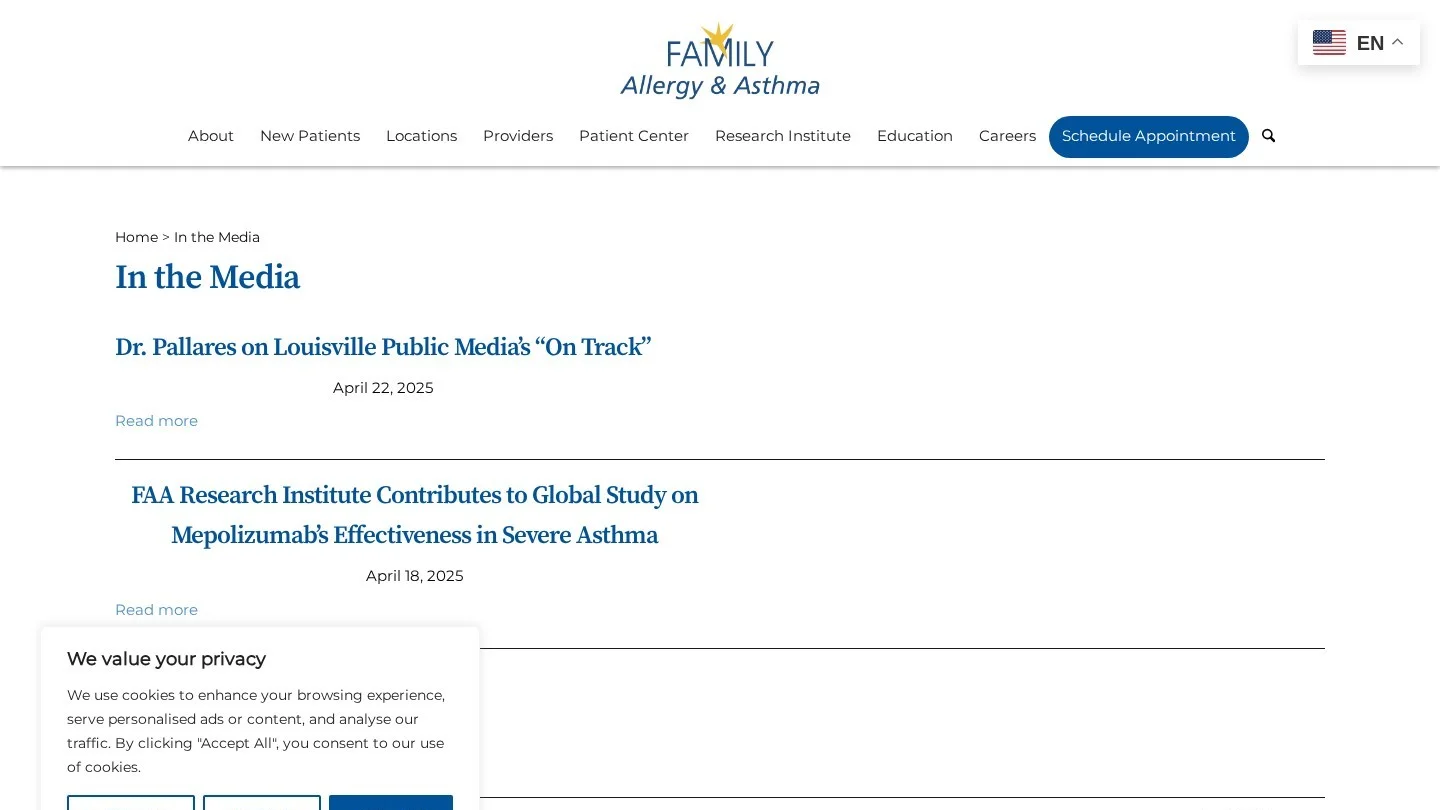
Local TV is the second source. Family Allergy & Asthma keeps an In the Media section that runs to 40 pages. In one March 2022 item, an allergist on a local show explains tree pollen and the coming grass season. Pitch your allergists to stations each spring and fall, and add every segment to a press page.
Other sources include hospital medical staff profiles and pediatric practices that refer to you. Food allergy walks and school health fairs bring event links too. Besides, a yearly summary of your own anonymized data, such as how many penicillin labels you removed, gives reporters something new to cover.
Google’s spam policies treat buying or selling links that pass ranking credit as link spam. Large link swaps and keyword-stuffed guest posts count too. If you pay for a sponsorship, the link should carry rel=”sponsored.” So politely decline any vendor that offers a bundle of links for a fee.
Display ABAI Certification and a Named Medical Reviewer
The American Board of Allergy and Immunology lists 6,928 active diplomates on its statistics page. ABAI was founded in 1971 as a conjoint board of the internal medicine and pediatrics boards. Patients and referrers can verify certification through ABAI and ABMS, so state it clearly.
Each allergist page should list board certification, fellowship training, hospital roles and the conditions that doctor treats. Also add society honors, such as Fellow of the AAAAI or ACAAI, where they apply. Then put a medical review line with a named allergist and a review date on every condition and treatment page.
Use the same practice name everywhere. That includes the website, Business Profiles, society locators and directories. For example, take a practice listed as “Lakeside Allergy” on Google and “Lakeside Allergy & Asthma Associates, PC” elsewhere. To software, those can look like two businesses.
Tell OIT Success Stories With Context and Consent
The FTC’s Endorsement Guides treat a testimonial about an unusual result as a claim that most patients get it. Adding “results may vary” does not change that. So a story about a child who now tolerates peanut needs context. Describe what the treatment is designed to do, and what most patients in your program reach.
Get a signed HIPAA authorization before you publish any patient’s name, photo or story. For a child, the parent or guardian signs. In addition, check your state medical board’s advertising rules before you use words like “cure” or “best.”
Shape Allergy Answers for AI Overviews and Chatbots
Google says no special markup is needed to appear in AI Overviews or AI Mode. A page only has to be indexed and eligible to show with a snippet. ChatGPT and Perplexity also show linked sources beside their answers, so a clear page that bots can crawl can be cited there too.
So write a short answer block under each question heading. Lead with the fact, then add the condition. For instance, a location page might say, “Shots at our Oak Park office run Monday to Thursday, and the last shot is at 6:00 p.m.” Then end each treatment page with five or six real questions from your front desk.
Next, keep practice facts the same across the web. That means your founding year, number of allergists, office names and services. For example, Atlanta Allergy & Asthma describes itself on its pollen page as the largest allergy group in Atlanta, with 19 locations. One clear line like that, repeated on every profile, gives AI tools a single version of the facts.
Finally, track the visits. Clicks from AI Overviews count in Search Console under the Web search type. For chatbots, build a GA4 channel group for chatgpt.com, perplexity.ai, gemini.google.com, copilot.microsoft.com and claude.ai. Our guide to tracking AI referral traffic for medical practices has the regex. If you want outside help with this work, we also list healthcare AEO and GEO agencies.
Time Review Requests to Testing Day and Shot Milestones
Allergy care gives you natural moments to ask. The first comes at the end of testing day, when the patient finally knows the triggers. Others come when the shot build-up phase ends, when a child finishes OIT or when a penicillin label is removed. So send the review request by text within a few hours of those visits.
Ask every patient, and do not filter. The FTC’s Endorsement Guides call it misleading to ask only the patients you expect to be happy. Also, the FTC rule on consumer reviews and testimonials, in effect since October 21, 2024, bans fake reviews and paying for positive ones. It also bans suppressing negative reviews through threats.
Reply to every review without confirming the person is a patient. For example, “Thank you for the kind words about our Oak Park team” works for praise. For a complaint, invite the reviewer to call the office manager by name. Never mention a test result, a diagnosis or a visit date. Practices that want help with this can compare healthcare reputation management agencies.
Judge SEO by Booked Allergy Visits, Season Over Season
Allergy traffic swings with pollen, so compare each month with the same month last year. For example, a March dip during a mild spring may mean nothing. Then judge growth by booked new-patient visits, because rankings alone do not fill the schedule.
Track four sources. Search Console shows queries and clicks, and GBP Performance shows calls, direction requests and website clicks for each office. Next, GA4 counts form submissions and booking clicks as key events. Finally, a call tracking vendor that signs a business associate agreement records calls from the website.
| Metric | Where to find it | What to compare |
|---|---|---|
| Clicks to treatment pages | Search Console, Pages tab | Same month last year |
| Queries with “allergist” or “allergy shots” | Search Console, Queries tab | Average position trend |
| Calls and direction requests per office | GBP Performance | Each office against the others |
| Booking clicks and form submissions | GA4 key events | Month over month and year over year |
| New-patient calls | Call tracking with a BAA | Share of calls that booked a visit |
| AI assistant visits | GA4 custom channel group | Landing pages they reach |
| New reviews and rating | Business Profile | Reviews per office per month |
For context on returns from digital channels, see our healthcare digital marketing ROI statistics. Still, your own booked visits are the number that counts.
Spend Your First 90 Days in This Order
The first month fixes what blocks rankings. The second builds pages, and the third builds trust and links. We set the order around allergy seasons, so shift the weeks if spring pollen is close.
| Weeks | Tasks | Done when |
|---|---|---|
| 1 to 2 | Audit indexing, speed and HTTPS; check every Business Profile name and category | Every office profile uses “Allergist” and points to a matching location page |
| 3 to 4 | Fix duplicate town pages, sitemap and canonicals; remove pixels from forms | Page indexing report shows all key pages as indexed |
| 5 to 6 | Write or rewrite allergy shot, testing and food allergy pages | Each page lists visits, hours and cost steps |
| 7 to 8 | Add OIT, penicillin testing, biologics, immunology and referral pages; add schema | Rich Results Test passes on each template |
| 9 to 10 | Claim AAAAI, ACAAI and health directory listings | Listing sheet complete with logins |
| 11 | Publish a pollen calendar and a back-to-school forms page; pitch local TV | Two outreach emails sent each week |
| 12 to 13 | Launch review requests; build the monthly report | First report sent to the practice |
Weigh the Trade-Offs Allergists Ask Us About
Do Allergy Shots and Allergy Drops Need Separate URLs?
No. Patients search for them as separate treatments, and they compare them. So build one page for each, then add a short comparison block on both pages that links across.
Will Maps Show Us in Suburbs Without an Office?
Rarely in Maps, because distance is one of Google’s local ranking factors. However, organic pages can rank for regional terms such as a county name. So mention nearby towns on the closest location page.
Is It Safe to Mention Xolair by Name on Treatment Pages?
Yes. Your website can describe the treatments your allergists prescribe, within each drug’s FDA-approved uses. Google Ads is stricter about prescription drug names in ads, so check the policy before you run campaigns.
Can Two Allergists at One Office Each Appear in Maps?
Yes. Each public-facing allergist may have a profile under Google’s practitioner rules, alongside the office profile. Use the doctor’s name only, and link the profile to the allergist page. Also, keep one profile per doctor, even if that doctor works at three offices.
How Do We Know It Is Time to Hire Outside SEO Help?
Groups with several offices, an OIT program and an immunology clinic often need help with technical work and content. In that case, compare firms in our list of healthcare SEO agencies or our medical practice SEO agencies. You can also ask us to match you with an agency.
Compare Agencies for This Topic
More From the Blog

Statistics
Private Hospital vs Public Hospital Cost Statistics
Hospital costs by ownership in the US, India and the UK, with our own ratios, growth rates and price-page advice for hospital marketers.
Nov 5, 2026

Statistics
Healthcare Mobile Search Statistics
Smartphone ownership, online health lookups by age, portal app use, telemedicine and page speed limits, with our own per-1,000-adults model for clinics.
Nov 5, 2026

Statistics
Healthcare Digital Marketing ROI Statistics
Hospital ad effects, health system marketing budgets, cost per patient by channel and Google's return claim, with our own math for clinics and hospitals.
Nov 5, 2026