
The safest social media emojis for doctors are the medical object emojis: 🩺 stethoscope, 🦷 tooth, 🫀 anatomical heart, 🫁 lungs, 🩻 X-ray, 🧬 DNA double helix, 💉 syringe and 🩹 adhesive bandage. They name a topic without adding an emotion that readers might misread. Use one to three per post, place them at the end of a sentence or before a link, and pick the ones that match your specialty.
Face emojis carry more risk. In a 2016 study of popular emoji, people rating the same image disagreed on whether it was positive, neutral or negative 25% of the time (Miller et al., ICWSM 2016). This guide gives emoji sets by specialty and post type, the accessibility rules from US and UK government guidance, captions you can adapt, and an awareness month calendar.
TL;DR: Pick object emojis that match your specialty, such as 🦷 for dentistry or 🫁 for pulmonology, and use no more than three per post. Put them at natural stopping points, never in a row, because screen readers read each one aloud by name. Avoid face emojis on serious topics, since their look and meaning change across Apple, Google, Microsoft and Samsung. Tie posts to federal health observances such as American Heart Month in February.
Keep It to About Three Emojis, Placed at Natural Stops
- Section508.gov advises limiting emojis, avoiding several in a row, and placing them at natural stopping points such as the end of a paragraph (Section508.gov).
- UK Local Government Association guidance says three emojis should be enough in most cases and warns against repeating the same emoji in a post (LGA).
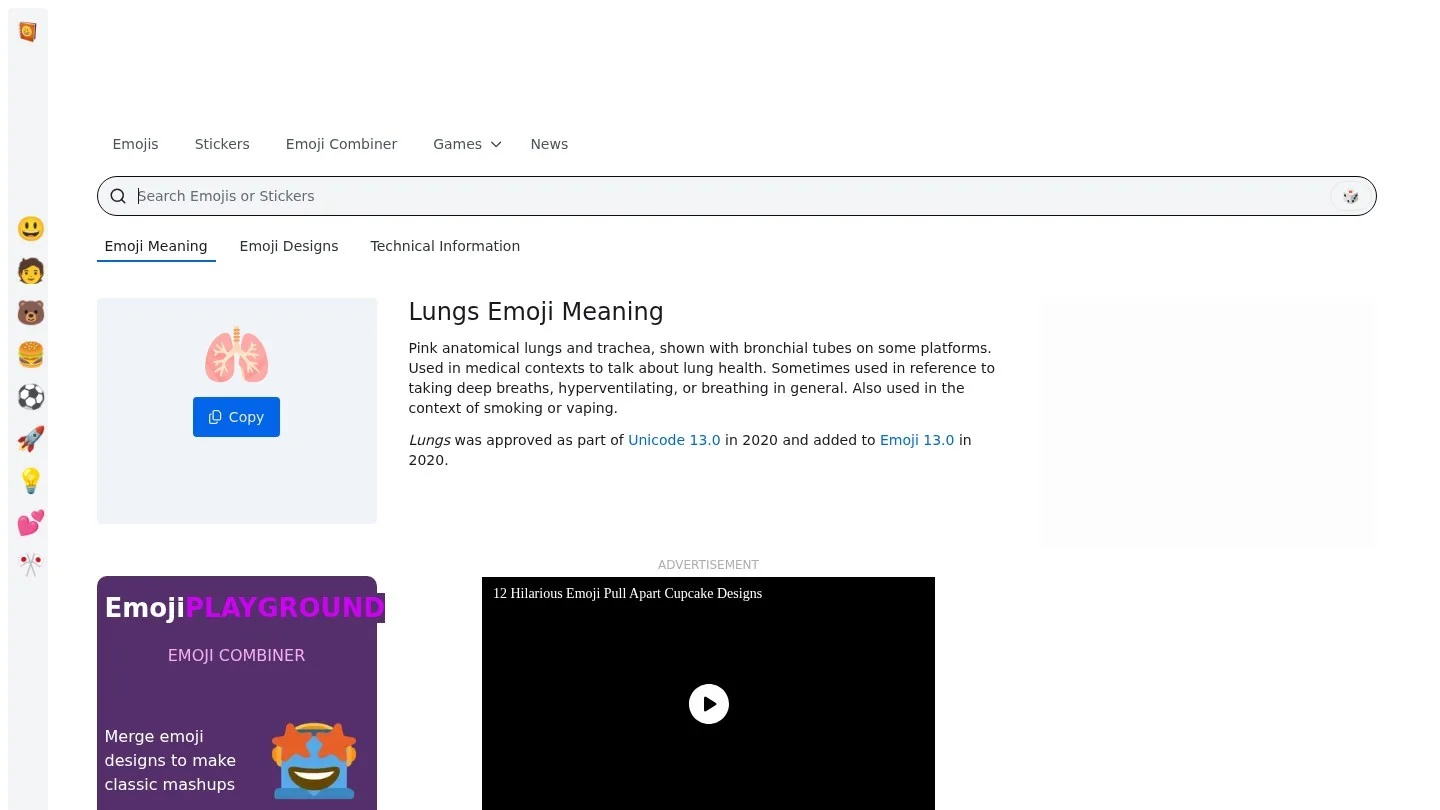
- The 🩻 X-ray emoji was approved in Emoji 14.0 in 2021, and 🫁 lungs in Emoji 13.0 in 2020 (Emojipedia).
- The X-ray emoji shows a chest on most platforms, a skull on Microsoft and a hand on X, so the same post looks different to different patients.
- In a 304-person study, Apple’s 😁 grinning face with smiling eyes differed by more than 4.7 points on a -5 to 5 sentiment scale from the other four platforms’ versions (Miller et al., 2016).
- ODPHP lists recurring national health observances, such as American Heart Month in February and National Diabetes Month in November, that give each month a ready post theme.
Medical Emojis Doctors Can Use, With Unicode Names
Every emoji is a Unicode character with an official name and a code point. The name matters because it is close to what a screen reader says aloud. The table below lists the medical emojis that work best on a practice page. We checked each code point and name against the Unicode Character Database. Two of the newer ones were confirmed on Emojipedia.
| Emoji | Unicode Name | Code Point | Best Use |
|---|---|---|---|
| 🩺 | STETHOSCOPE | U+1FA7A | Primary care, checkups, general practice news |
| 🦷 | TOOTH | U+1F9B7 | Dental and orthodontic posts |
| 🫀 | ANATOMICAL HEART | U+1FAC0 | Cardiology and heart health |
| 🫁 | LUNGS | U+1FAC1 | Pulmonology, asthma, smoking cessation |
| 🩻 | X-RAY | U+1FA7B | Radiology, imaging, orthopedics |
| 🧬 | DNA DOUBLE HELIX | U+1F9EC | Genetics, oncology, research news |
| 💉 | SYRINGE | U+1F489 | Vaccines, injections, blood draws |
| 🩹 | ADHESIVE BANDAGE | U+1FA79 | Minor injuries, wound care, first aid tips |
| 🩸 | DROP OF BLOOD | U+1FA78 | Lab work, blood donation, diabetes |
| 🦴 | BONE | U+1F9B4 | Orthopedics, bone density |
| 🧠 | BRAIN | U+1F9E0 | Neurology, mental health |
| 🦻 | EAR WITH HEARING AID | U+1F9BB | Audiology and hearing care |
| 💊 | PILL | U+1F48A | Medication reminders, pharmacy |
| 🧪 | TEST TUBE | U+1F9EA | Lab results, research |
| 🦠 | MICROBE | U+1F9A0 | Infection prevention, flu season |
| 🩼 | CRUTCH | U+1FA7C | Injury recovery, physical therapy |
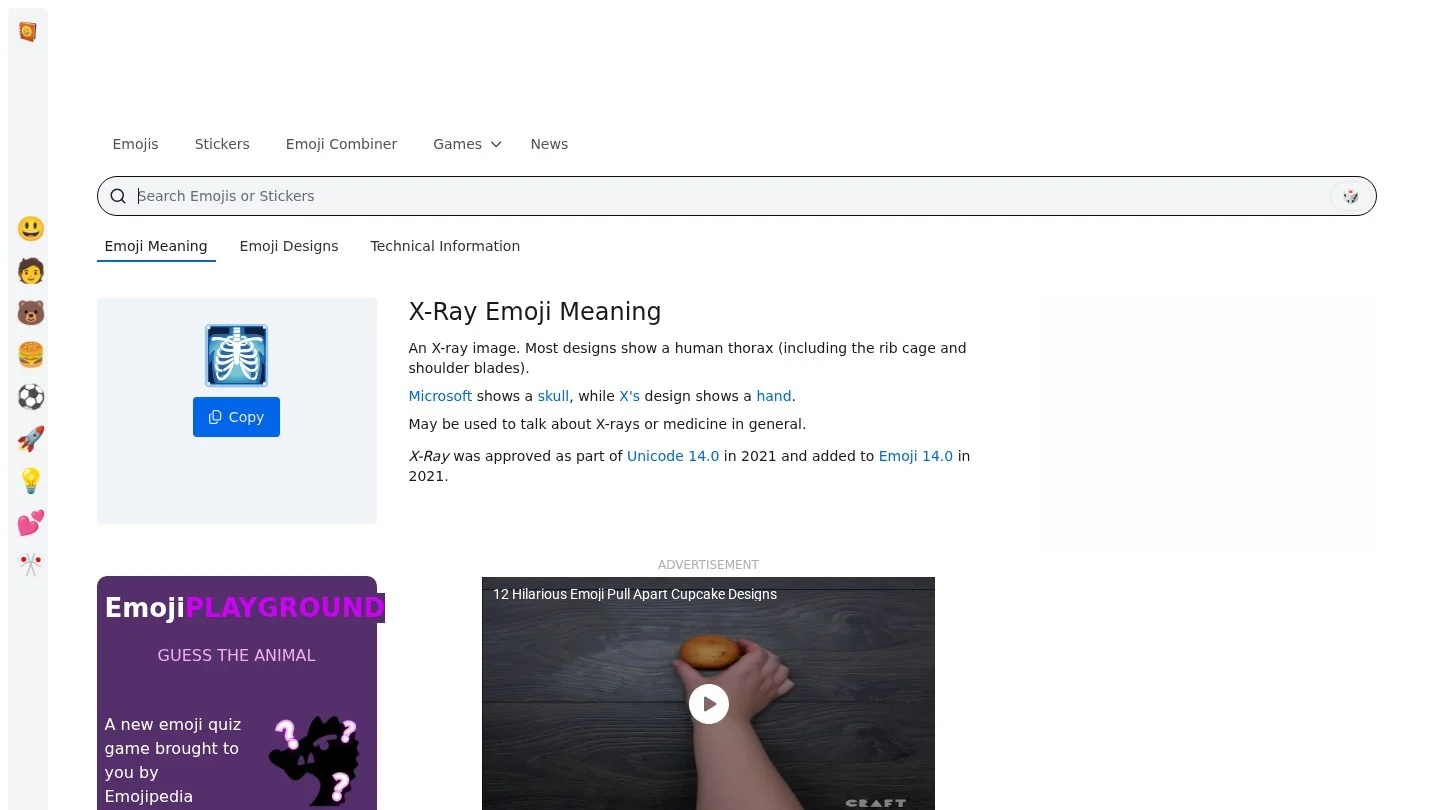
Some medical emojis are newer than many phones. Emojipedia records 🩻 X-ray as part of Emoji 14.0, approved in 2021 (Emojipedia). It records 🫁 lungs as part of Emoji 13.0, approved in 2020 (Emojipedia). Before you schedule a post, preview it on an older phone in the office to see whether the character displays.
The “health worker” emoji 🧑⚕️ is not one character. It is 🧑 ADULT plus ⚕ STAFF OF AESCULAPIUS, joined by an invisible zero width joiner. Phones that support the sequence show one image of a clinician. Phones that do not may show the two parts side by side. That makes it a poor choice for a headline, though it works fine at the end of a caption.
Emoji Sets by Medical Specialty
A small, consistent set of emojis works like a visual signature. Patients who follow a dental office start to link 🦷 with that practice’s tips. The sets below pair one anchor emoji that names the specialty with two or three support emojis for common topics.
| Specialty | Anchor Emoji | Support Emojis | Example Topic |
|---|---|---|---|
| Primary care | 🩺 | 💉 🌡️ 📋 | Annual physicals, flu shots |
| Dentistry and orthodontics | 🦷 | 🪥 😁 📅 | Brushing tips, checkup reminders |
| Cardiology | 🫀 | ❤️ 🏃 🥗 | Blood pressure, exercise |
| Pulmonology | 🫁 | 🚭 🌿 😷 | Asthma, quitting smoking |
| Radiology and imaging | 🩻 | 🔬 📋 | Screening prep, new scanner |
| Orthopedics | 🦴 | 🦵 🦶 🩼 | Joint replacement recovery |
| Physical therapy | 🦵 | 🏋️ 🧘 🩼 | Home exercises |
| Neurology | 🧠 | 💤 🔬 | Migraine, sleep |
| Mental health | 🧠 | 🫶 💬 🌿 | Coping skills, support groups |
| Eye care | 👁️ | 👓 🔍 | Eye exams, screen time |
| Hearing care | 🦻 | 👂 🔔 | Hearing tests |
| Dermatology | 🧴 | ☀️ 🔍 | Sunscreen, mole checks |
| Pediatrics | 👶 | 🧸 💉 🍼 | Well-child visits, vaccines |
| Obstetrics and gynecology | 🤰 | 🍼 🩷 | Prenatal care, screenings |
| Oncology and genetics | 🧬 | 🎗️ 🔬 | Screening, research news |
| Lab and diabetes care | 🩸 | 🧪 🥗 | A1C tests, fasting labs |
Two rules keep these sets working. First, use the anchor emoji in most posts and rotate the support emojis, so no single post repeats the same one. Second, match the emoji to the body part or tool, not to a mood. A cardiology post about blood pressure reads clearly with 🫀, while a red heart ❤️ can read as “love” or “like”. Practices that want a full content plan for a specialty can compare healthcare social media marketing agencies, or look at dental social media marketing agencies and cardiology marketing agencies for those specialties.
Which Emojis to Use by Post Type
The post type decides how many emojis fit and where they go. A tip can carry a little warmth. An office closure needs clarity first. The four types below cover most of what a practice posts in a year.
Health Tips
Lead with the tip in plain words and put one topic emoji at the end. If the post has a short list, an emoji can mark the end of the list, but do not start every line with one. A screen reader would read the emoji name before each item, which slows the listener down. Good choices are the specialty anchor plus one action emoji, such as 🥗 for diet or 🏃 for exercise.
Appointment Reminders
Reminders work best with one scheduling emoji, such as 📅 calendar or ⏰ alarm clock, placed after the key date. Keep the date, time and booking step in words, since those are what the patient needs. Never post a reminder that names or hints at a specific patient, even with an emoji in place of the name. The AMA’s ethics opinion on social media bars posting identifiable patient information (AMA Code of Medical Ethics, Opinion 2.3.2).
Awareness Months
Awareness posts can carry two emojis: the body part and a ribbon or heart. The 🎗️ reminder ribbon is a neutral symbol for any cause. Write the hashtag in camel case, such as #AmericanHeartMonth. Section508.gov says screen readers may read a multiword hashtag as one long word unless each word is capitalized (Section508.gov).
Office Closures and Schedule Changes
Put the facts first: which office, which dates, when it reopens, and where to go for urgent needs. One emoji is enough, such as 📅 for dates or 📍 round pushpin for a location note. Seasonal emojis such as 🦃 turkey or 🎄 Christmas tree can soften a holiday notice. Leave them out of closures caused by weather or emergencies, where a playful tone would feel wrong.
Emoji Accessibility Rules for Medical Posts
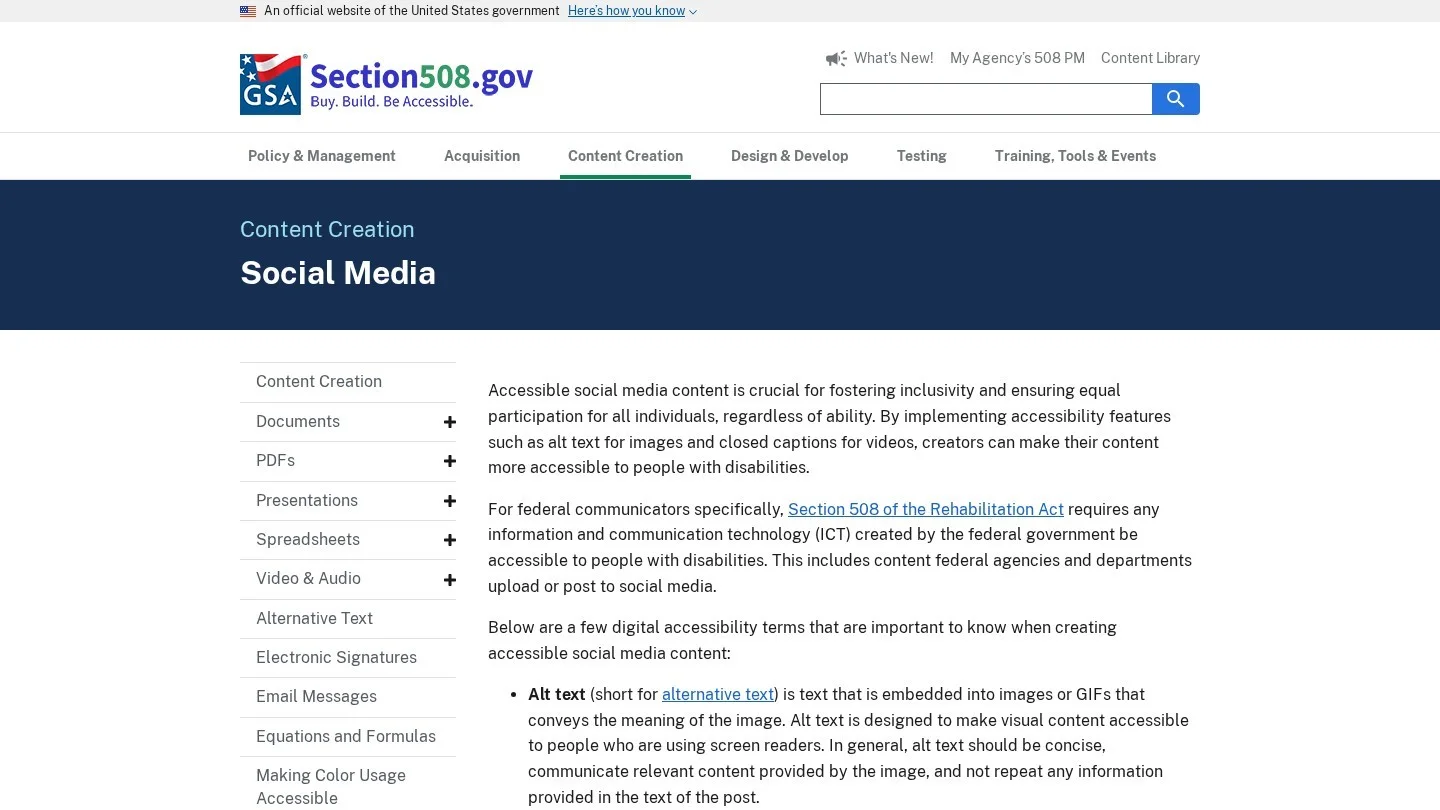
Patients who are blind or have low vision often use screen readers, which read each emoji aloud by its name. The US federal accessibility site Section508.gov says too many emojis in one post “can be confusing or annoying” for screen reader users, and that several in a row cause the same problem. It also says emojis placed between sentences can be “disorienting and distracting”. Its advice is to place them at natural stopping points, “such as at the end of a paragraph or prior to a link that concludes a post” (Section508.gov).
The UK Local Government Association gives a number. It says “in most cases three emojis should be enough” and warns against using the same emoji more than once in a post. Its example of a surprise is a sarcasm emoji that a screen reader announces as “information desk person” (LGA). That matches the Unicode name of 💁, INFORMATION DESK PERSON.
Here is how a short flu post sounds when the Unicode names are read in place of the emojis. The caption “Flu shots are here 💉🦠🩹” becomes “Flu shots are here syringe microbe adhesive bandage”. That adds four spoken words to a four-word message, so the emojis double its spoken length. The fix is to keep one emoji: “Flu shots are here. Walk in Monday to Friday, 8 to 5. 💉” Always add alt text to images too, and on Facebook write your own custom alt text instead of using the automatic one, as Section508.gov advises.
Professionalism and Misinterpretation Risks
The main risk with emojis is that the reader sees a different meaning than you meant. A research team surveyed 304 people about 22 popular emoji, each shown as rendered by Apple, Google, Microsoft, Samsung and LG. Sentiment was rated on a scale from -5 (strongly negative) to 5 (strongly positive). People looking at the exact same image disagreed on whether it was positive, neutral or negative 25% of the time (Miller et al., 2016).
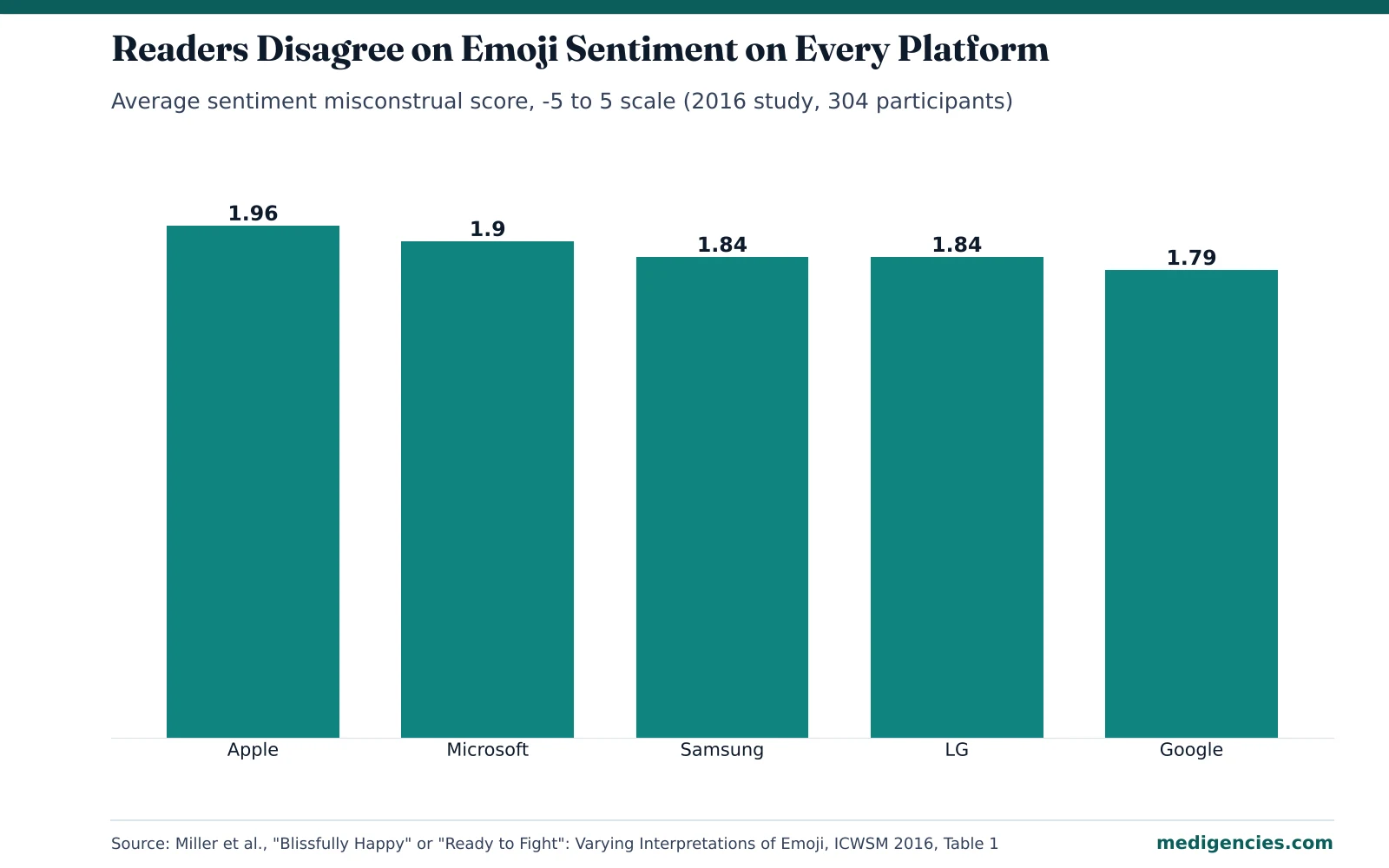
The chart shows the average gap between two readers’ sentiment ratings of the same rendering, by platform. Every platform averaged close to 2 points on the -5 to 5 scale. Across platforms, the gap grew to 2.03 points on average, compared with 1.86 within a platform (Miller et al., full paper). One emoji stood out. Apple’s 😁 grinning face with smiling eyes differed from each of the other four versions by more than 4.7 points. A doctor who posts it on an iPhone may look cheerful to one patient and grimacing to another.
For medical accounts, that study points to three practical rules. Use object emojis, which name a thing, in place of faces, which suggest an emotion. Leave emojis out of posts about deaths, serious diagnoses, safety recalls and public health emergencies. Keep the tone of a doctor’s personal account and the practice account in line with each other, since patients see both. The AMA opinion on social media also asks physicians to keep patient boundaries online and to consider keeping personal and professional content apart (AMA Opinion 2.3.2). For more on how doctors set tone on a professional network, see our guide to LinkedIn marketing strategies for doctors.
How Emojis Look on Different Platforms
Each company draws its own version of every emoji, so the same code point can look quite different. Emojipedia notes that most designs of 🩻 X-ray show a human chest with ribs and shoulder blades. Microsoft’s version shows a skull, and the design used on X shows a hand (Emojipedia). A radiology practice that posts 🩻 about chest imaging is showing some followers a skull.
The 🫁 lungs emoji shows pink lungs and a trachea, with bronchial tubes on only some platforms. Emojipedia also notes it is used for deep breaths and for smoking or vaping (Emojipedia). Context in the caption keeps the meaning clear. Before a campaign, look up each emoji on Emojipedia and view every vendor’s design. If one platform’s version could confuse a patient, choose a different emoji.
Ready-to-Use Captions With Emojis for Medical Practices
The captions below are original examples written for this guide. Each uses one to three emojis, places them at stopping points, and keeps the facts in words. Replace the bracketed details with your own.
- Primary care, flu season: “Flu shots are now available at [clinic name]. Walk in Monday to Friday, 8 a.m. to 5 p.m., or book online. 💉”
- Dental tip: “Brush for two full minutes, twice a day, and replace your brush when the bristles splay. Your gums will thank you. 🦷🪥”
- Cardiology, awareness month: “February is #AmericanHeartMonth. Do you know your blood pressure numbers? Our team can check them at your next visit. 🫀”
- Pulmonology: “Thinking about quitting smoking? Our clinicians can walk you through your options. Call [phone] to start. 🫁🚭”
- Appointment reminder: “School physicals fill up fast in July. Book your child’s visit now to get the date you want. 📅”
- Office closure: “Our [city] office will be closed Thursday, November 26, and will reopen Friday at 8 a.m. For urgent needs, call [after-hours line]. 🦃”
- Dermatology: “Sunscreen is not only for summer. Use broad-spectrum SPF every day you spend time outside. ☀️🧴”
- New provider: “Please welcome Dr. [name], who joins our orthopedics team this month and sees patients at our [location] office. 🦴”
- Mental health: “This May, we are talking about mental health. Asking for help is a sign of strength, and our counselors are here when you are ready. 🧠🫶”
Notice what these captions avoid. None of them uses a face emoji, none stacks more than two emojis, and none mentions a patient. Each one would still make sense if every emoji were removed. That is the best test of a medical caption. For examples of how large health systems handle tone across platforms, see our roundup of healthcare brands on social media.
Health Awareness Month Calendar With Matching Emojis
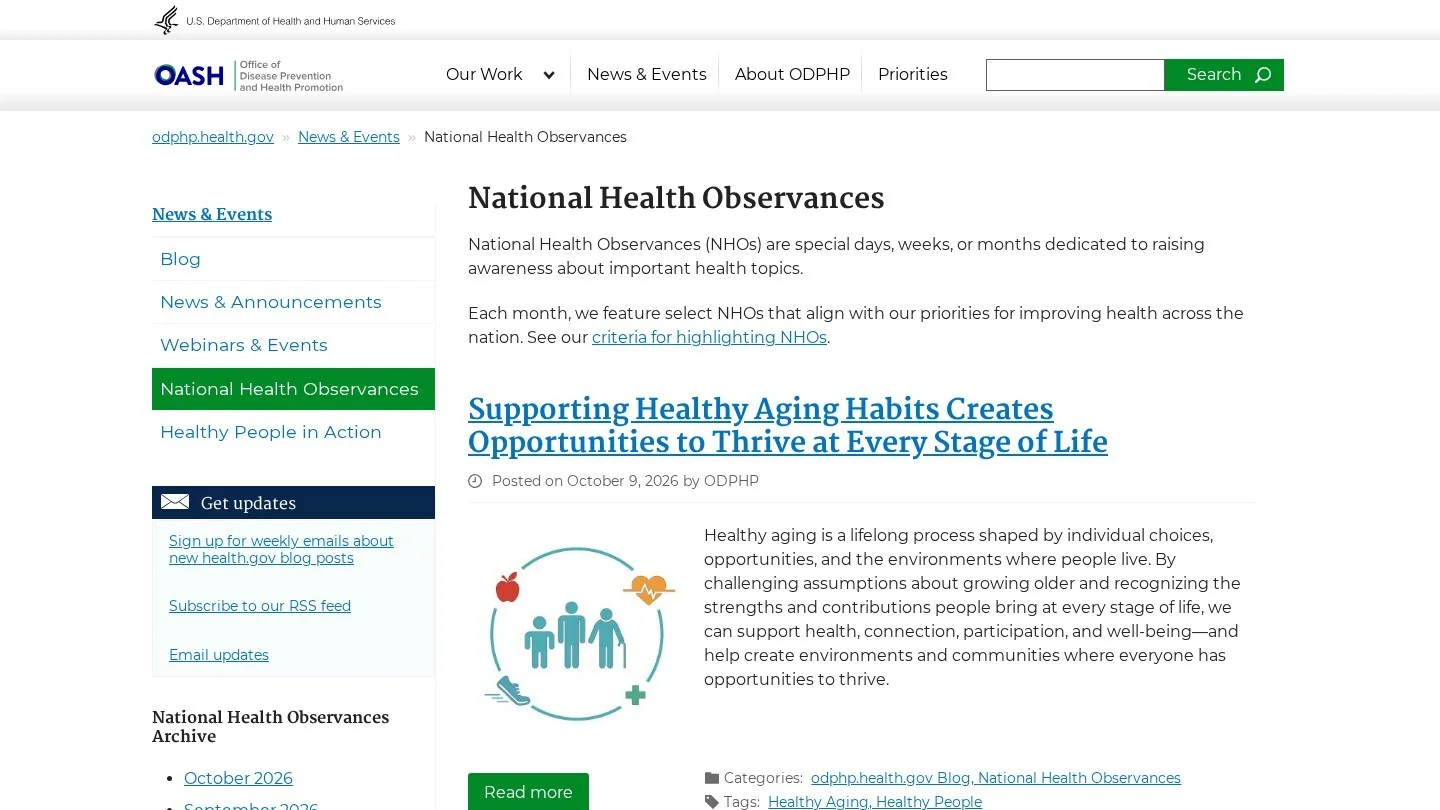
The US Office of Disease Prevention and Health Promotion (ODPHP) publishes posts on national health observances each month. The calendar below lists observances from those posts and pairs each with emojis that name the topic. Month-long observances repeat each year. Specific days and weeks can move, so the table gives the year the date was published.
| Month | Observance | Emojis | Fits These Specialties |
|---|---|---|---|
| February | American Heart Month (NHLBI) | 🫀 ❤️ | Cardiology, primary care |
| February | National Girls and Women in Sports Day (early February) | 🏃 💪 | Sports medicine, orthopedics |
| May | Mental Health Awareness | 🧠 🫶 | Mental health, primary care |
| May | National Physical Fitness and Sports Month | 🏃 🦵 | Physical therapy, orthopedics |
| May | Older adults’ health | 🧓 🩺 | Geriatrics, home health |
| May | Women’s health | 🩷 🩺 | OB-GYN, women’s health |
| September | Healthy Aging Month | 🧓 🥗 | Primary care, senior living |
| September | National Recovery Month (SAMHSA) | 🫶 🎗️ | Addiction treatment, mental health |
| September | National Sickle Cell Awareness Month | 🩸 🎗️ | Hematology, primary care |
| October | Health Literacy Month | 📖 💬 | All practices |
| October | National Breast Cancer Awareness Month | 🎗️ 🩷 | OB-GYN, radiology, oncology |
| November | National Diabetes Month | 🩸 🥗 | Endocrinology, primary care |
| November | National COPD Awareness Month | 🫁 | Pulmonology |
| November | U.S. Antibiotic Awareness Week (CDC; mid-to-late November) | 💊 🦠 | Primary care, urgent care, pediatrics |
Use the calendar to plan a year of posts in one sitting. Pick the three or four observances that match your services and draft the captions in advance. A women’s health practice might post in May and October, while a pulmonology group would focus on November. Our directories of mental health marketing agencies and women’s health marketing agencies list firms that build observance campaigns for those fields.
A Simple Emoji Policy for Your Practice
Write the rules down so every staff member who posts follows the same style. A one-page policy can list your approved anchor and support emojis, the three-emoji limit, the rule about placing them at stopping points, and the topics where emojis are never used. Add a final check before posting: read the caption aloud with each emoji replaced by its name. If it sounds odd, cut an emoji.
Review the policy once a year, when new emojis are released and platforms update their designs. If you track how posts perform alongside your website, our guide to healthcare SEO tools covers the analytics side, including HIPAA limits on tracking tags. For a partner who can run the whole program, get matched with a vetted agency.
Doctor Emoji, X-Ray Emoji and Screen Reader Questions
Is It Professional for Doctors to Use Emojis on Social Media?
Yes, when they are used sparingly and on light topics. Object emojis such as 🩺 or 🦷 add a topic cue without an emotion. Leave them out of posts about serious diagnoses, deaths or emergencies, and never post anything that could identify a patient.
What Is the Doctor Emoji?
The clinician image 🧑⚕️ is a sequence of 🧑 ADULT and ⚕ STAFF OF AESCULAPIUS joined by a zero width joiner. Many practices use 🩺 STETHOSCOPE (U+1FA7A) as a simpler single-character symbol for medicine.
Is There an X-Ray Emoji?
Yes. 🩻 X-RAY is code point U+1FA7B and was approved in Emoji 14.0 in 2021. Most platforms draw a chest, but Microsoft shows a skull and X shows a hand (Emojipedia).
How Many Emojis Should a Medical Post Have?
Three at most. UK LGA guidance says three should be enough in most cases, and Section508.gov advises limiting emojis and avoiding several in a row because screen readers read each one aloud.
Do Screen Readers Read Emojis?
Yes. Screen readers announce each emoji by name, so “💉🦠” is read as words such as “syringe microbe”. Place emojis at the end of a sentence or before a closing link so they do not break up the message.
Emojipedia, Section508.gov, AMA Ethics and ODPHP Calendars We Used
- Miller et al., “Blissfully Happy” or “Ready to Fight”: Varying Interpretations of Emoji, ICWSM 2016
- Miller et al., full paper PDF
- Section508.gov: Social Media
- Local Government Association: Guide to Creating Accessible Social Media Content
- Emojipedia: X-Ray Emoji
- Emojipedia: Lungs Emoji
- AMA Code of Medical Ethics Opinion 2.3.2: Professionalism in the Use of Social Media
- ODPHP: National Health Observances
- ODPHP: February National Health Observances (2024)
- ODPHP: May National Health Observances (2024)
- ODPHP: September National Health Observances (2024)
- ODPHP: October National Health Observances (2024)
- ODPHP: November National Health Observances (2024)
Compare Agencies for This Topic
Cardiology Marketing AgenciesDental Marketing AgenciesDermatology Marketing AgenciesHealthcare Branding AgenciesHealthcare Content Marketing Agencies
More From the Blog
Guides
Cataract Surgery Center SEO: The Complete Guide
A full SEO guide for cataract surgery centers, from keywords and technical fixes to lens pages, Business Profiles, directories, links, AI citations, reviews and…
Nov 4, 2026

Guides
Interventional Cardiology SEO Guide for Cath Lab and Structural Heart Programs
A full SEO guide for interventional cardiology groups, from keyword research and technical fixes to procedure pages, Business Profiles, citations, links, AI search, reviews…
Nov 4, 2026

Statistics
Childhood Cancer Survival Rate Statistics
Childhood cancer survival rates by type, age and decade, with Medigencies calculations and guidance on communicating survival data ethically to families.
Nov 4, 2026