
Cataract surgery center SEO is the work of getting a practice’s lens, cost, surgeon and surgery center pages found in Google Search, Google Maps and AI answers by people planning cataract surgery. Most patients are on Medicare and many are past 70, so an adult child often runs the first search. The job runs from keyword research and technical fixes through page content, Business Profiles, directories, links, brand trust, AI citations and reviews, and ends with a monthly report.
We built this plan from public pages at eye practices, surgery centers and hospital eye departments, plus the Medicare and CMS rules on premium lenses. Prices come from one practice’s published list. Anything we calculated is labelled.
Start With the Words Patients Use Before Their First Eye Exam
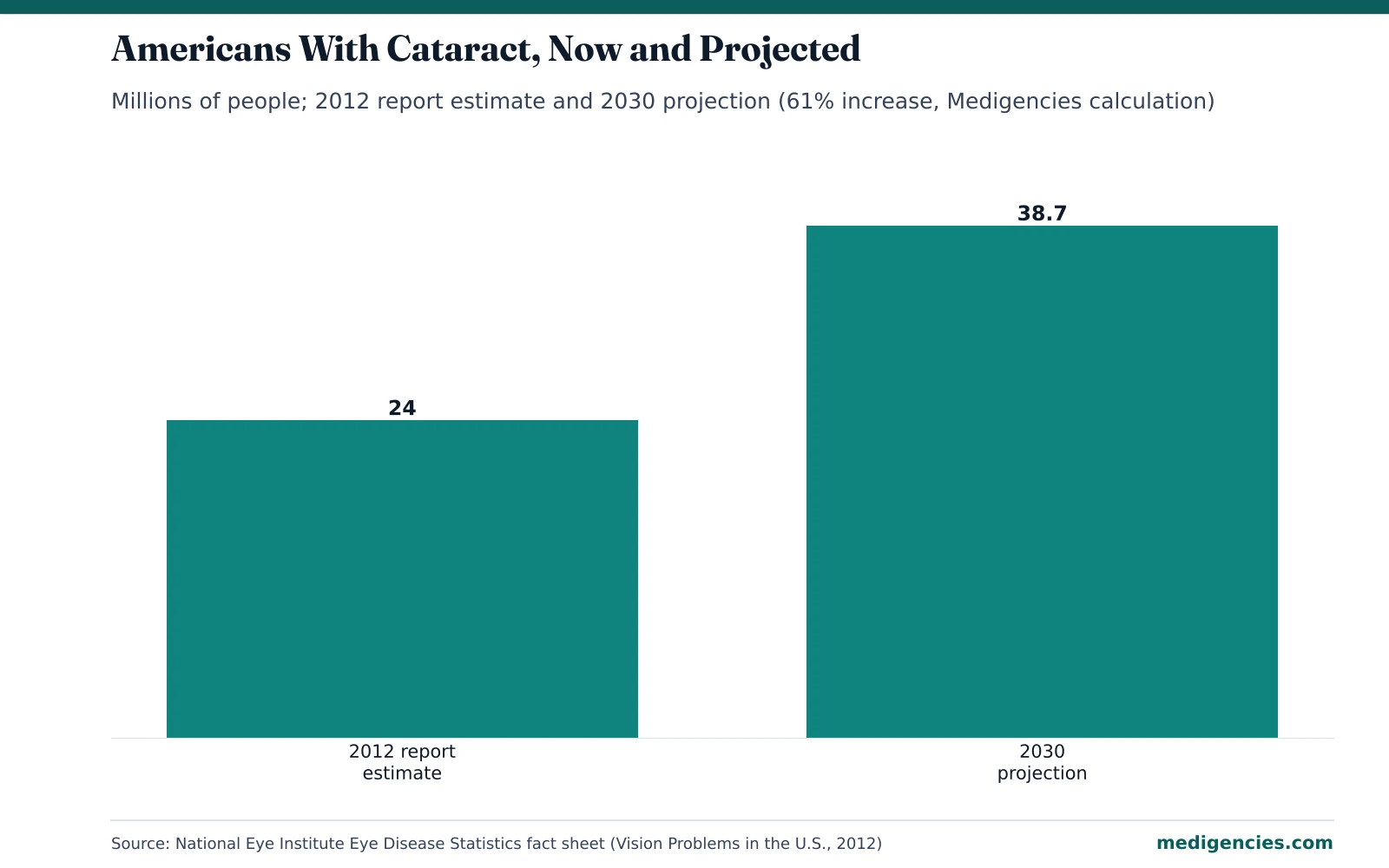
About 24 million Americans had cataract in the 2012 Vision Problems in the U.S. estimates, and 38.7 million are projected to have it by 2030. We calculate that as a 61% bigger patient pool in under two decades.
The patient with blurry vision types symptoms and “cataract surgery near me.” An adult child looks up cost and recovery. Optometrists search too, for surgeons who send patients back to them for follow-up care. Most of the research happens around the lens choice. Someone who hears “multifocal” or “toric” at the consult tends to go home and search that word plus “cost” or “reviews.”
We wrote the search groups below as a starting set. Each group follows one stage of the patient’s journey and maps to one page type.
| Stage | Example searches | Page type | Example title tag |
|---|---|---|---|
| Symptoms | cloudy vision; glare when driving at night; do I have cataracts | Cataract symptoms page | Cataract Symptoms and When to See an Eye Surgeon |
| Lens research | toric lens vs monofocal; multifocal lens halos; light adjustable lens candidates; edof lens | Lens hub and lens pages | Cataract Lens Options Compared | [Practice] |
| Cost | cataract surgery cost with medicare; premium lens cost per eye; does medicare cover toric lens | Cost and coverage page | Cataract Surgery Cost With Medicare and Lens Upgrades |
| Local | cataract surgeon near me; cataract surgery [city]; eye surgery center [city] | Location and surgery center pages | Cataract Surgery in [City] | [Surgery Center Name] |
| Surgery day | how long does cataract surgery take; can I drive after cataract surgery; eye shield after cataract surgery | Surgery-day page | Your Cataract Surgery Day, Step by Step |
| Surgeon lookup | dr [name] cataract surgeon; dr [name] reviews | Surgeon page | Dr. [Name], Cataract and Lens Surgeon | [Practice] |
| Optometrist referral | cataract co-management [city]; refer patient cataract surgery | Co-management page | Cataract Co-Management for Optometrists | [Practice] |
Open Google Keyword Planner from the Tools menu in Google Ads and choose “Discover new keywords.” Enter five or six seed terms from one row, then set the location to the counties your surgery center draws from. Accounts with little ad spend see volume as ranges, which is enough to rank one lens term against another. Drop any term that doesn’t fit a page you plan to build.
Search Console shows what people already type to reach you. In the Performance report, filter queries containing “lens,” “cataract” or “toric” and sort by impressions. Queries with plenty of impressions and an average position between 8 and 20 are the first pages to improve. If two URLs keep swapping for the same query on the Pages tab, merge them or give each a clearly different topic.
Google’s Health in personalized advertising policy lists invasive medical procedures, surgical procedures included, as a sensitive category. Cataract ads therefore can’t use customer match or lookalike segments, so organic pages carry more of the research stage. Our guide to Google’s healthcare ad rules walks through the full policy.
Clean Up the Site Before You Add a Single Lens Page
Start in the Search Console Page indexing report. Every lens, cost, location and surgeon page should sit under “Indexed.” Pages listed as “Crawled, currently not indexed” are usually thin or near copies of another page, and “Excluded by noindex” often means a template setting left over from the site build.
Group Lens, Cost and Surgery Pages Under One Cataract Folder
Group pages in folders that match how patients think. A two-location practice might use this structure.
| Page | URL pattern | Links to |
|---|---|---|
| Cataract surgery hub | /cataract-surgery/ | Lens hub, cost page, surgery-day page, locations |
| Lens hub | /cataract-surgery/lens-options/ | Each lens page |
| Lens page | /cataract-surgery/lens-options/toric/ | Cost page, surgeons who implant it |
| Cost page | /cataract-surgery/cost/ | Lens pages, financing, booking |
| Surgery center page | /locations/[center-name]/ | Surgery-day page, surgeons at that site |
| Surgeon page | /doctors/[name]/ | Locations, lens pages, reviews |
| Co-management page | /referring-doctors/cataract-co-management/ | Surgeons, surgery centers, forms |
Keep every lens and cost page within two clicks of the home page. Use plain anchor text such as “toric lens cost” in body copy. A lens page that only appears in a mega menu gets far fewer internal links than one also linked from the cost page, the surgeon pages and the lens hub.
Cut Load Time on the Tablets Older Patients Read On
Google indexes the mobile version of each page, and the adult child often researches on a phone. The Core Web Vitals report in Search Console groups URLs by three metrics. Largest Contentful Paint should be 2.5 seconds or less, Interaction to Next Paint 200 milliseconds or less and Cumulative Layout Shift 0.1 or less.
On the cataract sites we review, the usual failures are large hero videos and booking widgets that load late and push content down. Serve the hero as a compressed still image, load the video on tap and reserve space for any widget. Every page should load over HTTPS, with the http and non-www versions sending a 301 redirect to one version.
Give Each Town Page Its Own Surgeon, Address and Directions
A practice that copies one “Cataract Surgery in [City]” page into 20 towns gets 20 near-identical pages, and Google tends to index only a few. Build a page only where you have a clinic or surgery center. Fill it with that site’s surgeons, hours, parking, arrival steps and directions. For towns you serve without an office, mention them on the nearest location page.
Each page should carry a self-referencing canonical tag. Add a canonical pointing to the main page when the same lens article lives at two URLs, for example a blog post and a service page. Tracking parameters on ad landing pages should also resolve to the clean URL.
Shrink Lens Diagrams and List Every Video in the Sitemap
Name image files for what they show, such as toric-lens-diagram.webp, and write alt text that describes the image for a screen reader. Compress photos to WebP and set width and height so the layout doesn’t jump. Surgeon headshots should be real photos of the surgeon.
Submit one XML sitemap in the Search Console Sitemaps report. List only canonical URLs that return a 200 status, and leave out thank-you pages, tag archives and form confirmations. Update the lastmod date only when the page content changes.
Mark Up the Surgery Center, Surgeons and Procedure in JSON-LD
Mark up each location with MedicalClinic, a subtype of MedicalBusiness, using that site’s own address and phone. A single surgeon now uses IndividualPhysician, with practicesAt pointing to each clinic, while Physician describes the practice as an organization. The cataract procedure itself can be a MedicalProcedure with procedureType set to SurgicalProcedure. Add FAQPage markup to pages with visible questions and answers, though Google limits FAQ rich results to well-known government and health sites.
{
  "@context": "https://schema.org",
  "@graph": [
    {
      "@type": "MedicalClinic",
      "@id": "https://www.example-eye.com/locations/riverbend-surgery-center/#clinic",
      "name": "Riverbend Eye Surgery Center",
      "url": "https://www.example-eye.com/locations/riverbend-surgery-center/",
      "telephone": "+1-555-010-2020",
      "address": {
        "@type": "PostalAddress",
        "streetAddress": "100 Example Way",
        "addressLocality": "Springfield",
        "addressRegion": "IL",
        "postalCode": "62701",
        "addressCountry": "US"
      },
      "openingHoursSpecification": [{
        "@type": "OpeningHoursSpecification",
        "dayOfWeek": ["Monday","Tuesday","Wednesday","Thursday","Friday"],
        "opens": "07:00",
        "closes": "15:00"
      }],
      "availableService": {
        "@type": "MedicalProcedure",
        "name": "Cataract surgery with lens implant",
        "procedureType": "https://schema.org/SurgicalProcedure",
        "bodyLocation": "Eye"
      }
    },
    {
      "@type": "IndividualPhysician",
      "name": "Dr. Jane Example, MD",
      "url": "https://www.example-eye.com/doctors/jane-example/",
      "practicesAt": { "@id": "https://www.example-eye.com/locations/riverbend-surgery-center/#clinic" }
    }
  ]
}
Every value in the markup must match the visible page. Test each template in Google’s Rich Results Test before launch. Our interventional cardiology SEO guide shows the same multi-site pattern for doctors who operate at several hospitals, and Google’s free testing tools are in our healthcare SEO tools roundup.
Keep Pixels Off the Consult Request Form
The HHS Office for Civil Rights bulletin on online tracking technologies says HIPAA rules apply when tracking code on a covered entity’s site collects protected health information. A June 2024 federal court ruling in American Hospital Association v. Becerra vacated the part of that guidance about unauthenticated public pages. Tracking inside patient portals, on booking forms and on intake forms still falls under HIPAA.
Remove ad pixels and session recording from booking, intake and portal pages. Any vendor that receives form data or call recordings needs a signed business associate agreement. Google states that it doesn’t offer a business associate agreement for Google Analytics, so keep names, dates of birth and symptoms out of event names, URLs and form field labels.
Write a Page for Every Lens, Price and Surgery-Day Question
Give each page one main topic, one H1 and a title tag of roughly 50 to 60 characters that names the procedure and the city or lens. Answer the main question in the first two sentences. Put the phone number and a booking button above the fold, then cover cost, candidacy and recovery in order.
Explain Toric, Multifocal, EDOF and Light-Adjustable Lenses Separately
Each lens type gets its own page, and one comparison hub links to all of them. On each page, state what the lens is meant to do for vision, who tends to qualify, the trade-offs and the price above the covered surgery. Finish with a short surgeon video and a “Questions to ask at your consult” list.
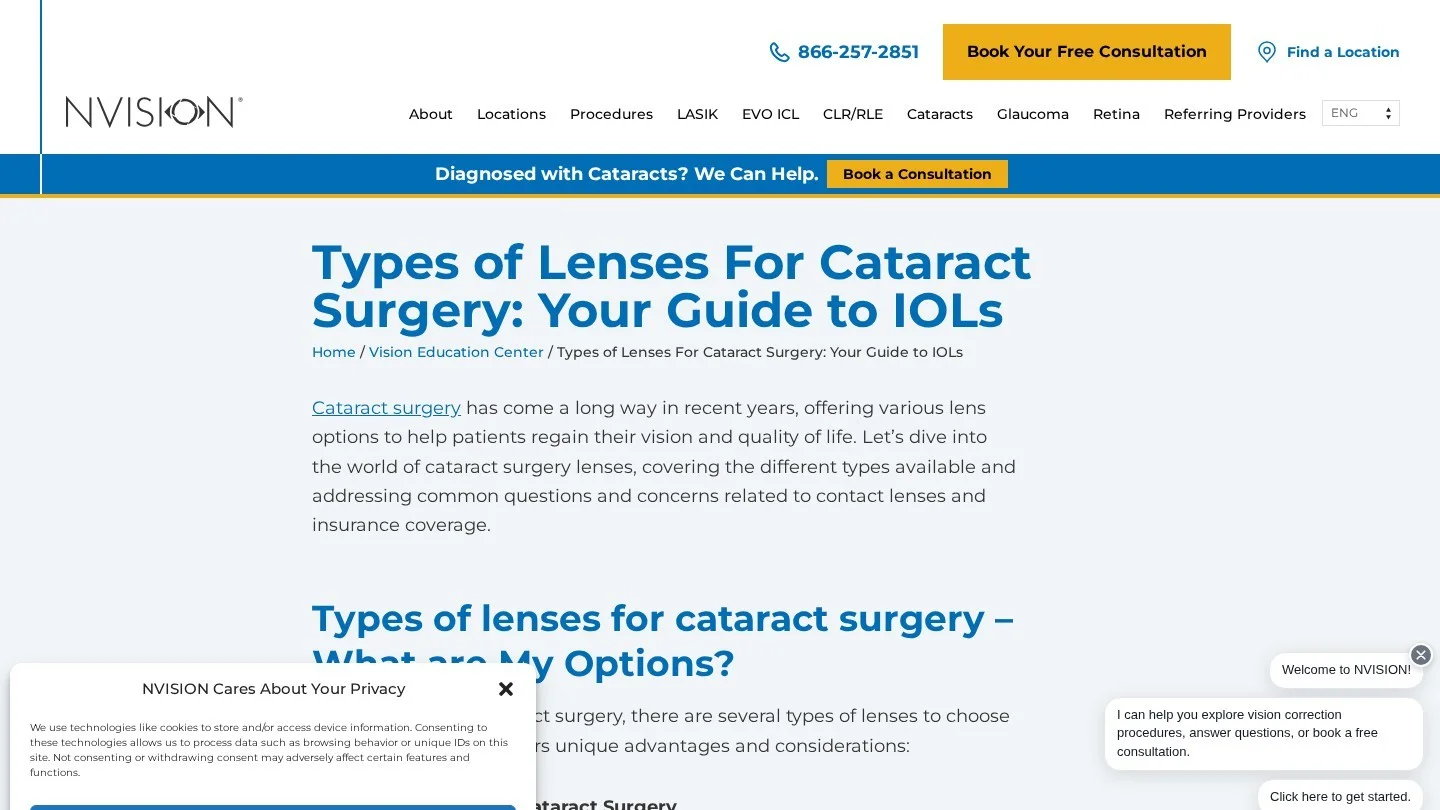
A standard monofocal lens focuses at one distance, usually far, so many patients still need reading glasses. Toric lenses correct astigmatism. Multifocals aim for clear vision at several distances, with glare and halos a known concern in some designs. NVISION’s lens types page puts all of these in one place and notes that Medicare typically covers the standard monofocal lens.
RxSight’s Light Adjustable Lens won FDA approval in November 2017, the first system able to make small changes to lens power after cataract surgery. Light treatments begin 17 to 21 days after surgery, and patients get 3 or 4 of them over 1 to 2 weeks. They wear UV-protective glasses until the last treatment. People taking certain medicines that raise UV sensitivity can’t have the lens, among them tetracycline, doxycycline, amiodarone and hydrochlorothiazide, and a history of ocular herpes simplex also rules it out. Put these points near the top of the page so a son or daughter checking a parent’s medicine list gets an answer before the consult.
Publish What Medicare Pays and What the Upgrade Costs
Medicare Part B covers cataract surgery with a conventional intraocular lens. Once the Part B deductible is met, the patient owes 20% of the Medicare-approved amount to the facility and to the surgeon. After each surgery that implants a lens, Medicare also pays for one pair of glasses with standard frames or one set of contact lenses.
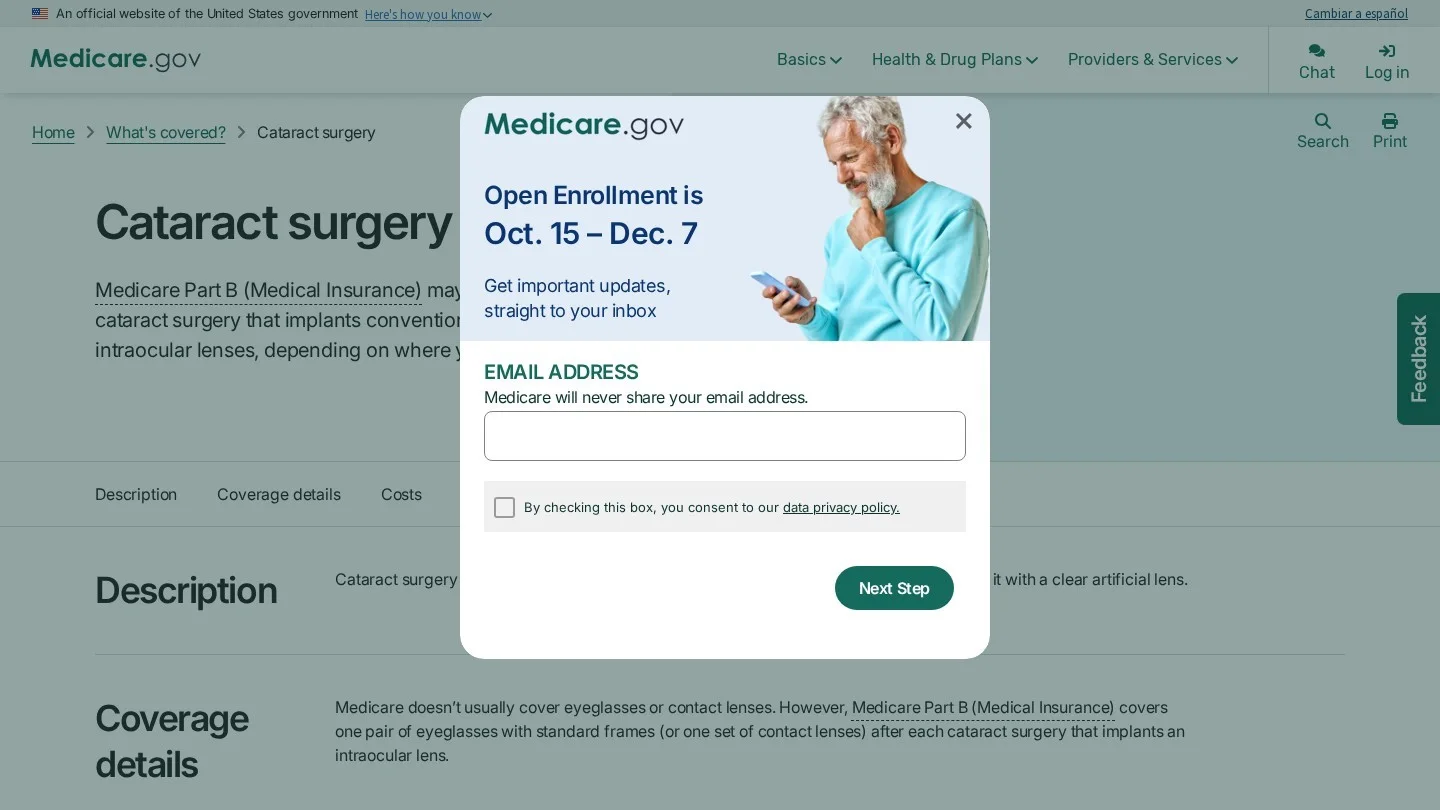
Two CMS rulings govern premium lenses. Under Ruling 05-01, Medicare pays the conventional lens portion of a presbyopia-correcting lens and the patient pays the charge above it. The facility and physician must tell the patient before surgery what Medicare won’t pay, though no Advance Beneficiary Notice is needed. CMS-1536-R, dated January 22, 2007, applies the same split to astigmatism-correcting lenses.
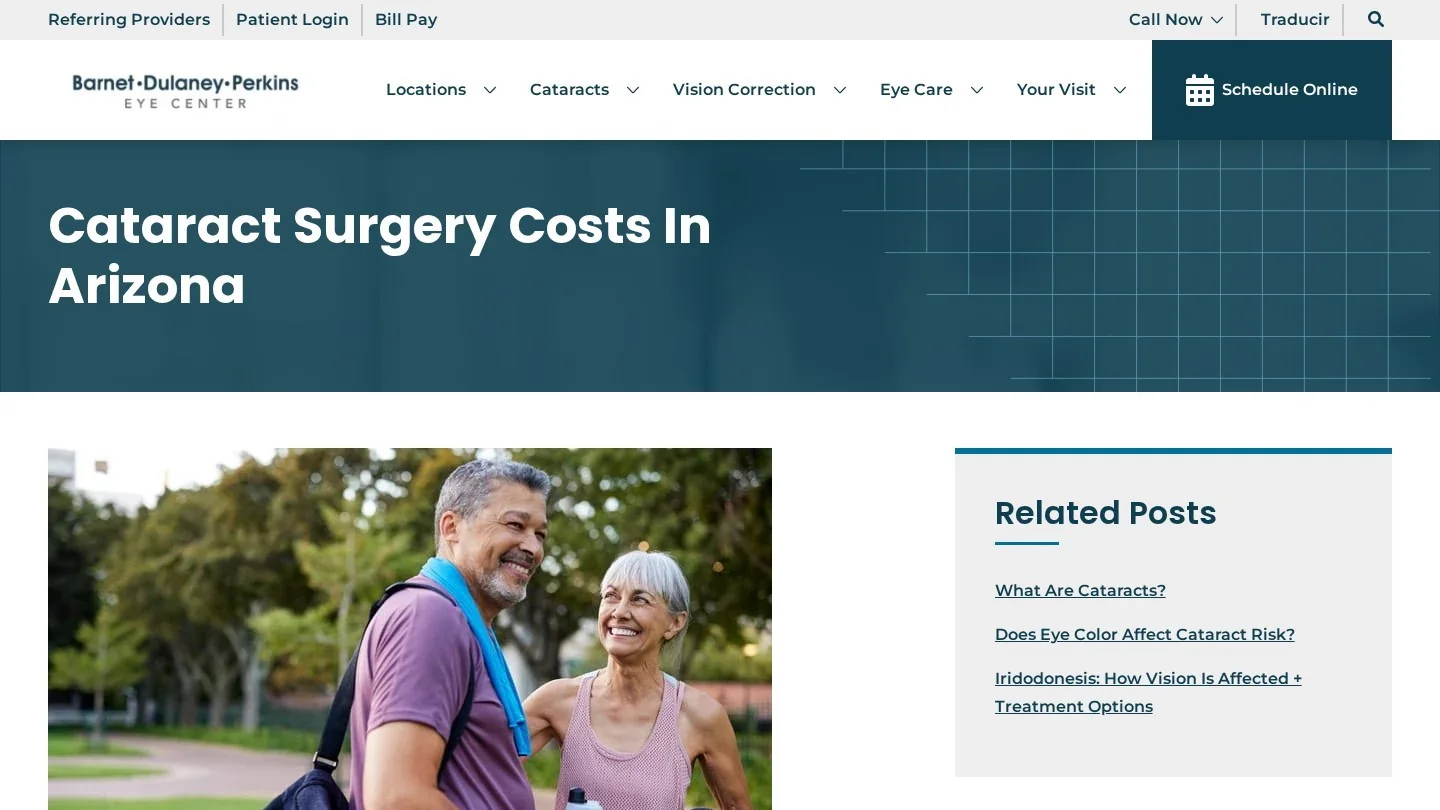
Barnet Dulaney Perkins Eye Center in Arizona posts its upgrade prices on a cataract surgery cost page. A multifocal (trifocal) lens is approximately $1,995 per eye, a toric lens $3,295 per eye and a light-adjustable lens $5,500 or more per eye. Monofocal lenses are listed as covered by insurance, and the practice calls its prices estimates.
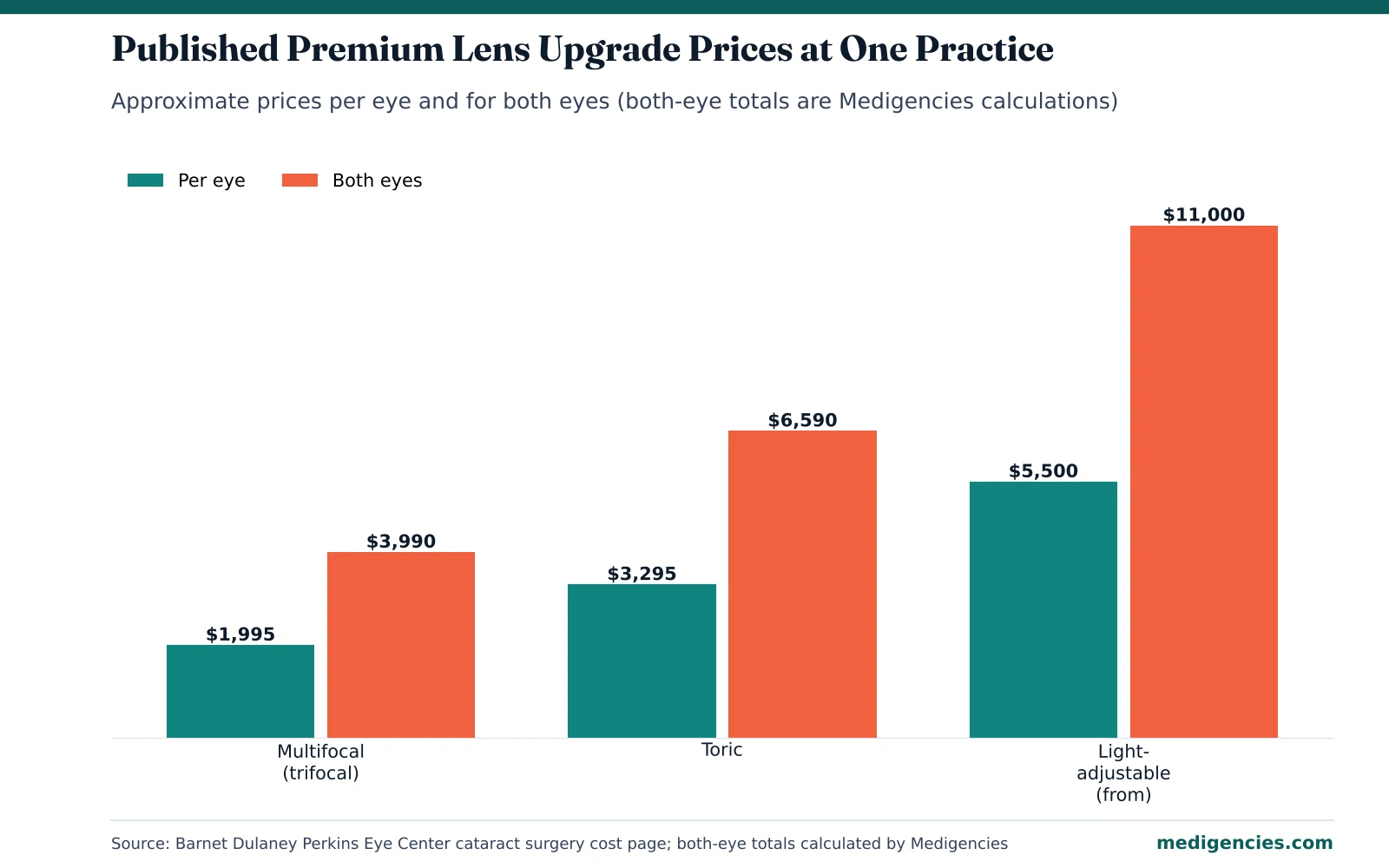
We doubled the per-eye prices for a patient having both eyes done. A multifocal upgrade comes to about $3,990, toric to $6,590 and light-adjustable to $11,000 or more, all on top of Medicare coinsurance. Families compare the two-eye number, so print it beside the per-eye price.
| Cost page block | What to write | Source of the rule or number |
|---|---|---|
| What Medicare covers | Surgery with a conventional lens; 20% coinsurance to facility and surgeon after the Part B deductible | Medicare.gov cataract surgery page |
| Glasses after surgery | One pair with standard frames, or one set of contacts, after each surgery with a lens | Medicare.gov cataract surgery page |
| Premium lens upgrade | Price per eye and for both eyes, with what the price includes | Your practice’s fee schedule |
| Notice before surgery | When and how the patient is told what Medicare will not pay | CMS Ruling 05-01 guidance |
| Post-surgery refraction exams | Whether exams tied to a toric lens are billed separately | CMS-1536-R |
| Financing | Payment plan options and who to call | Your billing office |
Turn the Front Desk’s Pre-Op Calls Into One Surgery-Day Page
ReFocus Eye Health in Penndel, Pennsylvania, publishes what to expect on cataract surgery day. Patients should plan on two to three hours at the center for a surgery that takes 10 to 15 minutes. The article covers the numbing drops, the mild sedative, the eye shield and the follow-up visit, which is usually the next day. Link a page like this from every surgery center page and from the confirmation email.
Spell Out Co-Management Terms for Referring Optometrists
Prevea Health in Green Bay, Wisconsin, states on its eye care co-management program page that the patient returns to the optometrist for continued care. The page lists six documents for referring offices, among them a co-management agreement, post-operative instructions with a medication chart and a billing detail sheet.
OCLI, a Northeast practice, puts relationship tools on its referring provider resources page. Optometrists can refer a new patient, order referral pads or sign up for continuing education events held twice a year. Your page should also name each surgeon and the centers they use, give a direct phone and fax line, and say when the optometrist gets the surgical report.
Set Type Size and Contrast for Readers Over 65
The W3C’s Web Accessibility Initiative ties the needs of older web users to specific WCAG success criteria. Declining vision means many older people need large text, and most lose some contrast sensitivity. Some struggle with a mouse, and forms give others trouble.
| Older reader’s need | WCAG criteria the W3C lists | What to do on a cataract page |
|---|---|---|
| Large text | 1.4.4 Resize Text (AA) | Use a large base font and test the page at 200% zoom |
| Contrast and color | 1.4.1 Use of Color (A), 1.4.3 Contrast Minimum (AA) | Dark text on a plain light background; never use color alone for lens price tiers |
| Mouse use | 2.4.7 Focus Visible (AA), 3.3.2 Labels or Instructions (A) | Large “Call” and “Book” buttons with visible labels |
| No surprises | 3.2.1 On Focus (A), 3.2.5 Change on Request (AAA) | No pop-up offers or new tabs on lens and cost pages |
| Forms | 3.3.1 Error Identification (A), 3.3.3 Error Suggestion (AA) | Short booking forms with clear error messages and a phone option |
Put the phone number in the header of every page, in large type, with tap-to-call on mobile. If you’re rebuilding an older site, our healthcare web design agencies list includes accessibility-minded designers.
Record Eight Short Videos for the Lens Pages
UW Health’s cataract and refractive patient education page has 22 videos. Twelve show cataract surgery with a particular lens type, in standard and femtosecond laser versions. Others cover lens options, YAG capsulotomy, refractive lens exchange and monovision.
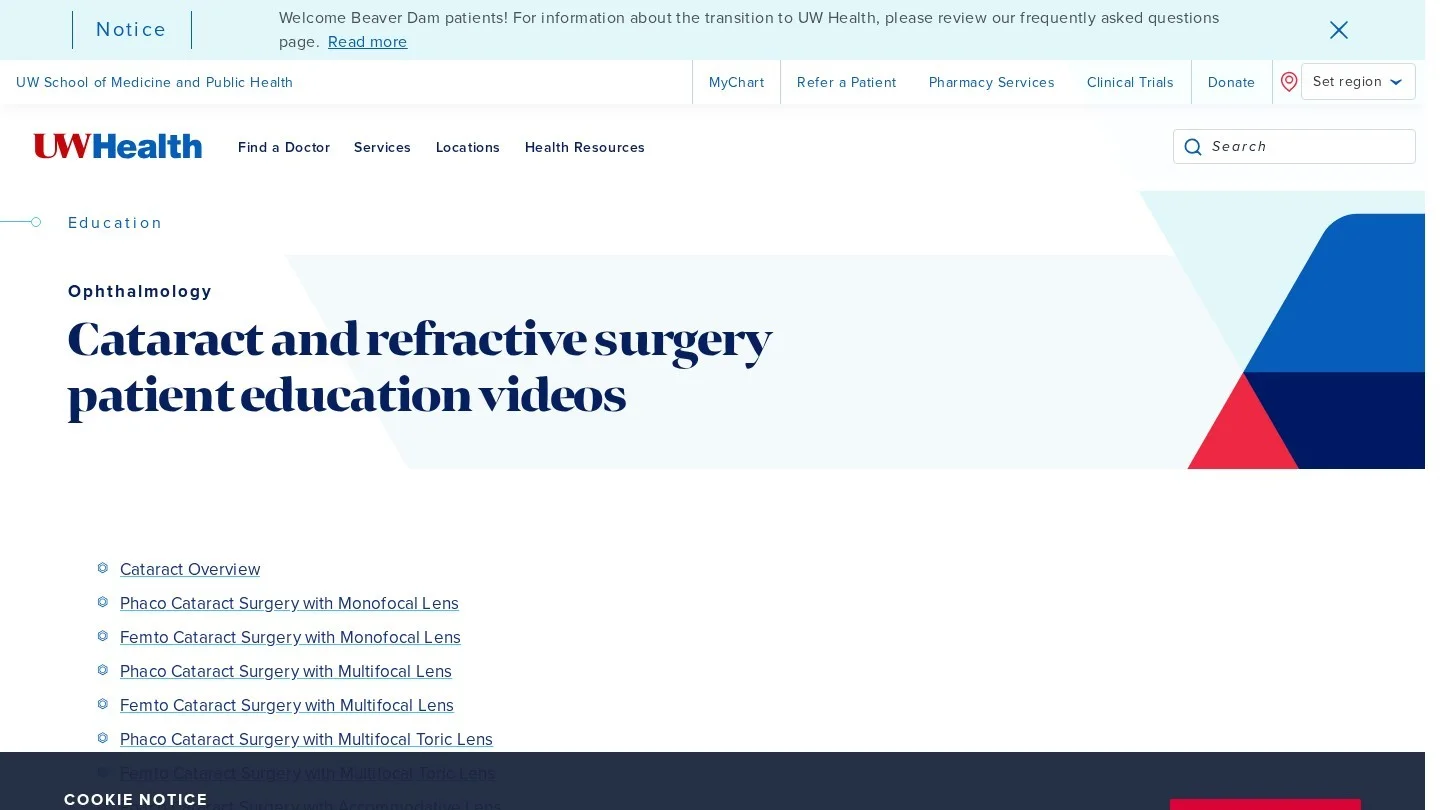
Most practices can start with eight videos of two to four minutes each. One surgeon explains what a cataract is, five cover one lens each, one walks through surgery day at the center and one explains Medicare’s share and the upgrade price. Each video goes on its matching page with captions and a transcript underneath, and the same files go to YouTube with titles taken from the keyword table.
Win the Map Pack in Every Town With a Surgery Center
Pick the primary category for what happens at that address. A clinic where surgeons see cataract consults usually fits “Ophthalmology clinic” or “Eye care center.” A freestanding surgery center with its own entrance, phone and staffed hours fits “Surgical center.” A surgeon’s own profile uses “Ophthalmologist.” Add “Lasik surgeon” or “Optometrist” as secondary categories only where that service is offered at that site.
Under Services, add cataract surgery, laser-assisted cataract surgery and each lens upgrade you offer, with a short description in plain words. Turn on accessibility attributes such as a wheelchair-accessible entrance and parking where they’re true. Point the appointment link at that site’s location or booking page.
Upload real photos of the building from the parking lot, the entrance, check-in, the waiting room and each surgeon. Google accepts profile videos of up to 30 seconds, long enough for a walk from the parking lot to the front desk. Post an update every two to four weeks that links to a lens page, a surgery-day page or a community event.
Google removed public Questions and Answers from Maps during 2025 and replaced it with an “Ask” button that answers from the profile and its reviews. Put the answers families need, such as parking, ride rules and accepted insurance, in the profile description, services and website. Those are the sources the Ask feature can read.
Point Each Profile at Its Matching Location Page
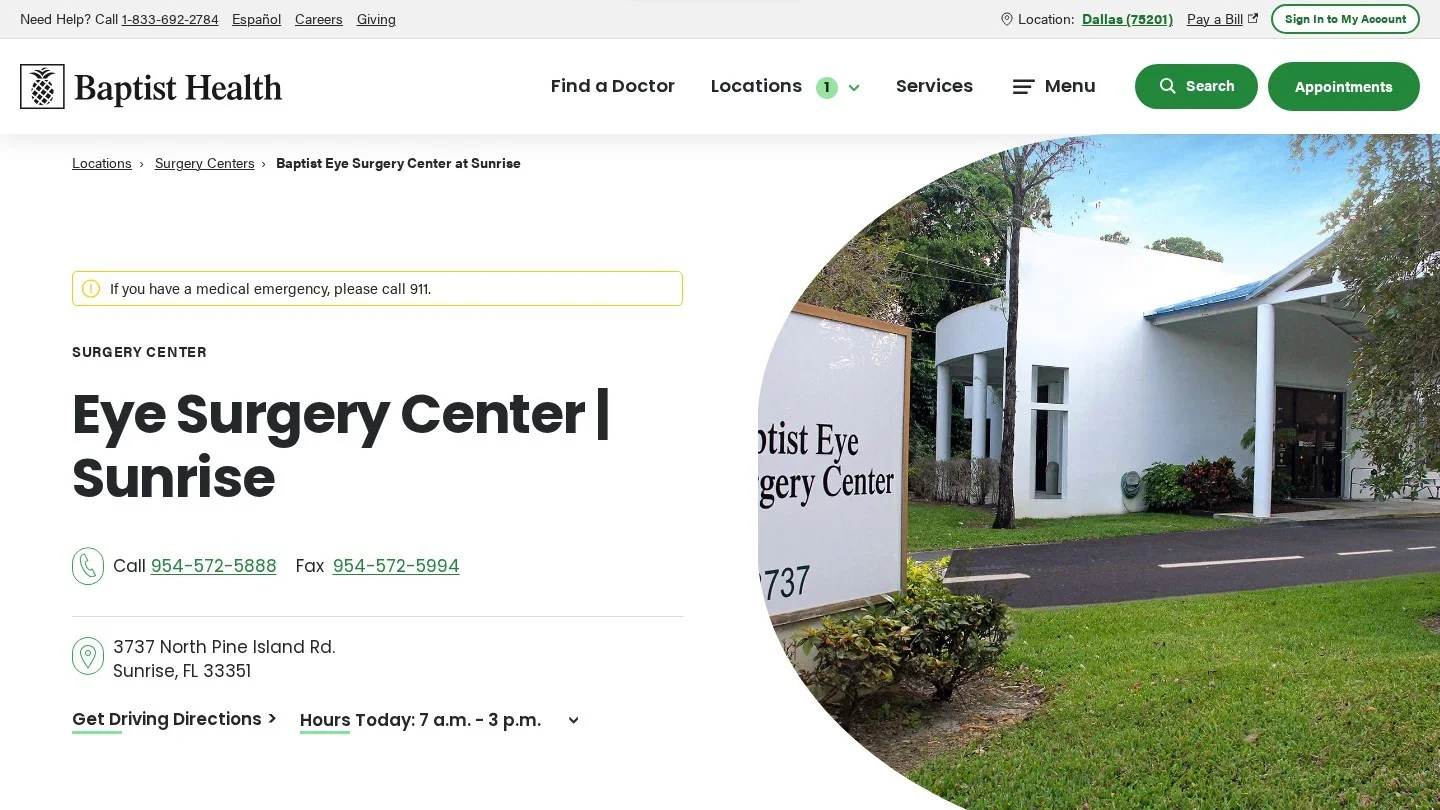
Baptist Health’s Baptist Eye Surgery Center page in Sunrise, Florida, gives a family what it needs before surgery day. Address, phone, fax and weekday hours of 7 a.m. to 3 p.m. are all there. Patients are told to arrive 1 to 1.5 hours early, and a responsible adult must drive them home. Parking, AAAHC accreditation, a Google Maps link and a Spanish version round out the page.
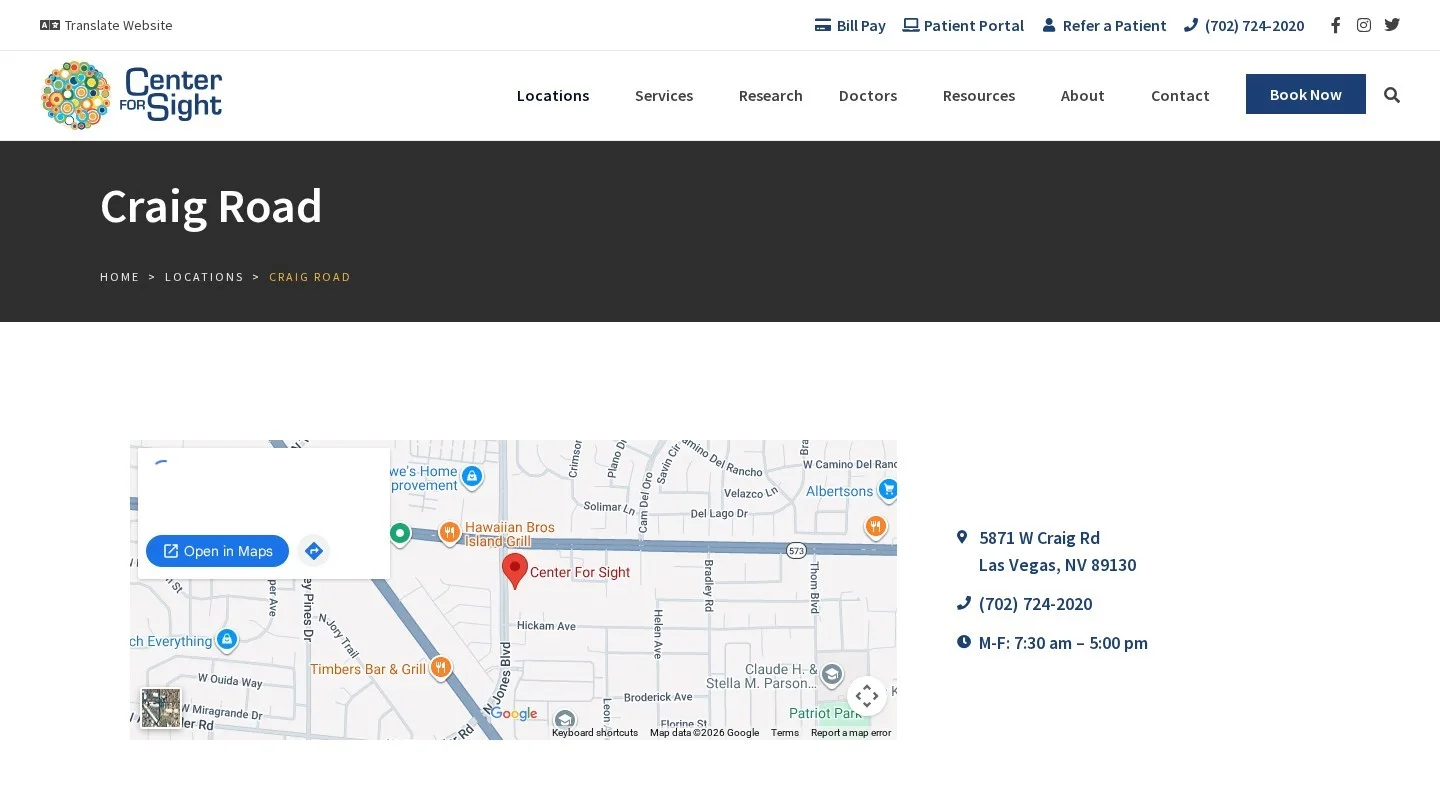
Center For Sight in Las Vegas gives its Northwest office a Craig Road location page with the address, a weekday 7:30 a.m. to 5 p.m. schedule and an embedded Google map. A separate phone line for referring doctors sits under the main number. The page lists cataract consultations and post-operative care among the services at that office, and links to Google for reviews. Adding the surgeons who see patients there would tie each surgeon page to this profile too.
Write the practice name, address and phone on each location page exactly as the Business Profile shows them. Suite numbers, “St” versus “Street” and call-tracking numbers are where most mismatches start.
Decide Which Surgeons Get Their Own Google Listing
Google’s guidelines let an individual practitioner have a profile if they are public facing and can be reached at the verified location during stated hours. Where several surgeons work at one site, the practice creates its own profile for the location, and each surgeon’s profile carries only the surgeon’s name. A surgeon who is the only public-facing doctor at a branded location shares one profile with the brand, named “Brand: Surgeon Name.” Support staff don’t get profiles, and a surgeon with several specialties still gets a single profile.
Hospital eye departments that operate as distinct units may have their own profile, with a name and primary category different from the hospital’s. Department hours may differ from the hospital’s, so list them separately.
Leave City Names and “Best” Out of the Business Name
Adding “Best Cataract Surgeon” or a city name to the business name is a common cause of suspension. Profiles for virtual offices, rented rooms used once a month or addresses with no staff during listed hours also break the rules. Keep one profile per real location. Merge duplicates through Google support, and change addresses or names through the profile’s own edit tools so the change is reviewed once.
Claim Surgeon Listings on Healthgrades, Vitals and the AAO Directory
Claim the surgeon and practice listings on Healthgrades, Vitals, WebMD Care and Zocdoc first, since these profiles often rank for “Dr. [Name]” searches. Then work through the professional and government directories. The core data platforms feed maps, car systems and smaller apps.
| Directory or platform | Who it lists | What to check |
|---|---|---|
| Healthgrades, Vitals, WebMD Care | Individual surgeons and practices | Specialty, accepted insurance, office address, photo |
| Zocdoc | Bookable doctors | Visit reasons such as cataract evaluation, insurance list |
| U.S. News doctor finder | Physicians with hospital affiliations | Affiliated hospitals and specialty |
| Medicare Care Compare | Clinicians enrolled in Medicare | Practice addresses, which come from Medicare enrollment records |
| American Academy of Ophthalmology Find an Ophthalmologist | Academy members | Member-reported practice details |
| Hospital medical staff directories | Surgeons with privileges | Name spelling, link to practice site |
| CareCredit provider locator | Practices that accept the card | Practice name and address for each location |
| Apple Business Connect, Bing Places, Yelp | Any local business | Same name, address, phone and hours as Google |
| Data Axle, Foursquare, Localeze | Data supplied to other apps and maps | Old addresses and closed locations |
Keep a spreadsheet with one row per listing, the login owner and the date last checked. When a surgeon leaves, update every listing for that surgeon in the same week. Patients still call old numbers from directory pages years later.
Get Lens Reps, Hospitals and Local Papers to Link to You
Ask your lens and laser reps whether the maker runs a surgeon locator and whether your surgeons appear on it. Some lens and laser makers list surgeons who offer their products, and a listing there reaches patients who already know which lens they want. Do the same for financing partners and for state ophthalmology society directories.
Hospital affiliations are the next source. Every surgeon with privileges should have a medical staff profile that links to the practice site, and the hospital’s eye department page may list affiliated surgery centers.
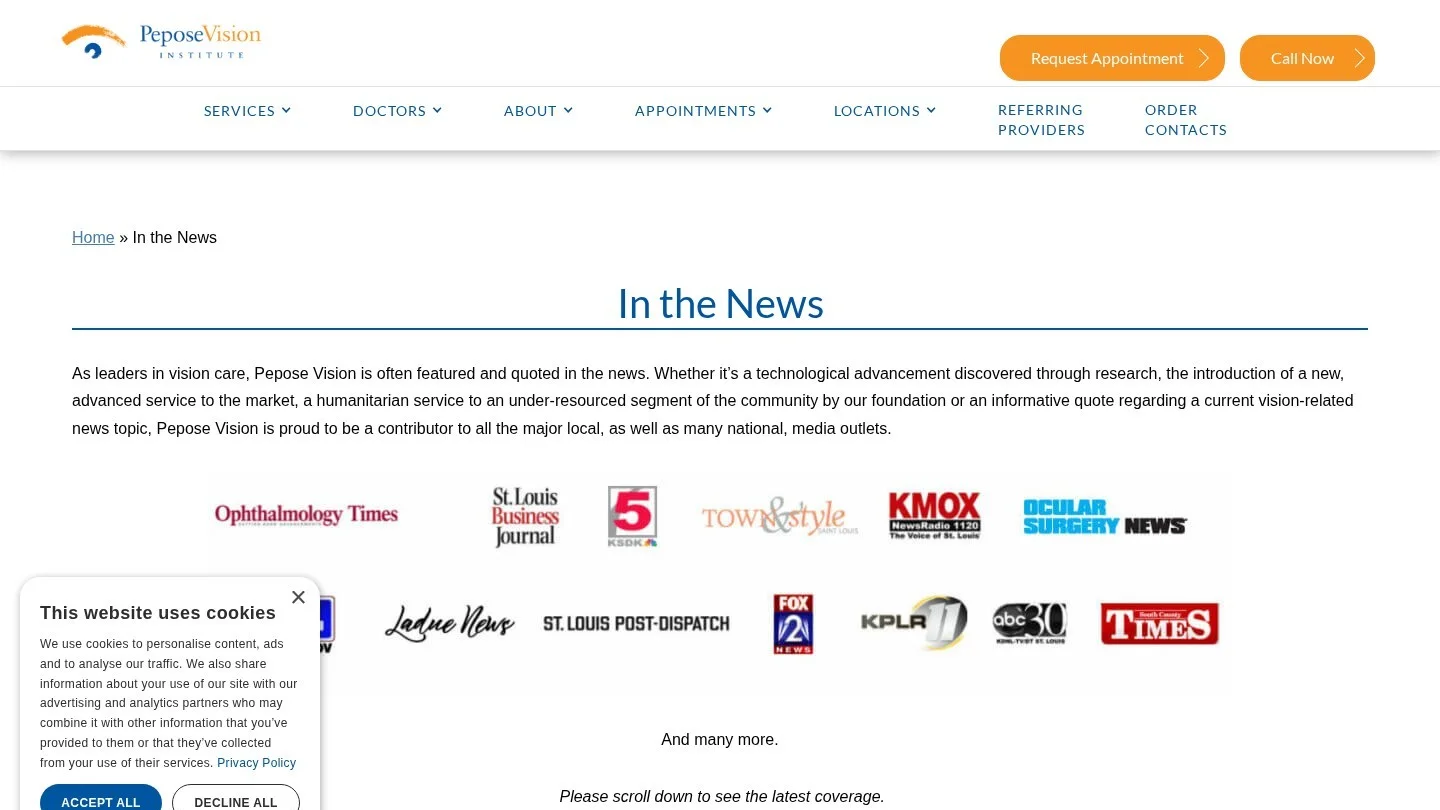
Local press covers new lens technology and first-in-region procedures. Pepose Vision Institute in St. Louis keeps an In the News page that lists coverage on FOX 2 Now, KSDK and the St. Louis Post-Dispatch, along with Ocular Surgery News and Ophthalmology Times. Several items cover accommodating lenses and toric lens implants.
Community work earns links from sites that rarely link to medical practices. Free vision screenings at senior centers, driving-safety talks for retirees and support for a local Lions Club vision program all produce event pages on other sites. Referring optometrists can list your surgeons on their own “our surgical partners” page.
Original data gets cited. A yearly summary of your own anonymized case numbers, such as the share of patients choosing each lens type or average days between first and second eye, is something no one else can publish. Surgeons can also answer journalist requests for expert quotes on eye health and aging.
Google’s spam policies treat buying or selling links that pass ranking credit as link spam, along with excessive link swaps and large-scale guest posting with keyword anchors. A paid sponsorship link is fine when it carries rel=”sponsored” or rel=”nofollow.” Skip any offer of guaranteed links, since a manual action can take months to clear.
Put Surgeon Training and Board Certification in Front of Patients
Each surgeon page should list board certification, medical school, residency, fellowship, hospital privileges and the procedures the surgeon performs. Wills Eye Hospital’s profile of Dr. Robert S. Bailey Jr. lists American Board of Ophthalmology certification and his role as Director Emeritus of the Cataract and Primary Eye Care Service. It also gives his medical school, his Wills Eye residency, his Chestnut Hill Hospital staff role and his “Top Doctors” honors.
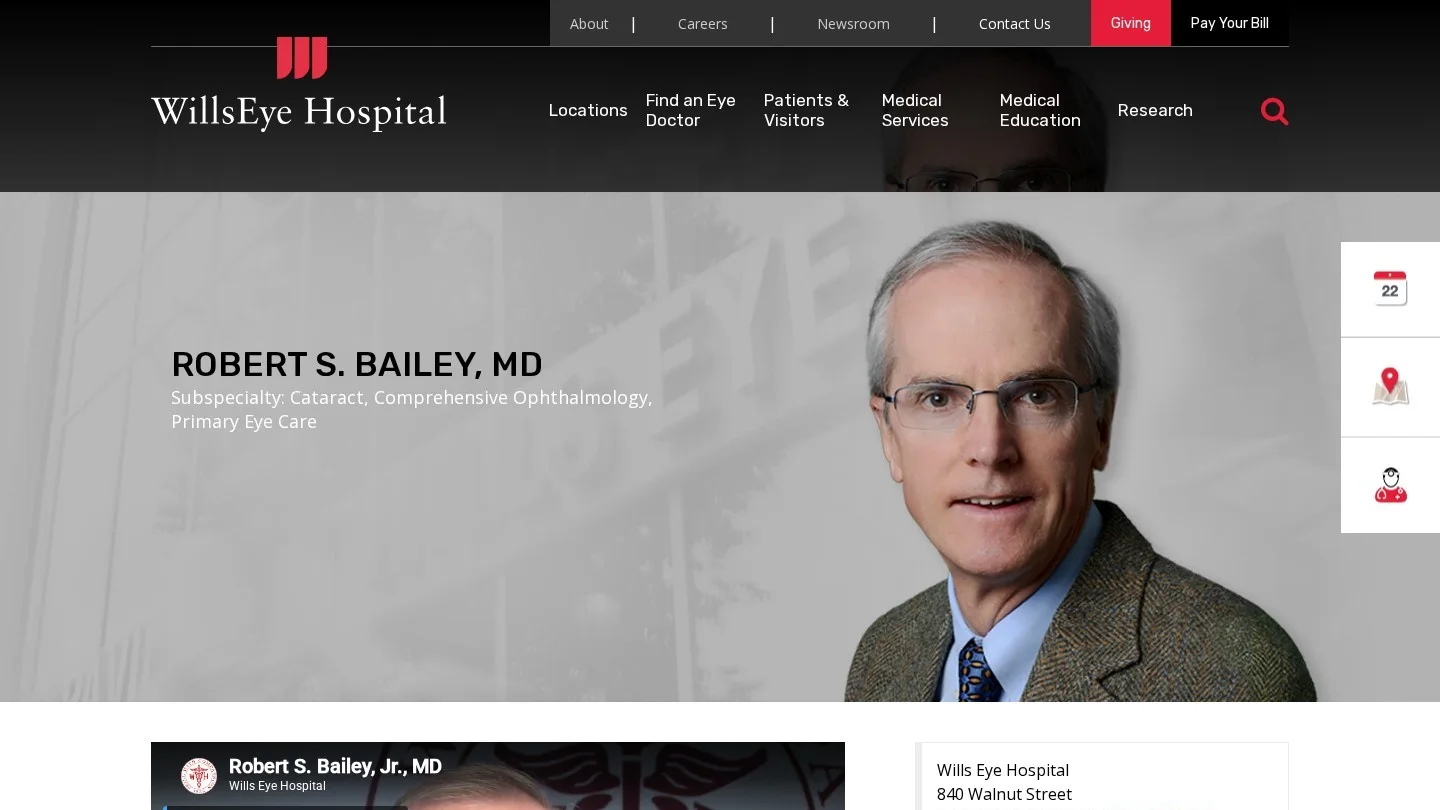
Patients can confirm board certification through the American Board of Ophthalmology, so state it the same way the board does. Add a booking button and the locations where the surgeon operates.
Lens and cost pages should carry a medical review line with a named surgeon, credentials and the review date. Use the same practice name everywhere, including the website, Business Profiles, directories, social accounts and press releases. A practice known as “Riverbend Eye” on Google and “Riverbend Eye Associates, PC” on Healthgrades looks like two businesses to software.
Check Lens Claims and Testimonials Against FTC Rules
“Throw away your glasses” promises a specific result. The FTC’s Endorsement Guides read a testimonial about an exceptional result as typical, and adding “individual results may vary” doesn’t change that. Describe what the lens is designed to do and what most patients can expect, then place patient stories next to that expected result.
Get a signed HIPAA authorization before publishing any patient’s name, photo, video or story. State medical boards set their own advertising rules for physicians, and some restrict testimonials and claims of superiority. Check your board’s rules before you publish “first” or “most experienced” claims.
Publish an About page with the practice history, accreditation for each surgery center, the Notice of Privacy Practices, a pricing page and a page for referring doctors.
Feed AI Answer Engines the Same Practice Facts Everywhere
Google’s Search Central documentation says there are no extra requirements and no special schema needed to appear in AI Overviews or AI Mode. A page must be indexed and eligible to show with a snippet. Google lists its usual advice for these features, including crawl access, internal links, important content kept as text and structured data that matches the visible page.
AI answers pull short, direct passages. Cleveland Clinic’s cataract surgery page uses subheads phrased as questions, such as “How long does cataract surgery take?”, and answers each in a sentence or two. The procedure usually takes 10 to 15 minutes, and full recovery takes about four weeks. A “Medically Reviewed” label and a last-updated date sit at the top.
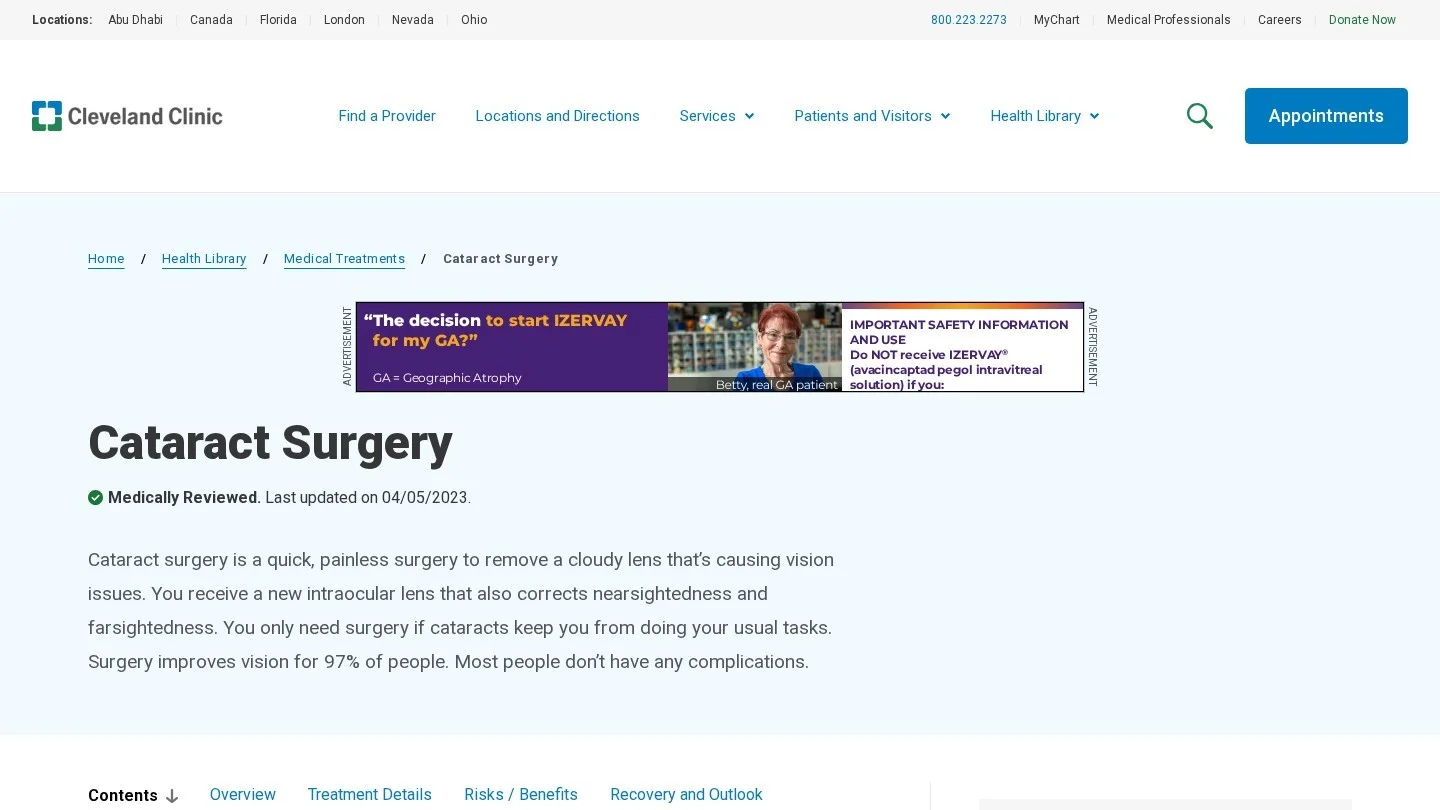
Write one direct-answer block under each question heading on your lens, cost and surgery-day pages. Start with the number or the yes-or-no answer, then add the condition. End each page with five or six real questions from consults and pre-op calls.
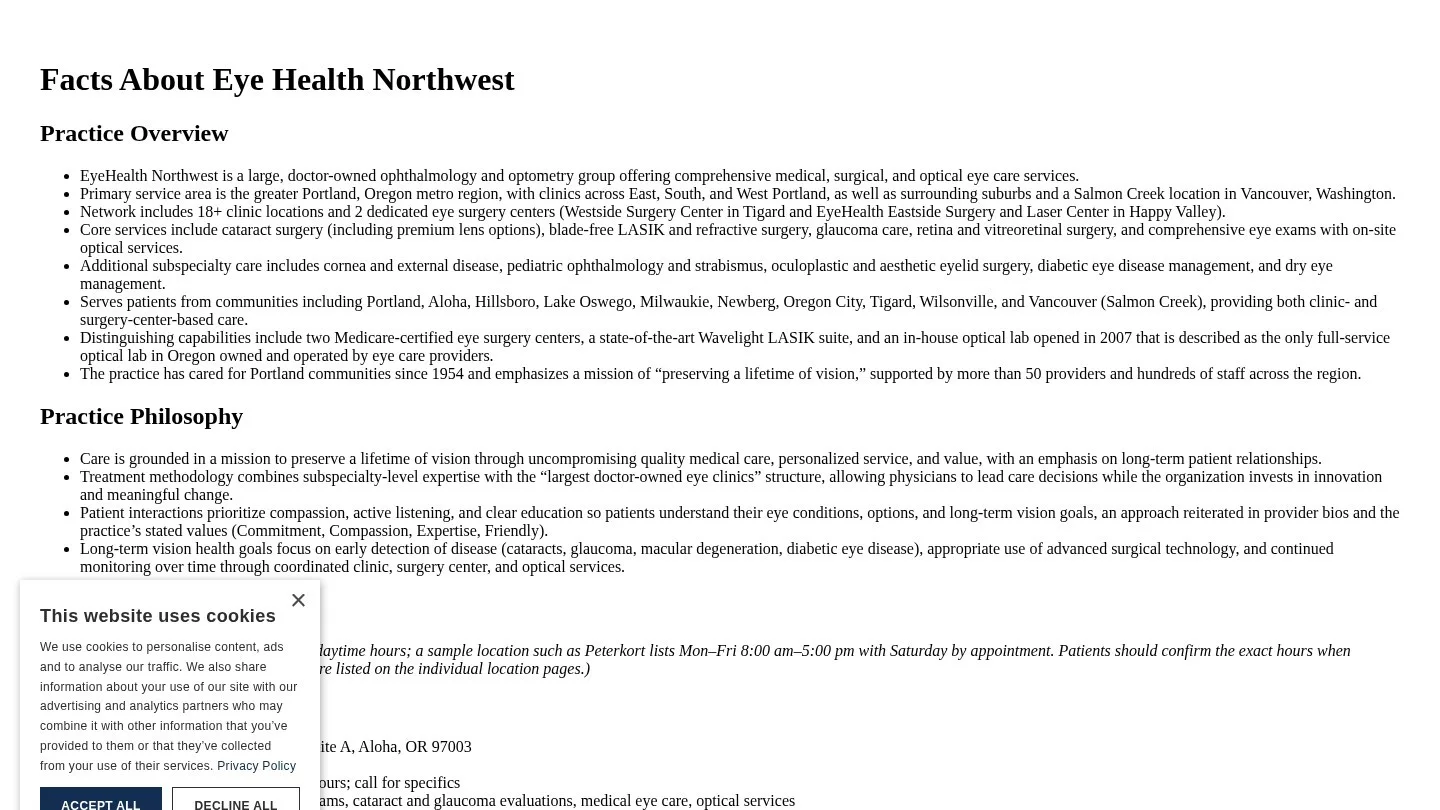
AI tools also need consistent facts about the practice as an entity. Eye Health Northwest keeps a facts page stating that it has served Portland since 1954, has more than 50 providers and runs two Medicare-certified surgery centers. Repeat the same founding year, provider count and surgery center names on Google, directories and social profiles.
ChatGPT, Perplexity and Google’s AI features cite directories, review sites, hospital pages and news coverage. Large health systems may meet Wikipedia’s notability standard. Where one does, independent editors should write the article, since Wikipedia discourages people from writing about their own organization.
Clicks from AI Overviews and AI Mode appear in Search Console’s Performance report under the Web search type. ChatGPT adds utm_source=chatgpt.com to many links it shows. In GA4, create a custom channel group named “AI assistants” with a source rule that matches chatgpt.com, perplexity.ai, gemini.google.com and copilot.microsoft.com, and place it above Referral.
Turn Second-Eye Visits Into Google Reviews
Send every cataract patient the same review request after the final post-op visit for the second eye. By then they have seen the full result, and the family member who drove them may open the link with them. Use a text message with the direct Google review link, then one email reminder a week later.
The FTC’s Endorsement Guides call it misleading to ask for reviews only from customers you expect to be happy. Its rule on consumer reviews and testimonials, in effect since October 21, 2024, bans fake reviews, paying for reviews that must be positive and suppressing negative reviews through threats. Insider reviews by staff or family need clear disclosure, and violations can bring civil penalties.

When you reply to a review, never confirm the person is a patient, and never mention dates, lenses or outcomes. HHS has fined practices whose review replies disclosed patient information. A reply such as “Thank you for the feedback. Please call our patient care manager at 555-0100 so we can talk” works for praise and complaints alike.
Reply within two business days and route complaints to one named manager. Firms that run review programs for eye practices are on our healthcare reputation management agencies list.
Report Booked Consults to the Practice Each Month
Track each page group as its own folder in Search Console, so lens pages, location pages and surgeon pages each have a clicks and impressions line. In Business Profile Performance, record calls, website clicks, direction requests and bookings for each location.
In GA4, mark call clicks, booking form submissions and co-management referral form submissions as key events. Call tracking must run on a vendor that signs a business associate agreement, since recordings and caller details can contain health information. The number that counts sits in the practice management system. Count consults and premium lens choices by source every month.
| Report line | Where it comes from | What to compare |
|---|---|---|
| Organic clicks to lens and cost pages | Search Console, page folder filter | Same month last year |
| Queries in positions 4 to 15 | Search Console Performance | Last month |
| Calls, direction requests, website clicks per location | Business Profile Performance | Last month and last year |
| New reviews and average rating per location | Business Profiles | Last month |
| Booking and call key events from organic search | GA4 | Last month |
| AI assistant sessions | GA4 custom channel group | Last three months |
| Cataract consults from search and maps | Practice management system | Same month last year |
| Premium lens choices from search patients | Practice management system | Practice average |
Firms that report this way can be compared on our healthcare SEO agencies page.
Roll Out the Work Over Three Months
Picture a fictional practice with four cataract surgeons, two clinics, one surgery center and five lens types. It needs 16 core pages. The lens hub and five lens pages make six, cost and surgery-day pages add two, and three location pages, four surgeon pages and one co-management page complete the set.
| Week | Work |
|---|---|
| 1 | Search Console and GA4 access, indexing report review, call tracking with a signed BAA |
| 2 | Remove pixels from booking and portal pages; fix redirects, canonicals and sitemap |
| 3 | Keyword Planner and Search Console research; URL plan |
| 4 | Business Profile categories, services, attributes and photos for all three sites |
| 5 | Three location pages with schema; match name, address and phone |
| 6 | Lens hub and first two lens pages |
| 7 | Cost and coverage page; remaining three lens pages |
| 8 | Four surgeon pages with credentials and medical review lines |
| 9 | Surgery-day page and co-management page |
| 10 | Directory claims and corrections; review request flow live |
| 11 | Lens rep locators, hospital staff profiles, optometrist partner links |
| 12 | Direct-answer blocks and FAQ sections; facts page; AI channel group in GA4 |
| 13 | First full monthly report; pick next pages from Search Console queries |
For outside help with the build, compare firms on our eye care marketing agencies page or the eye care SEO agencies list. Our vetting criteria explain how a firm gets listed.
Clear Up What Administrators Ask About Cataract Search
Should We Publish Premium Lens Prices Online?
Yes. Families search for cost before they book a consult, and a published price answers them. Barnet Dulaney Perkins posts approximate per-eye prices, labels them estimates and does a detailed review at the consultation.
Does Medicare Pay for a Toric or Multifocal Lens?
Medicare pays only the conventional lens portion. Under CMS Ruling 05-01 and CMS-1536-R, the patient pays the charges above the conventional amount for the premium function.
Does a Surgery Center Need Its Own Business Profile?
It should have one if it has its own address, phone and staffed hours. Link the profile to the center’s own location page.
Should Each Cataract Surgeon Have a Google Profile?
A surgeon who sees patients at a location during set hours may have one under Google’s practitioner rules. Use the surgeon’s name only, pick “Ophthalmologist” as the category and link to the surgeon page.
How Long Should a Cataract Lens Video Be?
We aim for two to four minutes per lens, with captions and a transcript. Keep each video to one lens so it can sit on that lens’s page.
Can We Ask Only Happy Patients for Reviews?
No. The FTC treats review requests sent only to likely-happy customers as misleading, so every patient gets the same ask.
Compare Agencies for This Topic
Ambulatory Surgery Center Marketing AgenciesOphthalmology and Optometry Marketing AgenciesHealthcare SEO Agencies
More From the Blog

Guides
Interventional Cardiology SEO Guide for Cath Lab and Structural Heart Programs
A full SEO guide for interventional cardiology groups, from keyword research and technical fixes to procedure pages, Business Profiles, citations, links, AI search, reviews…
Nov 4, 2026

Statistics
Childhood Cancer Survival Rate Statistics
Childhood cancer survival rates by type, age and decade, with Medigencies calculations and guidance on communicating survival data ethically to families.
Nov 4, 2026

Statistics
Heart Disease Statistics by Country
Heart disease death rates across G20 countries and world regions, with our analysis of the US gap, 30-year trends and campaign takeaways for cardiology…
Nov 4, 2026