
About 3.0% of US adults, or 7.55 million people, say a health provider has diagnosed them with psoriasis, based on national survey data for 2011 to 2014. Global totals depend on the method. The count is 42.98 million prevalent cases in the Global Burden of Disease 2021 study and at least 100 million in the World Health Organization’s 2016 report.
Adult prevalence is 1.99% in Australasia and 0.14% in East Asia, a 14-fold gap by our calculation. In the US, people aged 50 to 59 have 2.7 times the rate of people in their 20s.
Psoriasis Figures That Shape a Dermatology Content Plan
- Global psoriasis cases rose 86.4% between 1990 and 2021, while the age-standardized rate rose only 8.0%. By our estimate, close to nine-tenths of the growth in cases came from a larger and older population.
- High-income regions have the highest recorded rates, with 1.92% of adults in Western Europe and 1.50% in North America.
- US prevalence is 3.6% in White adults and 1.5% in Black adults.
- About 21.5% of US adults with psoriasis report 3 or more palms of affected skin, roughly 1.6 million people by our calculation.
- In a 2011 patient survey, about a quarter of people with moderate psoriasis were getting no treatment.
- Up to a third of people with psoriasis develop psoriatic arthritis.
How Many People Have Psoriasis Worldwide
At least 100 million people have psoriasis in the World Health Organization’s 2016 global report on the disease. The 2020 Global Psoriasis Atlas model lands near 60 million. It was built at the University of Manchester from 168 usable studies, with modelling to fill in countries that have no data. GBD 2021 has the lowest total, at 42.98 million prevalent cases.
Each total uses a different method, and most of the gap between them comes down to missing data. Some 81% of the world’s countries have no psoriasis epidemiology data at all.
For planning we lean on the GBD trend, since it runs back to 1990. Cases grew to 42.98 million in 2021, up from 23.06 million in 1990, an 86.4% rise. The age-standardized prevalence rate went up only 8.0% over the same years, to 516.0 per 100,000 (477.7 in 1990). We split the growth using the two ratios. A higher underlying rate accounts for about 12% of the extra cases, and population growth and ageing for roughly 88%.
| Estimate | Figure | Source and period |
|---|---|---|
| People affected worldwide | At least 100 million | WHO Global Report on Psoriasis, 2016 |
| People affected worldwide | About 60 million | Global Psoriasis Atlas, Parisi et al., BMJ 2020 |
| Prevalent cases | 42.98 million (23.06 million in 1990) | GBD 2021 |
| Age-standardized prevalence | 516.0 per 100,000 (477.7 in 1990) | GBD 2021 |
| New cases per year | 5.10 million (2.85 million in 1990) | GBD 2021 |
| Countries with no psoriasis data | 81% | Parisi et al., BMJ 2020 |
| Share of case growth from rate change | About 12% (our calculation) | Medigencies, from GBD 1990 and 2021 |
The rate barely moves, so psoriasis demand grows mainly because the population is getting older. A US dermatology practice should expect more psoriasis patients each year as its local population ages, with older patients a growing share of them. Most sites give too little room to people in their 50s and 60s, who are often managing other conditions as well.
Psoriasis Prevalence by Region and Country
Australasia had the highest adult prevalence in the 2020 Global Psoriasis Atlas model at 1.99%, followed by Western Europe at 1.92% and Central Europe at 1.83%. North America came in at 1.50%. East Asia sat at the bottom with 0.14%.
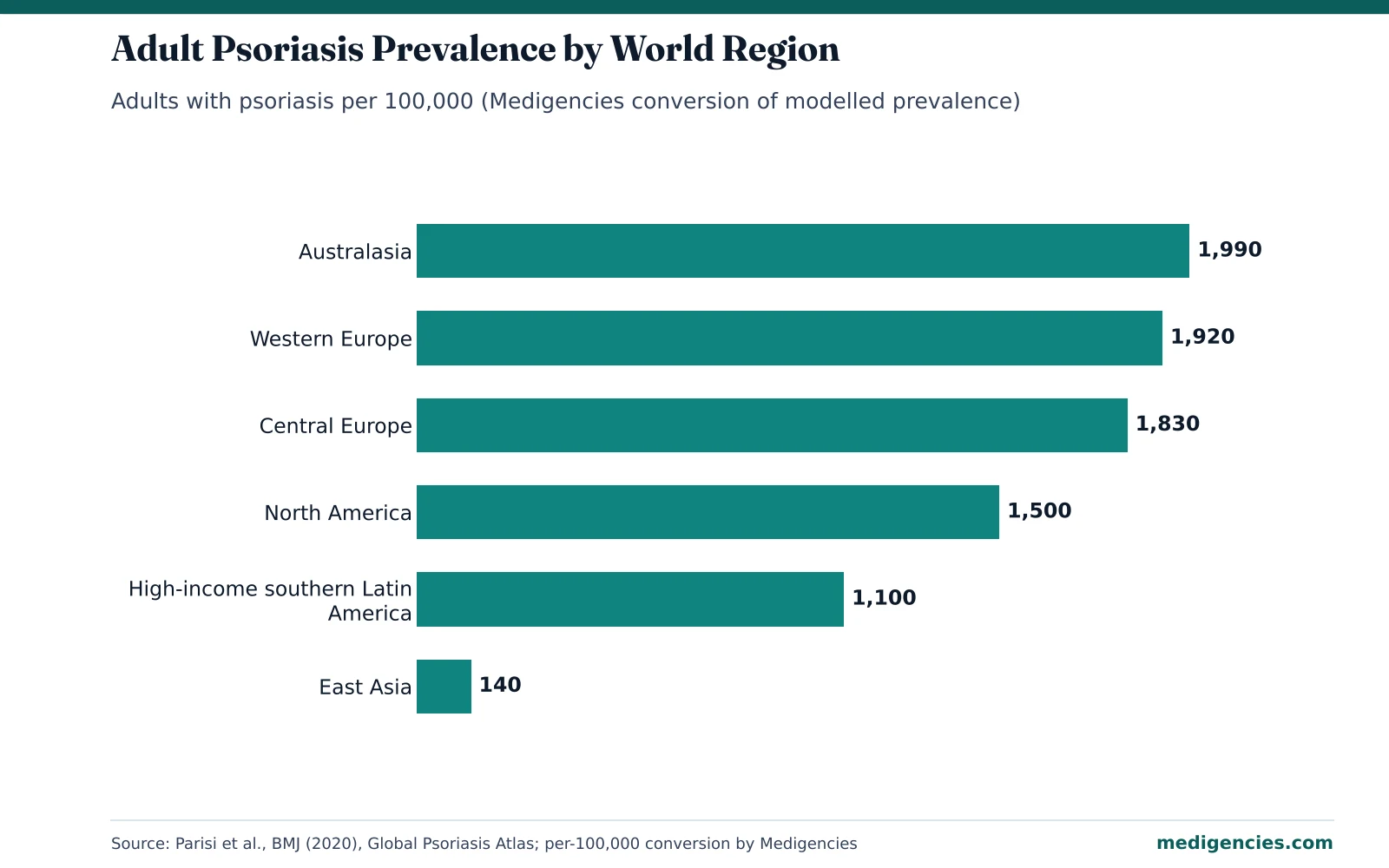
We converted each regional figure to cases per 100,000 adults and compared it with East Asia. Australasia’s rate is 14.2 times East Asia’s. North America’s is 10.7 times. Incidence varies almost as much. Adults in Taiwan develop psoriasis at 30.3 per 100,000 person-years, against 321.0 in Italy, a 10.6-fold difference.
| Region or country | Adult prevalence | Per 100,000 adults | Times East Asia’s rate |
|---|---|---|---|
| Australasia | 1.99% | 1,990 | 14.2 |
| Western Europe | 1.92% | 1,920 | 13.7 |
| Central Europe | 1.83% | 1,830 | 13.1 |
| North America | 1.50% | 1,500 | 10.7 |
| High-income southern Latin America | 1.10% | 1,100 | 7.9 |
| East Asia | 0.14% | 140 | 1.0 |
Which country tops the list depends on the model. In the 2019 Global Psoriasis Atlas release, Norway had the highest national prevalence at 1.98%, and the UK ranked 21st at about 1.7%, or 1.1 million people. The UK figure could reach 2.78% once self-reported and undiagnosed cases are counted. In GBD 2021, Germany has the highest rate at 1,593.7 per 100,000 and Somalia the lowest at 114.9, a 13.9-fold gap by our maths.
Richer regions report more psoriasis. High-SDI regions in GBD 2021 had an age-standardized prevalence of 852.3 per 100,000, against 268.9 in low-SDI regions, a ratio of 3.2. Part of that gap may come from better healthcare, data and awareness in richer countries, and part from their older populations.
North America is in the upper group of the world table. Watch which US number you quote. The national survey’s 3.0% is double the Atlas model’s 1.50% for North America, because the survey counts anyone ever told they have psoriasis and the Atlas figure is a modelled point prevalence. On US patient pages we’d use the survey figure and give its 2011 to 2014 survey years.
Does Latitude Change Psoriasis Rates
In the evidence WHO reviewed for its 2016 report, latitude had only a very weak link with psoriasis prevalence. Northern European populations appear to have the highest prevalence and eastern Asian populations the lowest. Suggested reasons for the variation include climate, genetic susceptibility and exposure to environmental antigens.
Single-country studies are all over the place, with results between 0.09% in the United Republic of Tanzania and 11.4% in Norway. That’s a 127-fold spread, and since the methods differ, the figures don’t compare well.
Skip claims such as “psoriasis is more common in northern states” on patient pages. The evidence for latitude is weak and the US survey does not break prevalence down by state. Sunburn is a known trigger, though, so a summer sun safety post for psoriasis patients is fair game.
Psoriasis by Age, Sex and Race in US Adults
Prevalence was 1.6% among US adults in their 20s and 4.3% among those aged 50 to 59, the highest band. Adults aged 70 and older came in at 3.9%. Each extra year of age nudged the odds up a little (odds ratio 1.03).
Onset has two peaks, one at ages 16 to 22 and a second at 57 to 60. Worldwide, prevalence peaks at about 40 to 60 years.
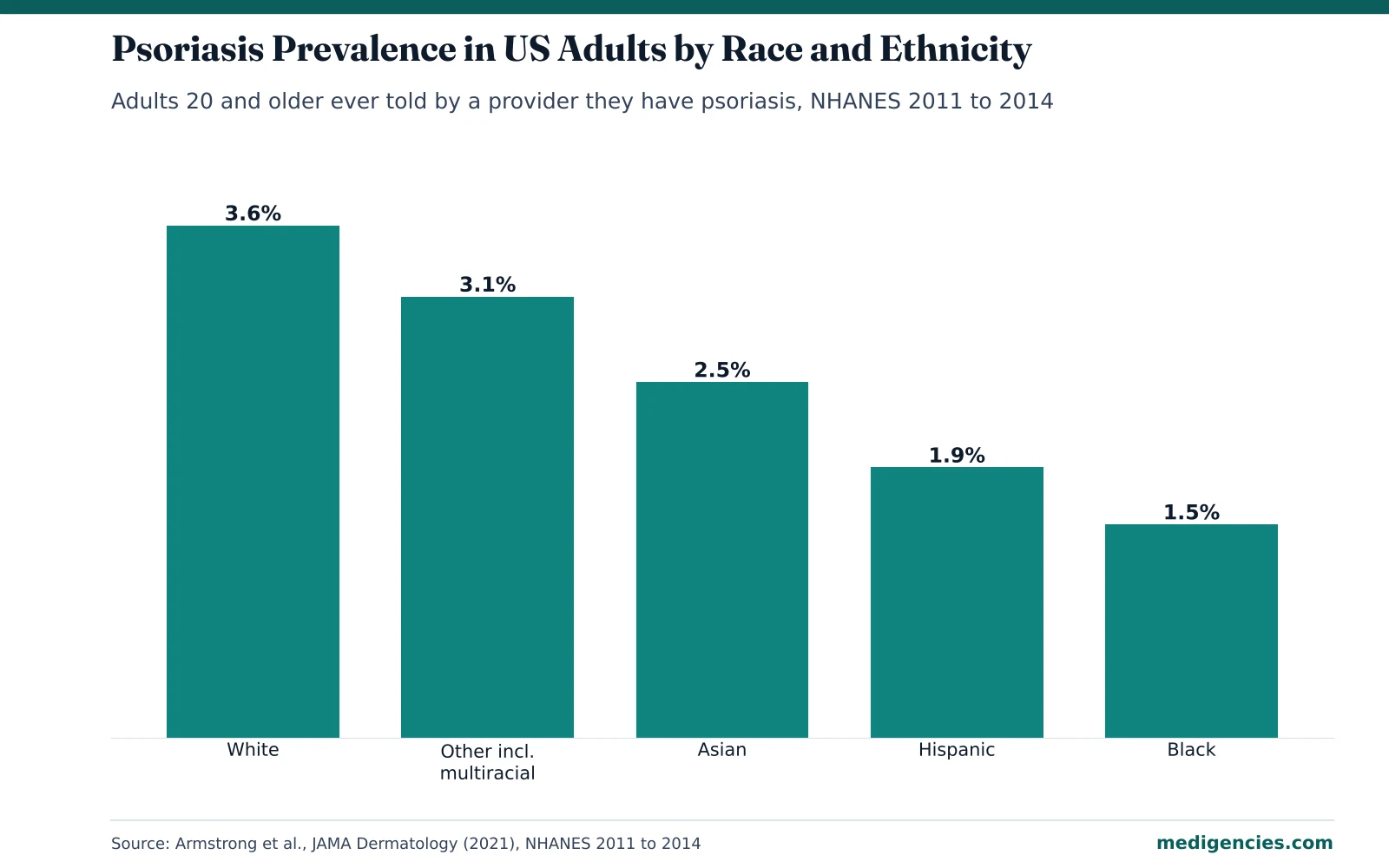
Women had a rate of 3.2% and men 2.8%, though psoriasis is generally considered equally prevalent in the two sexes. The gaps by race and ethnicity are bigger. White adults had a rate of 3.6%, which is 2.4 times the 1.5% rate in Black adults by our calculation. Asian adults were at 2.5% and Hispanic adults at 1.9%.
| US adult group | Prevalence | Medigencies note |
|---|---|---|
| All adults 20 and older | 3.0% (7.55 million) | Not statistically different from 2003 levels |
| Ages 20 to 29 | 1.6% | Lowest band; overlaps the first onset peak at 16 to 22 |
| Ages 50 to 59 | 4.3% | Highest band, 2.7 times the rate in the 20s |
| Ages 70 and older | 3.9% | Large share of patients with other conditions to manage |
| Women | 3.2% | Slightly above men |
| Men | 2.8% | Slightly below women |
| White | 3.6% | 2.4 times the rate in Black adults |
| Asian | 2.5% | Far above the East Asia regional model of 0.14% |
| Hispanic | 1.9% | About half the White rate |
| Black | 1.5% | Lowest measured rate |
We’d plan two content tracks. Young adults near the first onset peak want a clear diagnosis and a plan they can live with. People in their 50s and 60s are the bigger group, and many are dealing with heart and metabolic risks on top of their skin. Pages and ads should show psoriasis on a range of skin tones, since 2.5% of Asian adults and 1.5% of Black adults report the condition. In markets with large Hispanic populations, add Spanish-language pages.
How Many Psoriasis Patients Have Moderate or Severe Disease
Among 329 US adults who rated their psoriasis, 56% reported little or no psoriasis and almost 22% reported 1 to 2 palms of affected skin. Another 16% had 3 to 10 palms involved, and 5.5% had more than 10 palms.
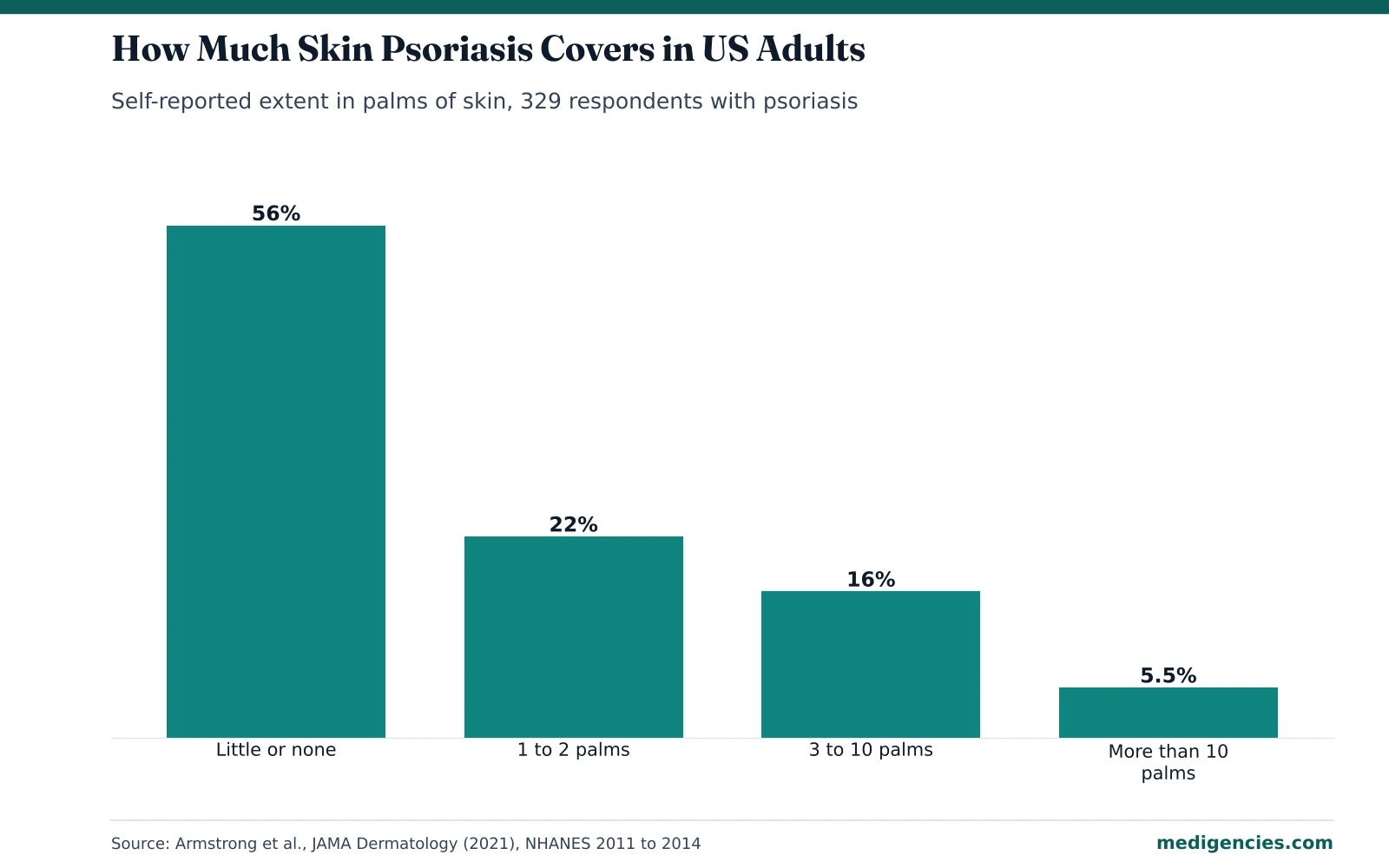
Applied to the 7.55 million US adults with psoriasis, the 21.5% who report 3 or more palms come to roughly 1.62 million people, and about 420,000 report more than 10 palms. Treat these as rough, since only 329 people answered the severity question.
| Self-reported extent | Share of respondents | Estimated US adults* | Content that fits |
|---|---|---|---|
| Little or none | 56% | About 4.2 million | Skin care, trigger tracking, when to book a check-up |
| 1 to 2 palms | About 22% | About 1.66 million | Topical treatment explainers, scalp and nail psoriasis pages |
| 3 to 10 palms | 16% | About 1.21 million | Phototherapy and systemic treatment education, insurance steps |
| More than 10 palms | 5.5% | About 420,000 | Specialist access, joint pain screening, care coordination |
In a National Psoriasis Foundation survey of 5,604 patients run between 2003 and 2011, almost half of people with mild psoriasis were untreated in 2011. So were about a quarter of those with moderate disease and almost a tenth of those with severe disease. Among treated patients, 29.5% of moderate and 21.5% of severe cases were on topical treatments alone. And 52.3% were dissatisfied with their treatment.
The 1.6 million adults with 3 or more palms affected are the people who need to hear about treatment beyond creams. Write unbranded pages on phototherapy, oral systemic drugs and biologics in plain terms, and end each one with an invitation to book a visit. Biologics are prescription drugs. Keep brand names out of ad text and keywords, and use them only in educational page content. With 52.3% unhappy with their care, a headline like “Still not happy with your psoriasis treatment?” speaks to a real group without fear or blame.
Psoriatic Arthritis and Heart Risk Alongside Psoriasis
Psoriatic arthritis develops in 30% to 33% of people with psoriasis in the joint American Academy of Dermatology and National Psoriasis Foundation guidelines. Individual studies range between 1.3% and 34.7%. Applied to 7.55 million US adults, 30% would be about 2.3 million people, a figure we use only to show scale.
Metabolic syndrome appears in 34% of psoriasis patients against 26% of controls. Obesity was 38% against 31%, and hypertension 31% against 28%. Heart attacks were seen in 1.8% of people with mild psoriasis and 2.9% of those with severe psoriasis.
Add a joint pain checklist to every psoriasis page and give it its own short article. Dermatology groups with an in-house or partner rheumatologist should say so, because a patient with stiff fingers wants to know where to go next. Frame heart and weight content as whole-person care. Our heart disease statistics by country have cardiology figures for those pages.
Ad Rules, Telederm and Stigma in Psoriasis Marketing
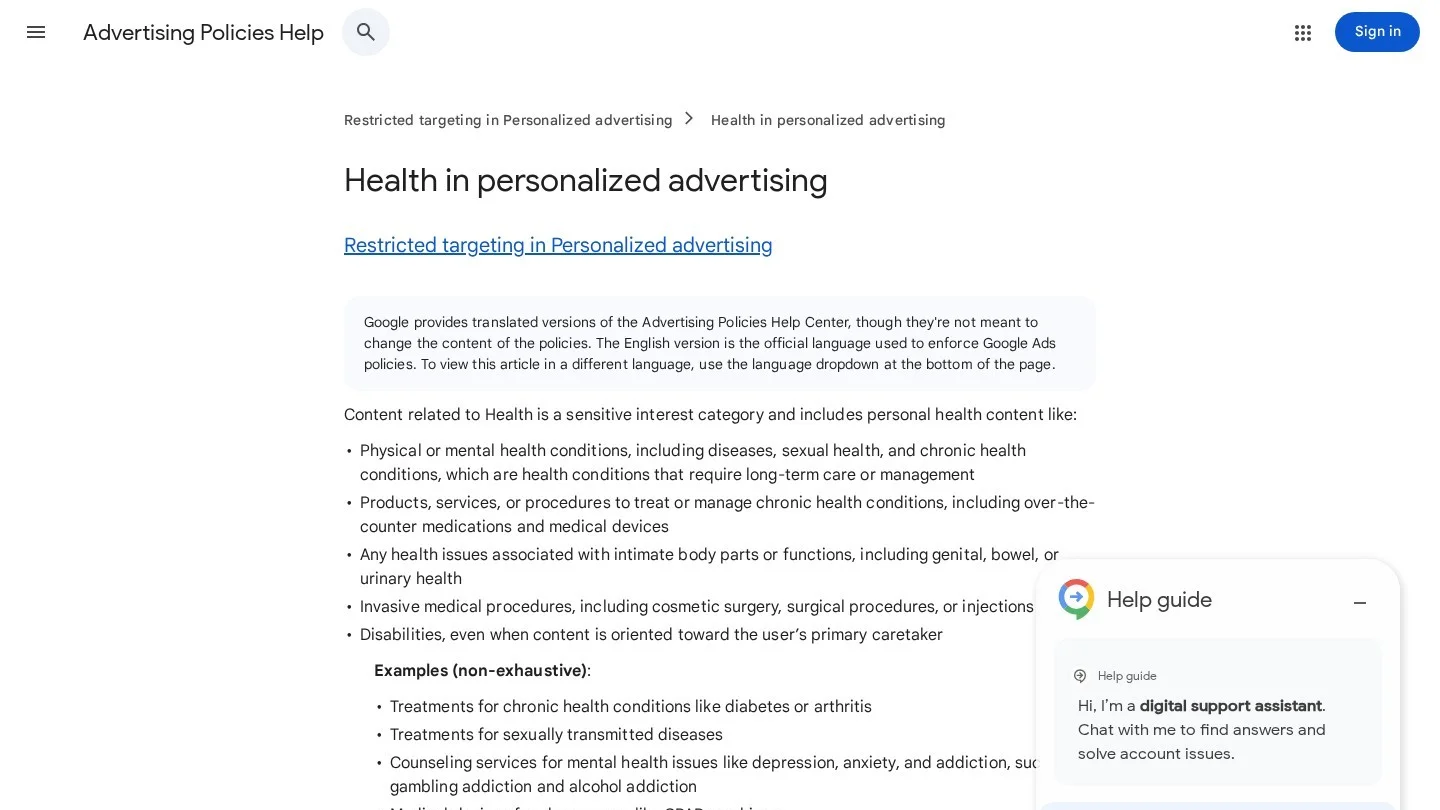
Google classes chronic health conditions as a sensitive interest category for personalized ads. That blocks Customer Match, your data segments, audience expansion and lookalike segments. Paid psoriasis campaigns therefore run mostly on condition and location keywords in search.
Telemedicine providers that prescribe fall under Google’s prescription drug services rules and must apply before running those ads. If your practice does video follow-ups for stable psoriasis patients, get that approval before advertising online prescribing. Our guide to healthcare PPC rules for Google covers the certification process, and digital health marketing agencies work with virtual care brands.

In patient surveys, 98% said psoriasis affected their emotional life, and 94% said it affected their social life. Reducing the stigma and discrimination people with psoriasis face is one of the actions set out in WHO’s 2016 report.
Drop words such as “unsightly” or “embarrassing” from ads and pages. Use photos of real patients, with consent, smiling and getting on with their day. Under FTC endorsement guidance, a testimonial about fast clearance needs the generally expected result next to it. Firms that run compliant review programs are in our list of healthcare reputation management agencies, and teams that write this kind of patient education are in our dermatology content marketing agencies list.
| Audience | Data signal | Message | Channel | Avoid |
|---|---|---|---|---|
| Young adults with new symptoms | First onset peak at 16 to 22 | Getting a clear diagnosis, first treatment plan | Search, short video | Implying psoriasis is contagious or caused by hygiene |
| Adults 50 to 69 | Peak prevalence of 4.3% at 50 to 59 | Whole-person care, joint and heart checks | Search, email to existing patients, referral pages for primary care | Scare framing about heart attacks |
| Moderate to severe patients | About 1.6 million with 3 or more palms | Options beyond creams, insurance help | Search, unbranded education pages, YouTube explainers | Biologic brand names in ad text or keywords |
| Unhappy with current care | 52.3% dissatisfied | A second opinion and a new plan | Search, Google Business Profile posts | Criticising other doctors |
| Stable patients on long-term care | Chronic condition with regular follow-ups | Video follow-up visits where offered | Patient portal, email | Advertising online prescribing without Google approval |
Our dermatology SEO agency list and the broader dermatology marketing agency directory name agencies already running dermatology search. Google’s own free tools for checking keyword demand by condition and city are in our roundup of healthcare SEO tools.
Questions About How Common Psoriasis Is
What Percentage of Americans Have Psoriasis?
About 3.0% of US adults aged 20 and older report a psoriasis diagnosis, or 7.55 million people, based on NHANES data for 2011 to 2014.
Which Country Has the Highest Rate of Psoriasis?
Norway had the highest national prevalence in the 2019 Global Psoriasis Atlas release at 1.98%. In GBD 2021, Germany has the highest rate at 1,593.7 per 100,000. Australasia has the highest regional adult prevalence at 1.99%.
At What Age Does Psoriasis Usually Start?
Onset has two peaks, one between ages 16 and 22 and one between 57 and 60. In US adults, prevalence is highest at ages 50 to 59.
Is Psoriasis More Common in Men or Women?
It is generally considered equally prevalent in the two sexes. In the US survey, 3.2% of women and 2.8% of men reported it.
How Many People With Psoriasis Get Psoriatic Arthritis?
About 30% to 33% in the joint AAD and National Psoriasis Foundation guidelines, though single studies run as high as 34.7%. Our acne statistics by age and gender cover a related skin condition.
Psoriasis Atlas Papers, WHO Report and US Survey Data We Used
- World Health Organization, WHO Publishes New Report on Psoriasis (February 26, 2016)
- World Health Organization, Global Report on Psoriasis (2016)
- Parisi et al., National, Regional, and Worldwide Epidemiology of Psoriasis: Systematic Analysis and Modelling Study, BMJ (2020)
- University of Manchester, Psoriasis Is Unequally Distributed Across the Globe (May 28, 2020)
- University of Manchester, New Figures Show Psoriasis Affects Around 1.1 Million People in UK (October 29, 2019)
- Xiong et al., Dynamic Trend Analysis of Global Psoriasis Burden From 1990 to 2021, GBD 2021 Data, Frontiers in Public Health (2025)
- Commentary on Parisi et al., Global Epidemiology of Psoriasis, Journal of Investigative Dermatology (2013)
- AJMC, Psoriasis One of the Most Common Immune-Mediated Diseases Affecting US Adults, on Armstrong et al., JAMA Dermatology (2021)
- MDedge, New Analysis Puts US Psoriasis Prevalence at 3% (2021)
- ACP Internist Weekly, Nontreatment and Undertreatment of Psoriasis and Psoriatic Arthritis Still Prevalent (August 20, 2013)
- AJMC, Psoriasis Guidelines From AAD-NPF Spotlight Comorbidities (May 8, 2020)
- Google Ads, Health in Personalized Advertising
- Google Ads, Healthcare and Medicines Policy
- Federal Trade Commission, FTC’s Endorsement Guides: What People Are Asking
Compare Agencies for This Topic
Dermatology Marketing AgenciesHealthcare Content Marketing AgenciesHealthcare SEO Agencies
More From the Blog

Statistics
Private Hospital vs Public Hospital Cost Statistics
Hospital costs by ownership in the US, India and the UK, with our own ratios, growth rates and price-page advice for hospital marketers.
Nov 5, 2026

Statistics
Healthcare Mobile Search Statistics
Smartphone ownership, online health lookups by age, portal app use, telemedicine and page speed limits, with our own per-1,000-adults model for clinics.
Nov 5, 2026

Statistics
Healthcare Digital Marketing ROI Statistics
Hospital ad effects, health system marketing budgets, cost per patient by channel and Google's return claim, with our own math for clinics and hospitals.
Nov 5, 2026