
Cardiology practices get more patient bookings by working two doors at once. One door is the referral from a primary care doctor or another specialist. The other is the patient who searches for a cardiologist, an AFib clinic or a heart scan and books on their own. The groups that grow fastest make both doors easy: a clear referral page, a complete Google Business Profile with a booking link, search ads that follow Google’s health rules, quick phone handling and reminders that cut no-shows.
This guide covers each of those strategies with examples from real cardiology groups and health systems, using their public pages. It then runs a booking-funnel model in Python so you can see where lost appointments hide. The model uses one sourced benchmark from LocaliQ and labels every other number as an assumption you can swap for your own.
Six Moves That Fill a Cardiology Schedule
- Give referring offices one page with a phone line, fax form, checklist and a promise to confirm, as Cleveland Clinic does for its heart institute.
- Add a booking link to every location’s Google Business Profile and set one as the preferred link (Google).
- Run search ads on symptoms, tests and “cardiologist near me” terms, but expect health audience limits: customer match and lookalike segments are not supported for health ads (Google).
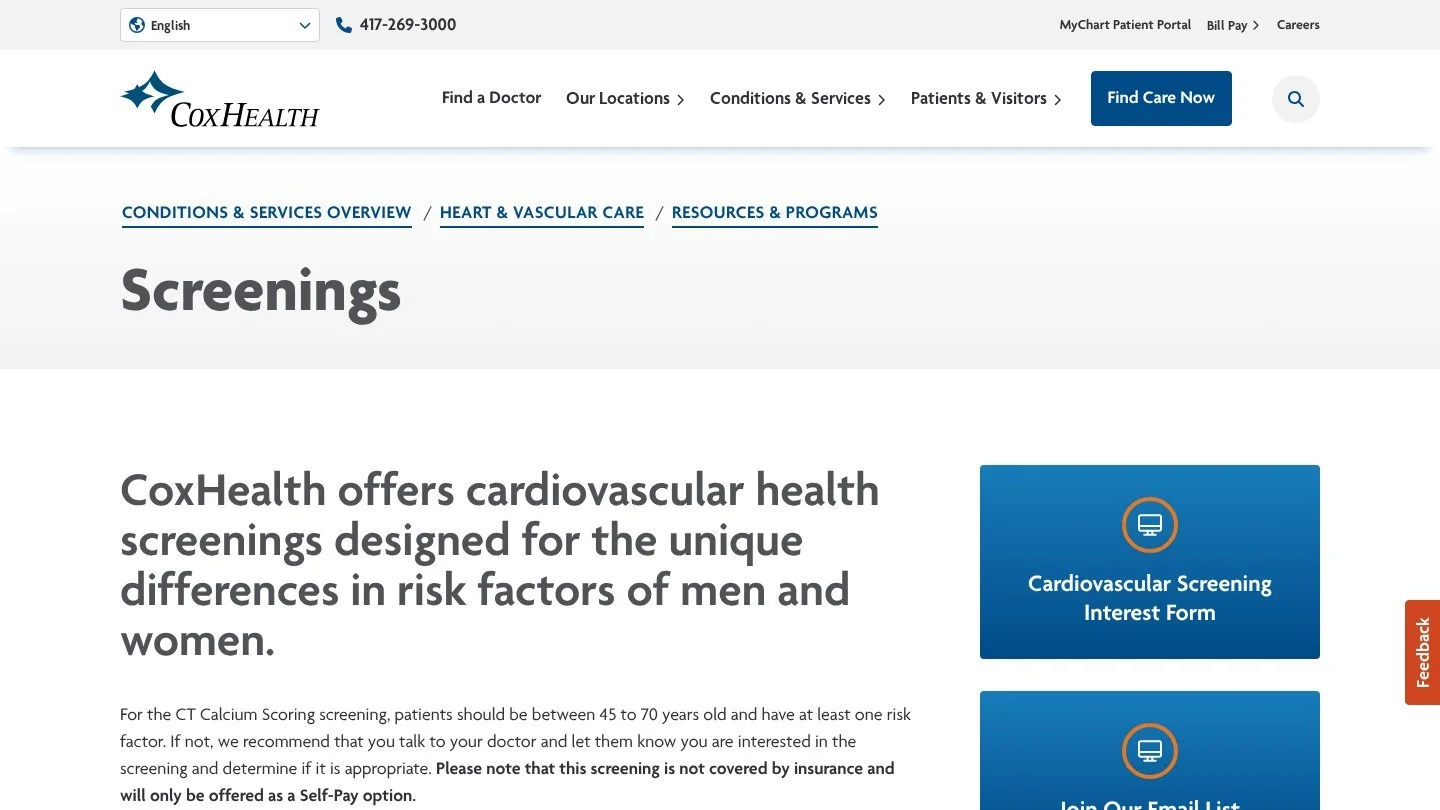
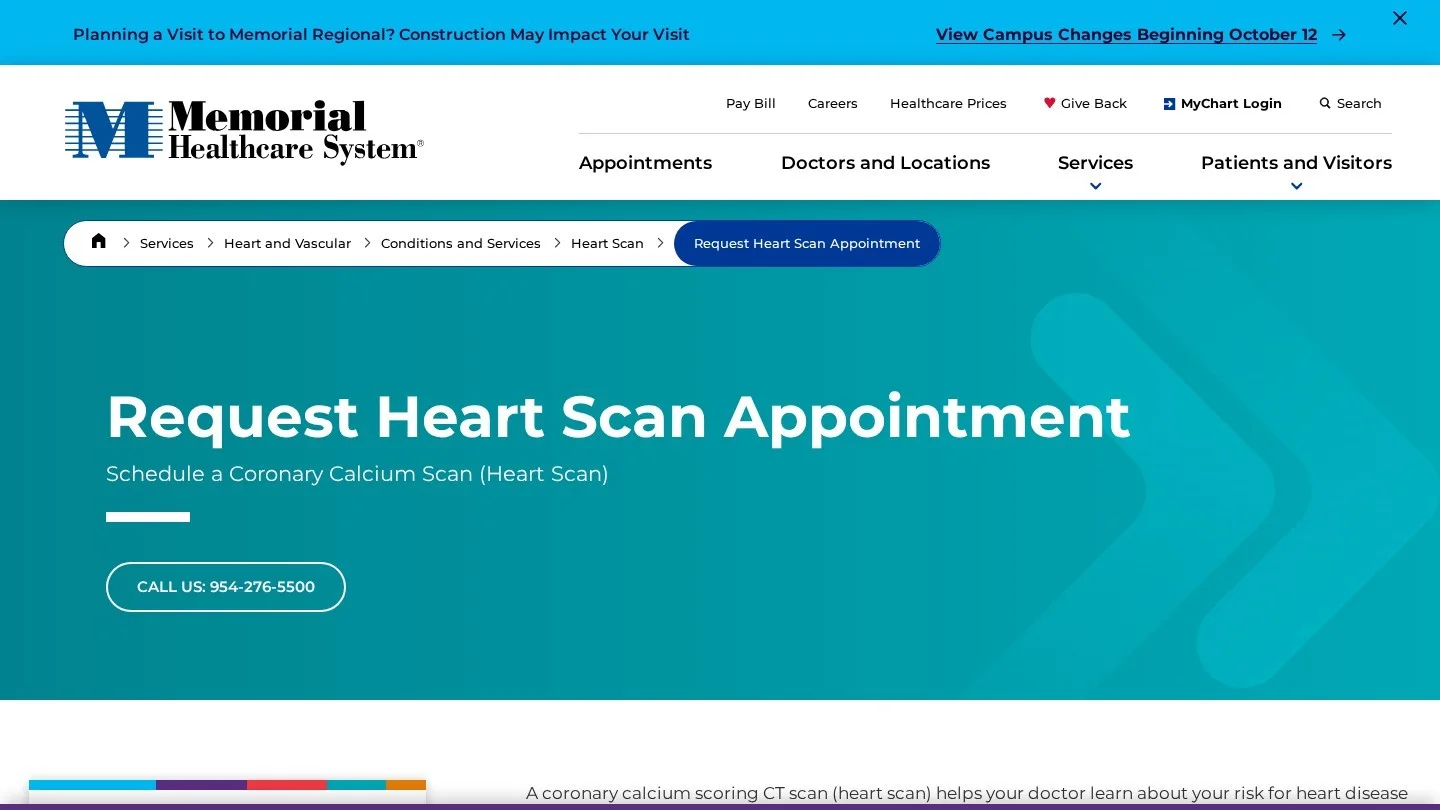
- Self-pay heart scans give worried adults a simple first step: CoxHealth and Memorial Healthcare System both list a $99 calcium score scan.
- Answering more calls and sending reminders can lift kept visits by over 40% in our model without adding ad spend.
- Appointment reminders count as treatment communications under HIPAA, but promotional texts need patient authorization and written consent (HHS).
- Count booked and kept new-patient visits by channel each month, not clicks or form fills.
Where New Cardiology Patients Come From Before They Book
A heart practice has more front doors than most specialties. Some patients arrive with a referral and a worried primary care doctor behind them. Others find you after a smartwatch alert, a high cholesterol result or a family history scare. Each route needs its own path to a booked slot.
The table below maps the main routes to the person who makes the booking decision and the number worth tracking. Use it to decide where your next dollar or staff hour goes.
| Channel | Who decides | What they need from you | Number to track |
|---|---|---|---|
| Physician referral | Referring doctor and their staff | Fast intake, clear forms, a consult note back | Referrals received and scheduled within 7 days |
| Google Business Profile | Patient searching locally | Hours, booking link, phone that gets answered | Calls and booking clicks per location |
| Organic search | Patient researching symptoms or tests | Condition and test pages with a next step | Booked visits from organic sessions |
| Paid search | Patient ready to act | A matching landing page and quick booking | Cost per kept new-patient visit |
| Self-pay screening | Health-conscious adult | Price, who qualifies, easy scheduling | Scans booked and follow-up visits created |
| Existing patients | Patient and family | Reminders, recall notices, portal messages | No-show rate and recall completion |
Making It Easy for Primary Care Offices to Refer Heart Patients
Referrals depend on the referring office’s staff as much as the doctor. A medical assistant with a stack of faxes will send patients where the process is simplest. Cleveland Clinic’s heart institute shows what simple looks like. Its referral page offers a fax form, a secure web appointment form and a physician hotline open 7 a.m. to 7 p.m. Eastern. It lists separate lines for cardiology, vascular medicine and surgery. It also tells referring doctors they will get confirmation once the appointment is scheduled.
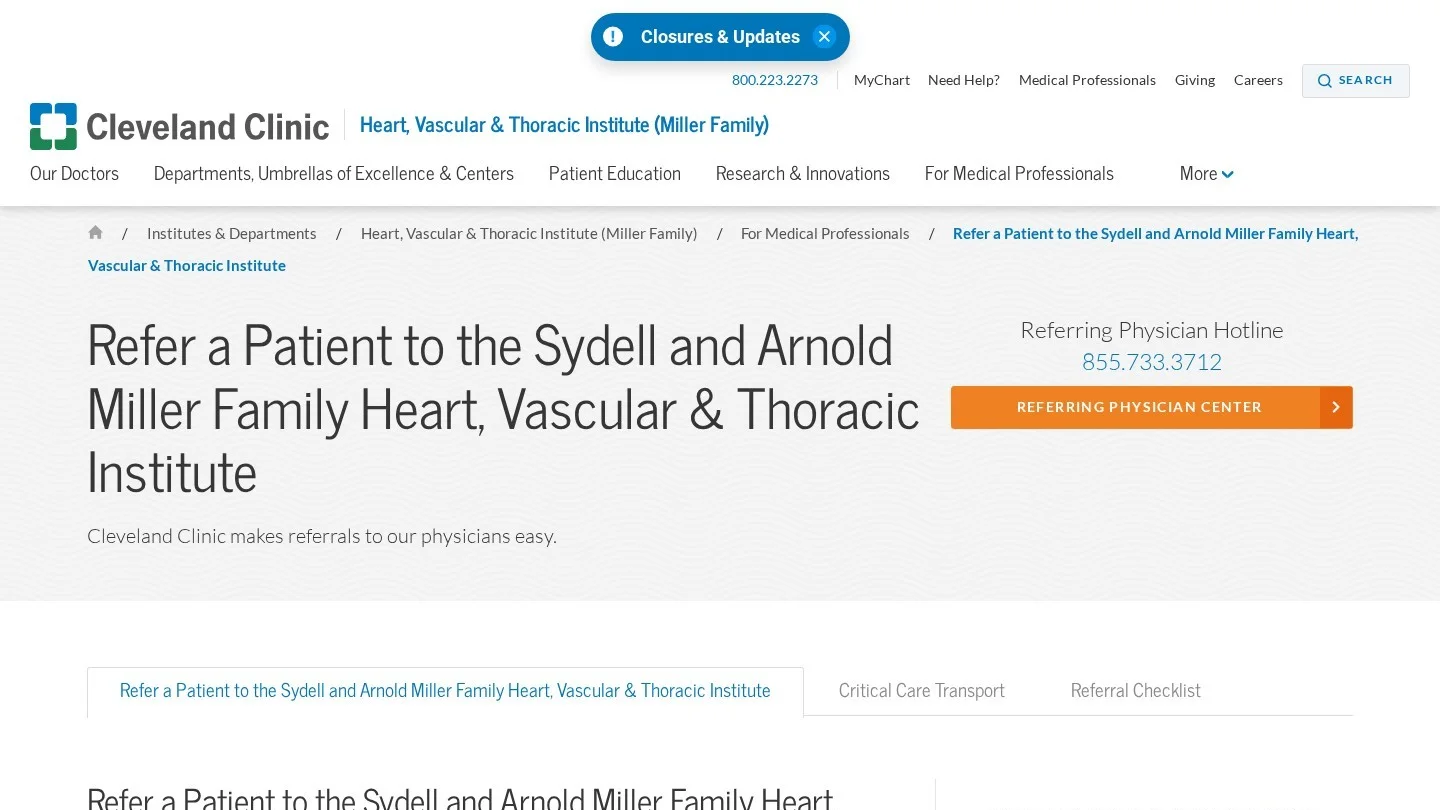
The same page gives a referral checklist. It asks for patient demographics and insurance, medical history, device type and settings, current medications and allergies, and diagnostic reports with tracings where available. Publishing that list up front saves a callback for missing records, which is often what delays a first visit.
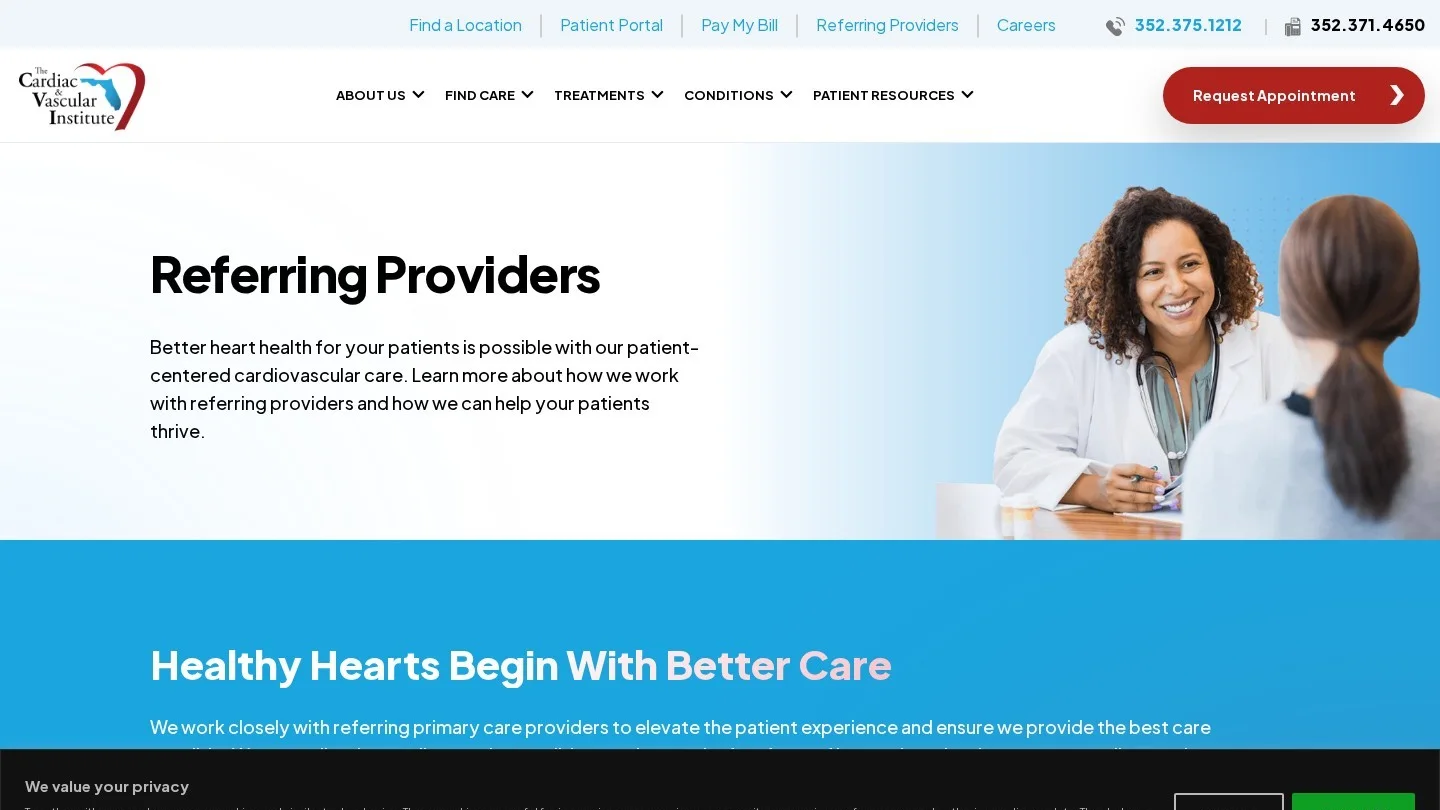
Smaller groups can copy the format. The Cardiac and Vascular Institute in Florida keeps its referring providers page short: one phone number, a dedicated referral fax line and a referral form in both PDF and editable formats. That is enough for a busy office to act on in under a minute.
Referral Habits Worth Building Into the Week
- Track referrals by referring practice each month and call any office whose volume drops.
- Send the consult note back quickly, since a referring doctor who hears nothing tends to refer elsewhere.
- Offer a named contact, such as a referral coordinator or physician liaison, so the referring office knows who to call.
- Hold open a few new-patient slots each week for urgent referrals and tell referring offices about them.
Content also helps referrals. The cardiology SEO guide covers how to build pages written for primary care doctors, so this guide will not repeat that work.
Setting Up Google Business Profile So Searchers Can Book a Cardiologist
For a patient who types “cardiologist near me,” the Business Profile is often the first thing they see. Two settings affect bookings directly. The first is the booking link. Google’s local business links help page explains how to add one from Search or Maps: open the profile, choose Booking, add the link and save. You can add up to 10 links per category, and you can mark one as “Business preferred” so it shows at the top.
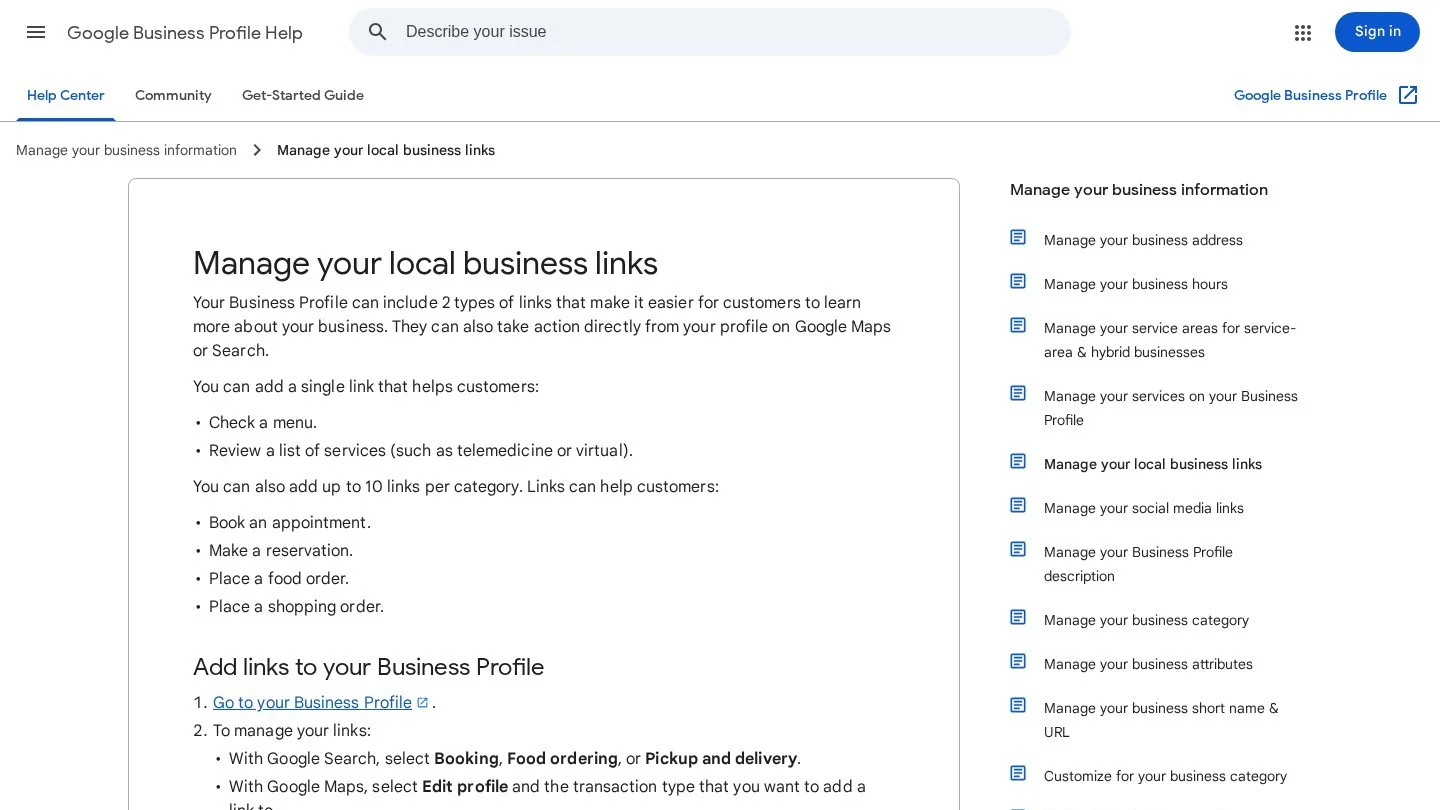
If you use a third-party scheduler, set your own scheduling page as the preferred link. That keeps the patient on a path you control and can measure. Google also says a provider must remove its booking link within 5 days after you ask, which matters if you change scheduling vendors.
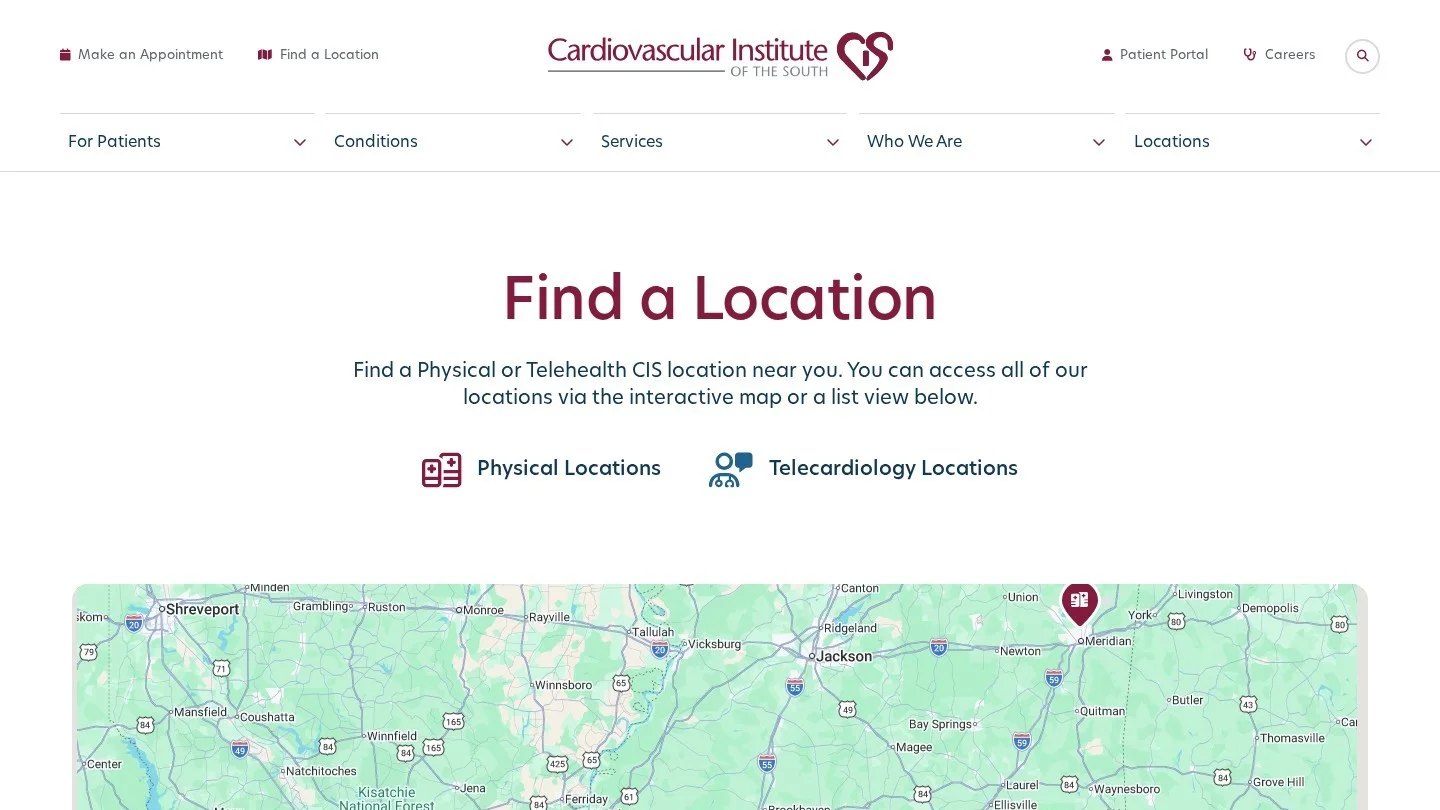
The second setting is location accuracy. Multi-site groups need one profile per office, each with its own hours and phone number. Cardiovascular Institute of the South (CIS), founded in 1983, lists every office on a locations page that links to the right scheduling flow. Its public pages say it serves patients at 20 locations across the Southeast. A tidy locations page gives each Business Profile a clean landing page to point to.
Category choice, reviews and location pages all affect how often your profile appears. Those ranking factors are covered in our cardiology SEO playbook, which goes into categories, schema and condition pages in detail.
Search Ads for Heart Care That Stay Inside Google’s Health Rules
Paid search fills gaps that referrals and SEO cannot fill quickly, such as a new office or a new AFib clinic. A cardiology clinic advertising its own services does not need special certification. The certification rules in Google’s Healthcare and medicines policy apply to areas such as online pharmacies, prescription drug keywords and addiction treatment. Our guide to Google healthcare ad rules walks through those cases.

Targeting is where heart practices feel the limits. Google’s Health in personalized advertising policy covers ads about physical health conditions, chronic conditions and invasive procedures. For those ads, customer match, your data segments, audience expansion and lookalike segments are not supported. In practice, a cardiology campaign should lean on keywords, locations and Google’s own predefined audiences instead of patient lists.

Ad text needs care too. Google’s Unreliable claims policy names “miracle cures” for medical ailments as an example of what it rejects, and it requires a clear refund policy if you guarantee results. Heart ads that describe access, credentials and next steps pass review more easily than ads that promise outcomes.
Keyword Themes That Match Booking Intent
Group keywords by what the searcher wants to do next, not by medical category. A person typing “cardiologist near me accepting new patients” wants a time slot. A person typing “what causes heart palpitations” wants an answer first, so that search belongs to your education pages rather than your ad budget.
- Access terms: cardiologist near me, heart doctor accepting new patients, same-week cardiology appointment.
- Test terms: stress test near me, echocardiogram appointment, calcium score scan cost.
- Condition terms with action words: AFib specialist, high cholesterol doctor, heart palpitations doctor.
- Brand terms: your practice name and your physicians’ names, kept in their own campaign so you can see what brand demand costs.
Keep each theme in its own ad group with its own landing page. A searcher who asked about stress tests should land on the stress test page with its prep notes and a booking button, not on the home page.
Example Ad Copy for an AFib Clinic
We wrote the sample below for a fictional practice to show the tone that tends to clear review. It names the service, the access benefit and the action, and it makes no outcome promise.
| Ad element | Sample text |
|---|---|
| Headline 1 | AFib Clinic in Springfield |
| Headline 2 | New Patients Seen This Week |
| Headline 3 | Board-Certified Cardiologists |
| Description 1 | Evaluation for irregular heartbeat, palpitations and AFib. Book online or call today. |
| Description 2 | Most insurance accepted. Ask about testing on the same day as your visit. |
Send each ad to a page that matches it. CIS runs a campaign landing page for searchers looking for a cardiologist in New Orleans. It opens with the question the searcher asked, puts a Make an Appointment button at the top and links straight to online self-scheduling. Award badges for blood pressure and cholesterol programs sit lower on the page as trust signals.

For cost planning, LocaliQ’s 2026 search benchmarks, published May 26, 2026, put the Physicians and Surgeons category at a $4.76 median cost per click, a 12.43% conversion rate and a $40.04 cost per lead (LocaliQ). Our healthcare PPC statistics page has more specialty figures.
Self-Pay Heart Scans as a Front Door for New Patients
A low, published price removes the biggest barrier for a worried adult. CoxHealth in Missouri offers CT calcium scoring for $99 as a self-pay screening (CoxHealth). Its page states who qualifies: adults 45 to 70 with at least one risk factor. It says no physician referral is needed. It also says the scan is not recommended for people already treated for heart disease or who have symptoms, and it points them to their cardiologist instead.
Memorial Healthcare System in Florida takes a similar approach. Its heart scan request page leads with a $99 self-pay rate, gives a Patient Access Center number and offers an online request form that asks for preferred location, days and times.
The marketing lesson is the follow-up. A scan with a high score creates a reason to see a cardiologist. Practices that own the scanner, or partner with an imaging center, can build a simple path: result letter, nurse call, then an offer to book a consult. Keep the scan page factual. State the price, the eligibility rules and the fact that the scan does not replace a doctor’s evaluation.
Online Scheduling and Phone Handling at the Cardiology Front Desk
Many heart patients still call, and many are older adults who prefer a person to a form. A missed call is often a lost booking because the caller tries the next practice on the list. Online scheduling helps, but only if the slots it shows are real.
CIS uses both. Its landing page sends patients to a self-scheduling tool with separate question sets for new and returning patients, while its location pages keep phone numbers visible (CIS). OhioHealth goes further with a memorable number. Its AFib Clinic uses (614) 788-AFIB for scheduling, acute visits, new diagnoses, second opinions and referrals. The clinic also promises quick access for patients having acute AFib episodes, aimed at reducing unnecessary emergency visits.

Front Desk Changes That Usually Pay Off First
- Measure answer rate by hour for two weeks before changing anything, so you know when calls are missed.
- Route overflow and after-hours calls to a callback queue that staff clear first thing in the morning.
- Give schedulers a short script for new-patient calls: reason for visit, referring doctor, insurance, then offer two specific times.
- Open a set number of new-patient slots to online booking so the tool never shows a two-month wait by default.
Patient Education on AFib, Cholesterol and Heart Screening
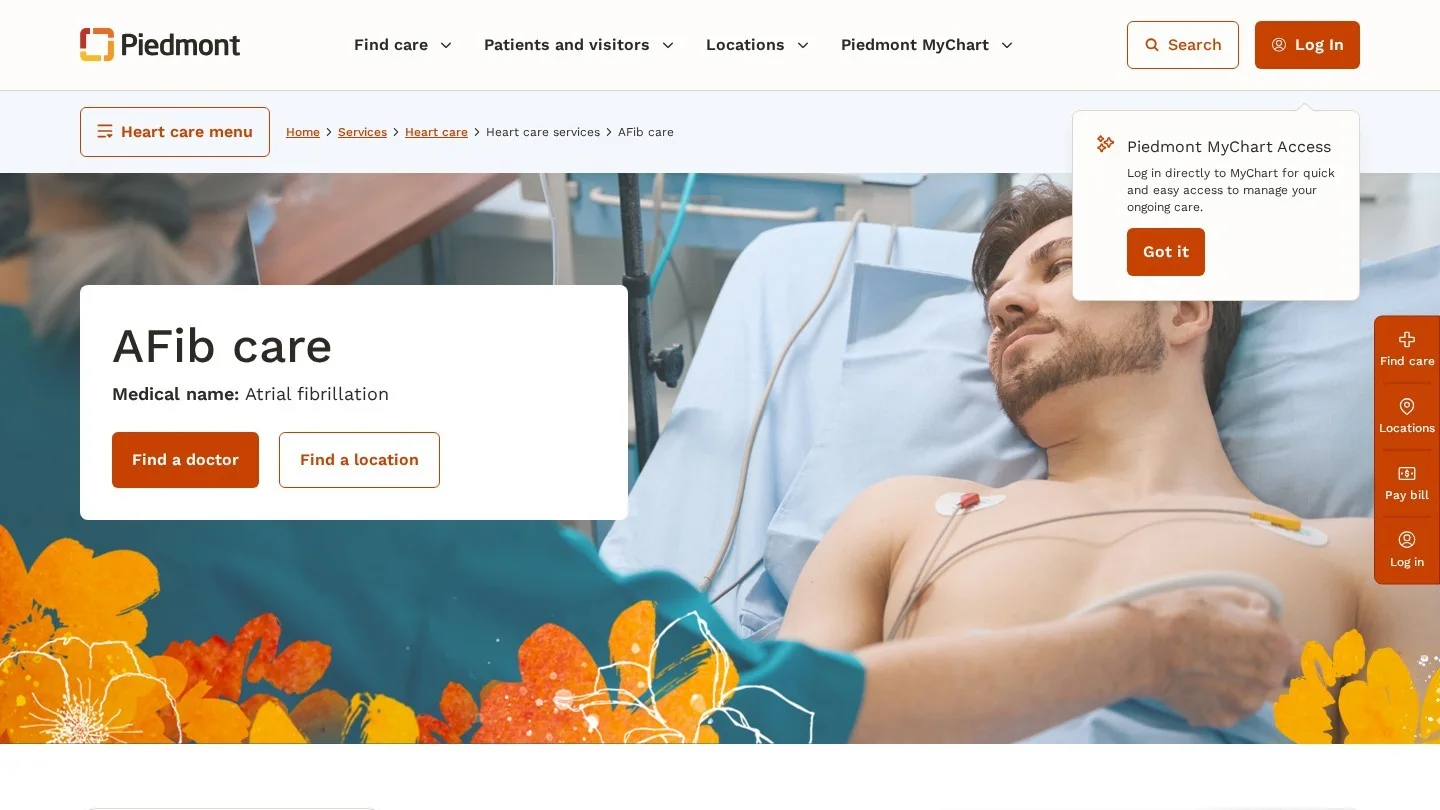
Education pages earn trust before a patient picks up the phone. Piedmont’s AFib patient resources page is a good model. It pairs a short video in which a Piedmont cardiologist explains atrial fibrillation with links to the American Heart Association and the Heart Rhythm Society. It also includes a patient story about a Watchman FLX device. Each item answers a question a newly diagnosed patient is likely to have.
Plan topics around the questions people ask at each stage, then give every page one clear next step. The table shows a starting set for a general cardiology group.
| Topic | Searcher’s question | Page format | Next step on the page |
|---|---|---|---|
| AFib | What does an irregular heartbeat mean? | Condition page with a doctor video | Book an AFib evaluation |
| High cholesterol | Do I need to see a cardiologist for cholesterol? | Q&A page reviewed by a cardiologist | Request a lipid clinic visit |
| Calcium score scan | Should I get a heart scan? | Test page with price and eligibility | Schedule a scan or ask your doctor |
| Chest pain | When is chest pain an emergency? | Safety page that starts with “call 911” advice | Book a non-urgent visit |
| Stress test | What happens during a stress test? | Step-by-step visit guide | Download prep instructions |
Keep claims within guidelines and name the reviewing physician on each page. Our healthcare content marketing agencies directory lists firms that write medically reviewed content if your team lacks time.
Collecting Cardiology Reviews Under the FTC Rule and HIPAA
Reviews shape which practice a patient calls. The FTC’s final rule on fake reviews, announced August 14, 2024, bans fake or AI-generated reviews and bans paying for reviews that must be positive or negative. It also limits undisclosed insider reviews and bans using threats or intimidation to suppress negative reviews. The FTC can seek civil penalties against knowing violators (FTC).
The safe approach is to ask every patient the same way, after the visit, with no filter for happy patients first. Replies are the other risk. In 2023, HHS reached a settlement with a New Jersey provider that disclosed patient information while responding to negative online reviews (HHS). A reply should thank the reviewer and invite them to call the office, without confirming they are a patient or mentioning any care.
Practices that get many reviews across several locations often hand replies and requests to a specialist. Our healthcare reputation management agencies page lists firms that do this work for medical groups. For search visibility work on heart pages, see the cardiology SEO agencies list.
Reminder Texts and Emails Within HIPAA and Phone Consent Rules
Reminders protect the bookings you already earned. Under the HIPAA Privacy Rule, marketing means a message that encourages someone to buy or use a product or service. HHS lists several kinds of messages that are not marketing. These include messages about treatment, care coordination and the health-related services of the covered entity itself (HHS). HHS also says a prescription refill reminder is not marketing (HHS FAQ).
So an appointment reminder, a pre-test instruction or a recall notice for an overdue echo is a care message. A text promoting a third party’s supplement is marketing and needs the patient’s written authorization. If a third party pays you to send it, the authorization must say so.
Phone and text rules come from a different law, the Telephone Consumer Protection Act. Under the 2015 FCC healthcare exemption, as summarized by Bass, Berry and Sims, exempt messages include appointment reminders and pre-operative instructions. They must be free to the patient, sent only to the number the patient gave, limited to one per day and three per week, and kept to 160 characters for texts. Each message needs an easy opt-out. Telemarketing texts fall outside the exemption and need prior express written consent.
Adventist HealthCare publishes these limits in a public SMS policy, including STOP replies and the rule that messages cannot include marketing or billing content. A practice can use the same page structure to show patients what to expect.
| Message | HIPAA status | Text-message consent |
|---|---|---|
| Appointment reminder for a booked echo | Treatment communication, not marketing | Exempt health message with opt-out |
| Recall for an overdue annual visit | Care communication about your own services | Exempt health message with opt-out |
| Newsletter about a new lipid clinic | Describes your own service, so no authorization | Treat as promotional and get written consent |
| Offer for a partner’s fitness program paid by that partner | Marketing with remuneration; authorization needed | Prior express written consent |
A Worked Booking-Funnel Model for a Cardiology Practice
Most practices judge ads by cost per lead. A lead is not a visit. Between the click and the kept appointment, a patient can be lost at the phone, at the scheduling step or on the day itself. We built a small model to show how those losses change the real cost of a new patient.
The only sourced input is the cost per lead: $40.04, the 2026 median for Physicians and Surgeons from LocaliQ. The budget and the three rates are assumptions, labelled in the code. Replace them with your own numbers from your phone system and practice management reports.
budget = 5000          # assumption: monthly search budget in USD
cpl = 40.04            # LocaliQ 2026 median cost per lead, Physicians & Surgeons
leads = budget / cpl   # 124.9 leads

scenarios = [
    # name, reached, booked if reached, showed up  (all assumptions)
    ("Baseline",               0.85, 0.55, 0.85),
    ("Faster callbacks",       0.95, 0.55, 0.85),
    ("Plus reminders",         0.95, 0.55, 0.92),
    ("Plus open slots online", 0.95, 0.65, 0.92),
]
for name, reach, book, show in scenarios:
    kept = leads * reach * book * show
print(name, round(kept, 1), "kept visits", round(budget / kept, 2), "USD each")| Scenario | Leads | Booked | Kept visits | Ad cost per kept visit |
|---|---|---|---|---|
| Baseline | 124.9 | 58.4 | 49.6 | $100.76 |
| Faster callbacks (95% reached) | 124.9 | 65.2 | 55.5 | $90.15 |
| Plus reminders (92% show) | 124.9 | 65.2 | 60.0 | $83.30 |
| Plus open online slots (65% booked) | 124.9 | 77.1 | 70.9 | $70.48 |

The ad budget never changes in this model, yet kept visits rise from about 50 to about 71, a 43% gain. The cost of each kept visit falls by about $30. None of the gains come from the ad account. They come from answering the phone, reminding patients and showing real open slots.
Run the same model on your own data before you raise spend. If your answer rate is the weak step, a bigger budget mostly buys more missed calls.
Counting Bookings by Channel Without Sharing Patient Data
Measurement should end at the kept visit, but the data path needs care. HHS guidance warns that tracking tools on pages patients use for care can send protected health information to vendors (HHS). A Texas court vacated part of that guidance in June 2024, and HHS withdrew its appeal (Epstein Becker Green). Pixels on patient portals, intake forms and scheduling pages still carry HIPAA risk.
A safer method is to report bookings inside your practice management system and join them to channel totals, rather than sending patient-level events to ad platforms. Ask new patients how they heard about you, and log the referring practice for every referral. Then build one monthly table.
| Channel | Leads or referrals | Booked new patients | Kept visits | Spend | Cost per kept visit |
|---|---|---|---|---|---|
| Physician referrals | From referral log | From scheduling report | From visit report | Liaison time | Spend divided by kept visits |
| Google Business Profile | Calls and booking clicks | Bookings tagged GBP | Kept visits tagged GBP | $0 media | Staff time only |
| Paid search | Calls and forms | Bookings tagged paid | Kept visits tagged paid | Ad spend plus fees | Spend divided by kept visits |
| Self-pay screening | Scan requests | Scans booked | Consults booked after scan | Scan promotion cost | Spend divided by consults |
Expect conversion rates to differ by service line. In LocaliQ’s healthcare dataset of 3,542 US campaigns from October 2024 to September 2025, the median conversion rate was 8.09% across healthcare. Hospitals and clinics converted at 6.10%, while general practice converted at 11.63% (LocaliQ).

When a Heart Practice Should Bring In Marketing Help
Outside help makes sense when the work is clear but nobody has time for it. Common triggers are a new location, a new service line such as an AFib or lipid clinic, or ad spend that has grown without a matching rise in kept visits. Compare firms that work with heart practices on our cardiology marketing agencies page. For search ads only, the healthcare PPC agencies list is a good start.
Ask any agency how it will report kept visits by channel and how it handles tracking on scheduling pages. Our agency vetting criteria explain what we check before a firm is listed. If you want a shortlist, you can ask us to match you with an agency.
Questions Cardiology Practice Managers Ask About Patient Growth
How Do Cardiologists Get More Patients Without Referrals?
Self-referred patients usually find a practice through Google. A complete Business Profile with a booking link, condition pages, search ads and self-pay offers such as a $99 calcium score scan (CoxHealth) all create paths that do not start with a referral.
Can a Cardiology Practice Use Google Ads Remarketing?
For ads about health conditions and procedures, Google does not support customer match, your data segments, audience expansion or lookalike segments (Google). Plan campaigns around keywords and locations instead.
Are Appointment Reminder Texts Marketing Under HIPAA?
No. HHS treats treatment and care coordination messages as outside the definition of marketing (HHS). Phone consent rules still apply, so keep reminders short, free to the patient and easy to opt out of.
What Is a Good Cost per New Patient for Cardiology Ads?
Start from your own kept-visit numbers. As a reference, LocaliQ’s 2026 median cost per lead for Physicians and Surgeons is $40.04 (LocaliQ). In our model that becomes about $70 to $101 per kept visit, depending on phone and reminder performance.
Should a Cardiology Practice Offer Online Booking for New Patients?
Yes, if the slots shown are real and the intake questions screen for urgent symptoms. CIS sends new and returning patients through separate question sets in its self-scheduling tool (CIS).
Heart Practice Pages, Ad Policies and Laws Cited in This Guide
- Cleveland Clinic, Refer a Patient to the Heart, Vascular and Thoracic Institute
- The Cardiac and Vascular Institute, Referring Providers
- Google Business Profile Help, Manage Your Local Business Links
- Cardiovascular Institute of the South, Locations
- Cardiovascular Institute of the South, Looking for a Cardiologist in New Orleans
- Google Ads, Healthcare and Medicines Policy
- Google Ads, Health in Personalized Advertising
- Google Ads, Unreliable Claims
- LocaliQ, 2026 Search Advertising Benchmarks (May 26, 2026)
- LocaliQ, Healthcare Search Advertising Benchmarks (Oct 2024 to Sep 2025 data)
- CoxHealth, Heart and Vascular Screenings
- Memorial Healthcare System, Request Heart Scan Appointment
- OhioHealth, Atrial Fibrillation Clinic
- Piedmont, AFib Patient Resources
- FTC, Final Rule Banning Fake Reviews and Testimonials (Aug. 14, 2024)
- HHS, Settlement Over Disclosures in Replies to Online Reviews (June 5, 2023)
- HHS, HIPAA Privacy Rule Marketing Guidance
- HHS, FAQ on Prescription Refill Reminders
- Bass, Berry and Sims, TCPA Exemptions for Healthcare Companies (Aug. 29, 2018)
- Adventist HealthCare, TCPA Policy for SMS Communications
- HHS, Use of Online Tracking Technologies by HIPAA Covered Entities
- Epstein Becker Green, OCR Withdraws Appeal on Tracking Guidance
Compare Agencies for This Topic
Cardiology Marketing AgenciesMedical Practice Marketing AgenciesHealthcare Content Marketing AgenciesHealthcare PPC AgenciesHealthcare Reputation Management Agencies
More From the Blog

Guides
Cataract Surgery Center SEO: The Complete Guide
A full SEO guide for cataract surgery centers, from keywords and technical fixes to lens pages, Business Profiles, directories, links, AI citations, reviews and…
Nov 4, 2026

Guides
Interventional Cardiology SEO Guide for Cath Lab and Structural Heart Programs
A full SEO guide for interventional cardiology groups, from keyword research and technical fixes to procedure pages, Business Profiles, citations, links, AI search, reviews…
Nov 4, 2026

Statistics
Childhood Cancer Survival Rate Statistics
Childhood cancer survival rates by type, age and decade, with Medigencies calculations and guidance on communicating survival data ethically to families.
Nov 4, 2026